
Hot Rice and Braised Dishes After 40 Minutes: How to Test Container Material, Seals, and Steam Control
For a 40-minute delivery window, do not try to solve soggy rice by choosing one universally “better” container. Treat the meal as two risks: rice needs less condensation overhead, while braised food needs dependable sauce containment. Start with a side-by-side delivery test of a sealed container for the wet component, a purpose-designed controlled-vent option for the rice component, and a separated format. Select the system that passes both texture and leak checks under your real packing, bagging, stacking, and travel conditions.
2026-09-01 - 6 min read
Summary
**Summary:** For a 40-minute delivery window, do not try to solve soggy rice by choosing one universally “better” container. Treat the meal as two risks: rice needs less condensation overhead, while braised food needs dependable sauce containment. Start with a side-by-side delivery test of a sealed container for the wet component, a purpose-designed controlled-vent option for the rice component, and a separated format. Select the system that passes both texture and leak checks under your real packing, bagging, stacking, and travel conditions.
Why rice goes soft in a closed delivery bowl
Freshly packed hot food gives off water vapour. In a tightly closed bowl, vapour can collect on the cooler lid and turn into droplets. If those droplets fall back onto rice, the rice texture can change before the customer opens the order.
That does not make every sealed bowl wrong. A braised dish, gravy, or loose sauce creates a different priority: it must stay inside the pack when the bag is carried, stacked, or tilted. The practical answer is to define which part of the meal needs containment and which part needs moisture management, then test those needs separately.
Start with the food, not the material name
Make a short packing map for every high-volume rice bowl or braised dish. Record these variables before comparing samples:
- **Food condition at packing:** actual portion temperature and how much visible steam is present.
- **Moisture load:** dry rice, rice with a little sauce, and liquid-heavy braise should be separate test cases.
- **Fill level:** leave the same realistic clearance beneath the lid in every sample; do not compare one overfilled bowl with one half-full bowl.
- **Component contact:** note whether sauce touches the rice during packing or only after delivery.
- **Delivery handling:** include the normal bag, stacking pattern, travel time, and route movement—not just a container sitting on a counter.
This turns a vague question about “plastic versus fibre” into a repeatable choice between actual packaging systems.
Three formats worth testing first
1. A PP bowl with a secure lid as the containment control
A polypropylene bowl with a secure lid is a useful baseline for the wettest part of the menu because it lets the team test closure reliability, sauce movement, and packing speed against the current pack. It is not automatically the best rice solution, and a secure lid alone is not evidence that it will manage steam well.
Use this control for a braised dish or sauce portion. Score it for rim leakage, lid retention after carrying and stacking, and whether condensation visibly reaches the food. Keep the same fill height for every comparison.
2. A bowl-and-lid system engineered for controlled venting
For rice-focused meals, test a container system that is specifically made with controlled venting. The goal is not maximum airflow: an open vent can also create spill and temperature risks. Use the supplier’s intended vented configuration; do not puncture or modify a closed lid yourself.
Compare the controlled-vent sample with the sealed control using the same recipe, portion, headspace, and delivery bag. Look for condensation on the lid, not just a subjective first impression when the pack is opened.
3. A separated meal format for rice plus braise
If a braised dish repeatedly softens the rice, separation may be more useful than changing the base material alone. Test a compartmented format or a sealed sauce container paired with rice in its own container. This gives the wet component its own closure test and lets the rice be evaluated independently.
A separated format adds an assembly step, so include pack time and driver handling in the score. The winning option should work at a busy pass, not only in a sample room.
Material comparison: what to verify rather than assume
Material labels are a starting point, not a performance result. Request the relevant specification for the exact container and lid pairing, then run a real-food test.
| Candidate system | What to verify during the 40-minute test | Best use in the comparison |
|---|---|---|
| PP bowl and matching secure lid | Closure retention, leakage, bowl shape after hot packing, and condensation pattern | Baseline for wet or sauce-heavy components |
| Moulded-fibre or paper-based bowl system | Exact food-contact suitability, lid fit, resistance to the specific sauce or oil, and shape after the full hold | Alternative bowl system for a rice-led meal |
| Compartmented or two-container format | Separation between rice and braise, closure of the wet section, packing speed, and order stability | When rice and sauce have conflicting needs |
Do not carry over a claim from one material family to another. The relevant unit is the exact base, lid, food portion, and delivery route. For any candidate, obtain product-specific food-contact, temperature, oil, and liquid-use information from the supplier for the intended market.
Seal and vent checks that matter in practice
A useful seal check is more than pressing the lid down once. Pack the sample as staff normally would, place it in the usual carry bag, stack it in a typical order, and inspect it at the end of the 40-minute hold.
For a wet braise, check the full rim, corners or hinges where applicable, and any area where the lid can flex under the weight of another meal. For a rice-led pack, inspect the underside of the lid and the surface of the rice for collected droplets. Do not assume that a visible vent makes a container leak-proof, or that a tight seal makes it suitable for every component.
Headspace should also be controlled. Record the fill line in the test sheet so that the next run is comparable. A change in fill level can change both contact with the lid and spill behaviour.
A simple 40-minute delivery trial
Run the trial with at least three representative orders: rice-heavy, braise-heavy, and the standard mixed bowl. For each candidate, keep recipe, cooked portion, packing temperature, fill level, bag, and simulated handling consistent.
At minute 40, record:
- **Rice texture:** grain separation and surface wetness.
- **Condensation:** droplets on the lid and moisture returned to the food.
- **Leakage:** inside the bag, around the rim, and onto adjacent packs.
- **Container condition:** lid position, bowl shape, and ability to open normally.
- **Service reality:** packing time, stacking stability, and whether staff can repeat the closure correctly.
Use a simple 1–5 score for each category and photograph the opened pack from the same angle. Repeat the test on another service period before placing a larger order. If one system protects rice but fails the leak test, reserve it for the dry component rather than forcing it onto the whole meal.
A Takeawaypack starting point for the control sample
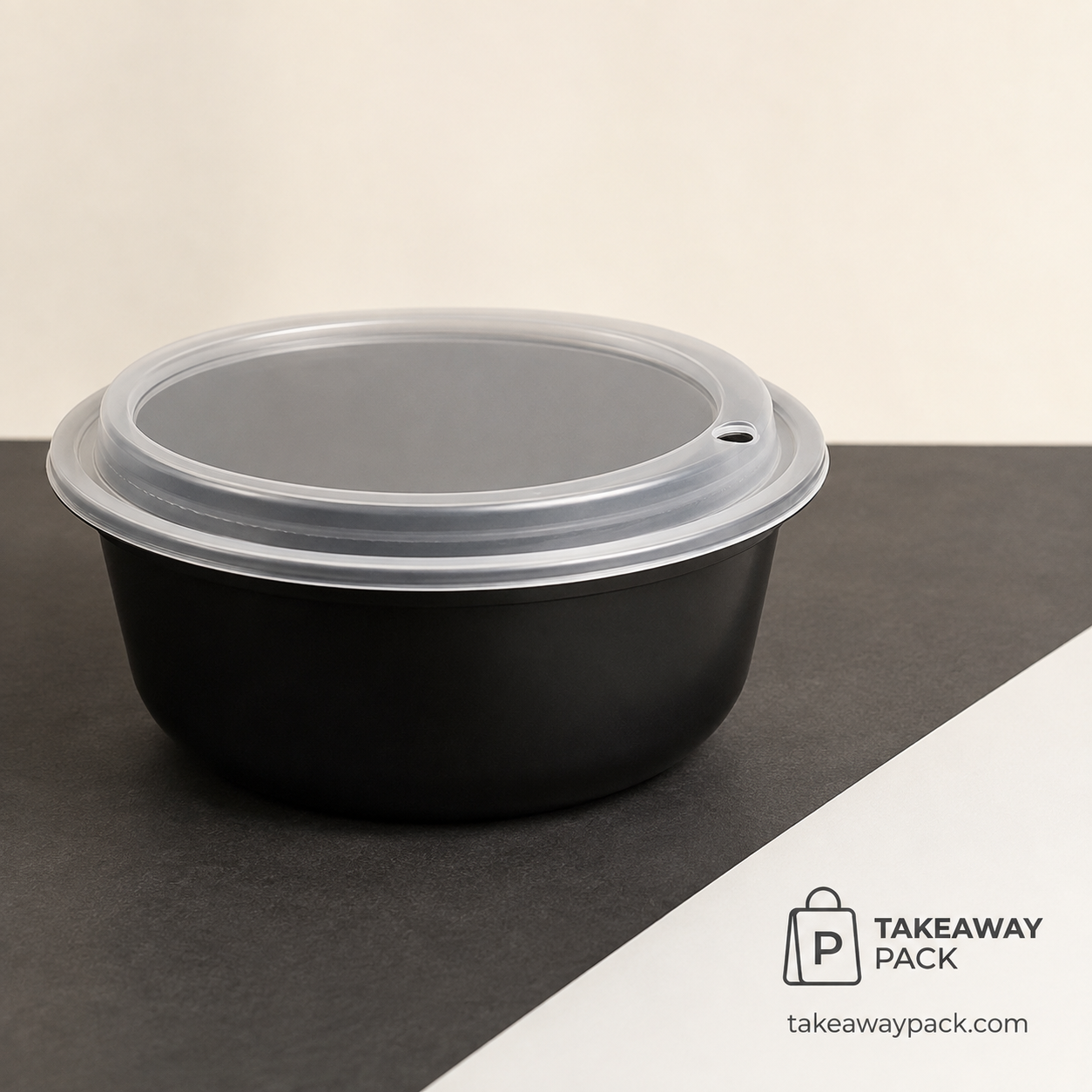
Takeawaypack’s ERP includes **TP-JMFQ-0063**, a 1000 ml black food-grade PP round bowl with a lock lid. The recorded size is a 17.2 cm top diameter, 13 cm bottom diameter, and 7 cm height. Its white-background product image shows a round black bowl with a clear fitted lid and a visible small opening near the rim.
That makes it a directly relevant **secure-lid PP control sample** for a hot rice or braised-dish delivery trial. It should not be presented as proof of a particular venting, heat, or leak result; test the exact bowl and lid with the intended portion. For a menu-specific sample comparison, contact Takeawaypack with the dish, portion, packing temperature, and 40-minute delivery conditions.