How Handle-Sealed Delivery Bags Create a Clear Final Handoff for Multi-Item Orders
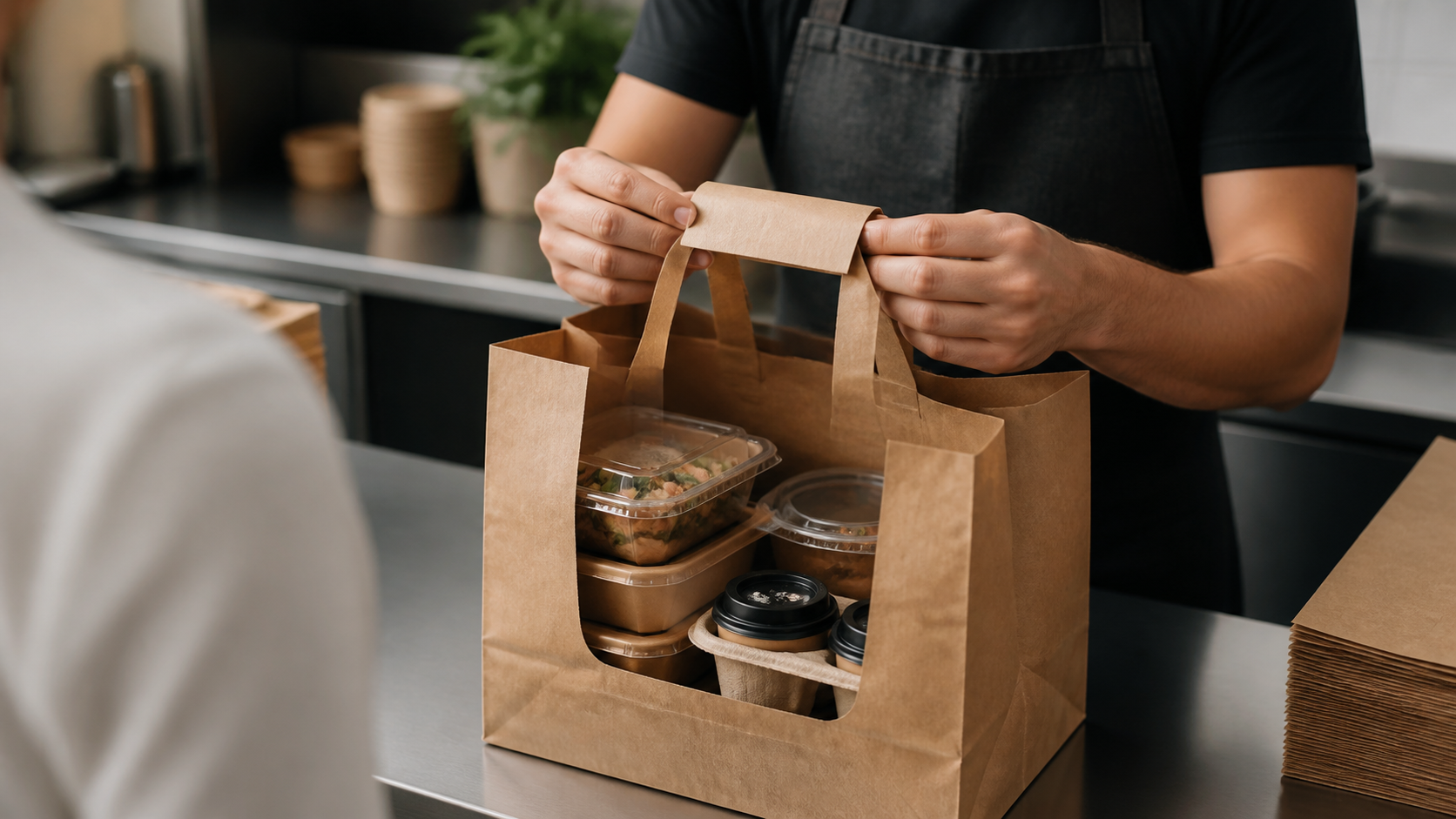
In a multi-item delivery order, the outer carry bag is often the last package the restaurant team touches and the first package the customer sees. A handle-sealed bag can therefore serve as the final handoff point: it brings separately packed meals into one visible order, shows whether the bag has been opened after sealing, and gives the customer a defined way to enter the order.
2026-08-16 - 9 min read
Summary
In a multi-item delivery order, the outer carry bag is often the last package the restaurant team touches and the first package the customer sees. A handle-sealed bag can therefore serve as the final handoff point: it brings separately packed meals into one visible order, shows whether the bag has been opened after sealing, and gives the customer a defined way to enter the order.
The useful question is whether a proposed bag, seal pattern, load arrangement, and opening method work together for the actual order and delivery route. Evaluate the configuration with representative samples: load the order as it is packed in service, seal it consistently, include handling and vibration, inspect visible opening evidence, and ask customers or staff to open it as intended. This article outlines that evaluation process without treating any closure format as a universal performance, hygiene, regulatory, or platform-compliance claim.
Why the outer bag is the final handoff point
A delivery order may contain containers, drink carriers, cutlery packs, receipts, and temperature-separated items. Each component can be closed, yet the order is still incomplete as a handoff unit until it is gathered into its outer bag.
At that point, the bag must make the order understandable to three people:
- the packer, who needs a repeatable way to load and close it;
- the courier, who needs a stable package to carry and place in a delivery bag; and
- the customer, who needs to see the package condition and open it without unnecessary struggle.
A handle-area seal is one possible approach because it focuses on the main access path to a handled bag. It should be considered as part of the full order system, not as a substitute for correct container closures or careful packing.
Define what a handle seal needs to accomplish
Before comparing samples, turn general concerns about tampering and convenience into observable checks. A useful brief describes the bag type, handle geometry, typical order size, loading order, courier handling, and desired customer opening action.
Create one clear access path
A seal design should make it clear where the customer is meant to start opening the bag. The intended opening action may involve a tear strip, a perforated area, or another deliberate release feature, depending on the chosen configuration.
During a sample review, ask simple questions:
- Can a customer identify the opening point without instructions?
- Does the opening action work when the bag is full?
- Does the customer need to pull near food containers or drinks?
- After opening, can the order be removed without tipping or tearing the bag further than intended?
A seal that is hard to understand can create frustration even if it looks secure at dispatch. Conversely, easy opening should not be assumed from an image or specification; it needs to be checked on the actual bag and order load.
Make opening evidence visible
Tamper-evident packaging is intended to provide visible evidence that an access feature has been opened or disturbed. It is not the same as a claim that access is impossible.
For a handle-sealed bag, the team can inspect whether the closure presents a continuous, easy-to-see condition when packed, and whether the intended opening action leaves a recognizable change. Evidence may be harder to read if the bag is overloaded, creased, wet, rubbed against other packages, or sealed inconsistently. These are reasons to test the full delivery journey rather than reviewing a flat, empty bag alone.
Load the order before judging the seal
A bag seal cannot correct an unstable load. The items inside determine where stress reaches the handles, side panels, top fold, and closure area.
Build a representative multi-item order
Use the normal menu components, fill weights, containers, and drink arrangements. Include the order combinations that regularly challenge the bag: several meal boxes, a mix of tall and flat packs, sauces, or an item that must remain upright.
Record the order before sealing:
- number and type of containers;
- total load and item positions;
- headroom between contents and the bag top;
- whether the handles can be brought together naturally; and
- any sharp corners, protrusions, or wet exterior surfaces near the seal area.
This record keeps a packaging trial tied to an actual use case. A result from one order shape should not be carried over automatically to a different bag size, menu, or loading pattern.
Keep handle movement in the test
When a loaded bag is lifted, force transfers through the handles and top area. If the bag is set down, carried at an angle, or placed among other orders, its shape can change again. The closure should therefore be applied only after the intended load is inside and the handles are aligned in the normal operating position.
Train the packing team to use one documented sequence. For example: check the order, orient containers, bring handles together, apply the chosen seal, press or secure the specified areas, and visually inspect the finished handoff unit. The exact sequence depends on the selected format and should be set during sample validation.
Compare sealing paths by the complete order, not by appearance alone
Self-adhesive labels, handle-area seal formats, shrink bands, and integrated locking containers have different access paths and operating steps. They should not be ranked in the abstract. Compare each candidate against the same order, route conditions, and customer-opening task.
Self-adhesive labels
A label can be evaluated for whether it bridges the actual access point, adheres to the bag surfaces used in the trial, remains legible after normal handling, and shows a visible change when opened. If the bag has folds, side gussets, or multiple top paths, test whether the chosen label placement leaves an untested route into the bag.
Handle-area seals
A handle-area seal can be evaluated for how it interacts with the handles, bag top, and side folds. The review should check alignment, coverage of the relevant access area, adhesion under the intended load, and the visibility of the opening indication after transport. Also test whether the customer can find and use the opening feature without pulling the handles apart first.
Shrink bands and integrated locks
Shrink bands and locking container formats may be candidates for particular components or order designs. They introduce different equipment, material, packing, and opening considerations. Compare them only in the configuration proposed for the route; do not assume that an option suitable for one container or bag will suit the complete multi-item handoff.
Test the sealed bag through handling and vibration
Countertop inspection is only the beginning. A useful trial includes the movements that occur between packing and arrival.
Use a repeatable route simulation
Set a trial plan that reflects the operation. It can include lifting the bag, placing it into an outer courier bag, unloading it, controlled turns or tilts, and a documented vibration or movement step. Keep the method consistent across candidate configurations so observations can be compared.
At the end of each test, inspect:
- the bag’s overall shape and handle position;
- the condition of the closure area;
- any lifted edges, tears, creases, or contact marks;
- whether containers shifted or pressed into the closure zone;
- whether the intended opening evidence remains easy to see; and
- leakage or moisture that may affect the bag or seal surface.
Photograph the sealed bag before loading, after the simulation, and after consumer-style opening. The photographs should be tied to the bag and closure configuration, menu load, and test conditions.
Separate visible disturbance from general wear
A rumpled bag is not necessarily an opened bag. During review, distinguish between ordinary handling marks and the change produced by the designed opening path. If a customer, courier, or service team cannot tell the difference consistently, the configuration needs further work.
This does not require a claim that a bag prevents all access. It creates a practical question: after a representative journey, does the final handoff provide a condition that the team and customer can inspect and understand?
Make customer opening part of the validation
A delivery bag should not shift all difficulty to the person receiving it. Add a consumer-opening check after the transport simulation.
Observe the opening sequence
Give participants a normally packed bag and ask them to open it without detailed coaching. Note where they begin, whether they use the intended feature, how much force or time the action appears to require, and whether removing the order disturbs other items.
Ask them what they noticed before opening. Their answers can reveal whether the closure communicates its condition clearly enough to support the final handoff.
Test accessible scenarios where relevant
Different customers may have different grip strength, dexterity, or visual needs. Where the service model calls for it, include a range of users in the opening review and record the conditions of the test. If the test identifies difficulty, consider whether a clearer opening cue, a revised bag size, a different load pattern, or another closure configuration should be sampled.
Use an evidence record before selecting a configuration
A short evaluation record prevents a one-time sample result from becoming an unsupported general claim. For every candidate, keep:
- the bag, closure, and order configuration identifier;
- the menu items, fill levels, and number of components;
- the packing and sealing sequence;
- the delivery handling or vibration method;
- before-and-after photographs of the closure area;
- observations of shifts, damage, moisture, and visible opening evidence;
- customer-opening observations; and
- changes that would require a retest, such as a new bag size, different menu mix, route pattern, or sealing method.
The result should state what was observed under the recorded conditions. It should not be expanded into a statement about every order, every route, or every regulatory or platform requirement.
Questions to ask a packaging supplier
For an RFQ or sample discussion, give the supplier enough operating context to prepare a relevant proposal. Useful inputs include the bag dimensions, handle style, typical and maximum order load, container mix, anticipated order volume, delivery movement, destination market, and desired opening experience.
Ask which catalogue categories or custom discussions may be relevant, then request samples for the exact bag and route test. Confirm any performance, material, food-contact, hygiene, regulatory, or platform-related requirement separately for the selected SKU, configuration, intended use, and destination.
Plan the final handoff with TakeawayPack
TakeawayPack can discuss packaging catalogue categories, RFQ details, and custom requirements for multi-item delivery programs. A handle-sealed bag configuration should be selected only after samples and route validation reflect the actual order, packing process, handling conditions, and customer-opening path. To begin that conversation, visit TakeawayPack.