Starbucks Cut Up to 20% Plastic From Its Cold Cups: How Smaller Chains Should Test Cups, Lids and Straws Together
Starbucks' publicly reported cold cup redesign removed up to 20% of the plastic in its clear cold cups while keeping lid fit, crush resistance and hand-feel intact ([Starbucks, April 2024](https://about.starbucks.com/stories/2024/new-more-sustainable-starbucks-cold-cups-are-made-with-up-to-20-percen…
2026-09-03 - 9 min read
Summary: Starbucks' publicly reported cold cup redesign removed up to 20% of the plastic in its clear cold cups while keeping lid fit, crush resistance and hand-feel intact (Starbucks, April 2024). The part worth copying is not the cup itself — it is the method: the cup body, the lid, the straw and the store workflow were qualified as one system, over years of small geometry changes rather than a single "thinner wall" decision. This article translates that approach into a lightweighting test protocol a 3–30 store chain can actually run, explains why rim diameter — not wall thickness — is the number that controls your lid strategy, and shows which questions to put to your packaging supplier before you approve a lighter cup for bulk production.
Why a lighter cold cup fails in the store, not in the spec sheet
A lighter cup almost never fails on paper. It fails at three specific moments:
- Lid application. A barista presses down with a thumb on a cup already full of ice and liquid. If the rim area lost stiffness, the sidewall gives way before the lid clicks.
- Hand-off. A customer grips the mid-body of a full cup. Squeeze force is transferred into the lid seal, and liquid pushes out of the straw slot or the lid seam.
- Dwell time. Ten to thirty minutes later, condensation has formed, ambient temperature has risen, and the same cup now behaves differently under the same grip.
None of those three moments are captured by "grams of plastic per cup". That is the core lesson from the Starbucks project: material reduction that is judged only by weight tends to move the cost into remakes, spills and staff frustration.
What Starbucks actually changed — and which parts transfer to a small chain
Three decisions from that redesign transfer well to a smaller operator, and one does not.
1. Geometry was changed before thickness
Rather than simply thinning the wall, the redesign adjusted rim diameter, wall radius and bottom contours, with many small iterations until a workable combination was found. Curvature, ribs and a reinforced rim let you remove material from low-stress zones while keeping stiffness where hands grip and where the lid seals.
Transferable action: ask your supplier which zones of the existing tool are already over-specified, instead of asking for "a 10% lighter cup".
2. Cup sizes were re-shaped so they could share one lid
The 12 oz cup was made wider and squatter — same fill volume, wider mouth — so it could take the same lid as the larger sizes. Fewer lid SKUs meant less back-of-house clutter, fewer wrong-lid errors and less variance between lid batches.
Transferable action: before you touch the cup, count how many lid SKUs you currently stock. Lid consolidation is usually the cheaper win, and it is available to you today without any tooling change.
3. Baristas and customers scored prototypes during real service
Store staff prepared drinks with prototypes in both lab and live conditions and rated feel and performance; customers were surveyed during the pilot. Accessibility details were added without giving up the performance targets.
Transferable action: you do not need an innovation lab, but you do need scoring from people working a Saturday rush.
What does not transfer
The multi-year development cycle, custom tooling and a dedicated test lab. A smaller chain works inside supplier-existing moulds. That is exactly why your leverage sits in selection and qualification, not in redesign — and why the rim diameter of a catalogue cup matters more to you than its wall thickness.
Rim diameter is the number that governs your accessory strategy
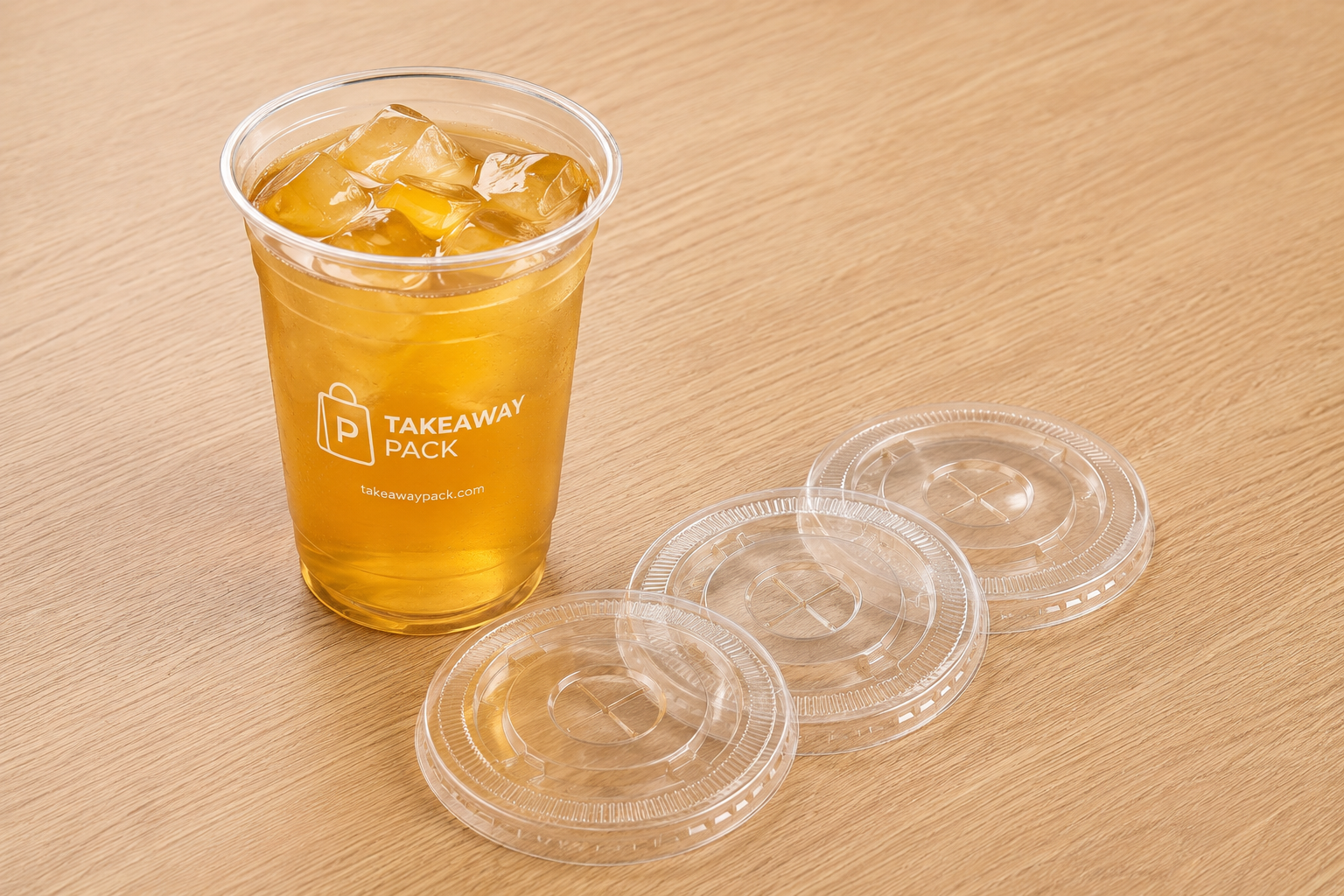
In a real disposable-cup catalogue, clear PET cold cups are not organised by volume. They are organised by rim (top) diameter, and lids are listed against the same rim figure. In the Takeawaypack catalogue, for example, clear PET cold cups run in 90 mm, 93 mm and 98 mm rim families:
| Rim family | Example cup range | Listed unit weights | Lid styles listed on the same rim |
|---|---|---|---|
| 90 mm | 10 / 12 / 14 / 16 oz, plus U-shaped variants | approx. 9–13.5 g (±0.5 g) | flat, tall, dome, direct-drink, diamond |
| 93 mm | 9 / 12 / 14 / 16 oz | approx. 8–13 g (±0.5 g) | flat, dome, direct-drink |
| 98 mm | 360 ml, 12 / 14 / 16 / 18 / 20 / 24 oz | approx. 11–16.5 g (±0.5 g) | flat, tall, dome, direct-drink, diamond, hinged |
Two practical implications follow.
First: a whole size ladder can already share one lid. A 90 mm rim covers 280 ml to 450 ml across straight-wall and U-shaped bodies. If your menu currently sits across two rim families, the Starbucks-style consolidation is available as a purchasing decision — pick one rim family and keep it — rather than as a redesign project.
Second: lightweighting is often a version choice, not a new tool. The same catalogue lists a 98 mm 16 oz cup at about 13.5 g and a heavier version of the same 500 ml, 16 oz, Ø98 × H122 mm body at about 16 g. That pair is exactly the A/B test you need: identical rim, identical footprint, identical fill line, different grammage. You can qualify the lighter version against your own lids without changing anything else in your operation.
Note also the stated working range for these PET cups: roughly −10 °C to 50 °C. Cold-drink and iced use is what they are specified for; hot beverages are a different material conversation entirely.
A four-stage lightweighting test protocol for 3–30 stores
Run every stage with the exact lid and straw you actually stock, not a generic sample. Set pass/fail criteria before the first prototype arrives.
Stage 1 — Lid-snap and vertical compression
- Setup: fill prototype cups with ice and water to your normal fill line.
- Method: have three staff of different hand strength snap on 50 consecutive lids per size.
- Pass criteria: zero rim buckling and zero ovalised rims. The lid must fully click before the sidewall deflects.
- If it fails: the fix is usually a tighter radius or more material at the top bead, not a thicker mid-wall.
Stage 2 — Lateral hand-off / squeeze test
- Setup: full, lidded drinks with straw inserted.
- Method: one-handed grip at the mid-body, lift, pass across a counter, and repeat with a delivery-bag shake and a cup-holder tilt.
- Pass criteria: sidewall may flex, but no lid-seal pop and no liquid displaced through the straw slot or spout.
Stage 3 — Condensation and dwell test
- Setup: lidded iced drinks left in ambient store conditions.
- Method: repeat the squeeze test at 5, 15 and 30 minutes.
- Pass criteria: the cup must not become slippery to the point of grip failure, and must not collapse under normal grip. This is the stage most small-chain trials skip, and the one that generates the most customer complaints after rollout.
Stage 4 — Batch tolerance and cross-batch audit
- Setup: request samples from two separate production runs.
- Method: test Batch A lids on Batch B cups, and vice versa.
- Pass criteria: consistent snap force and seal across the cross-pairing.
- Why it matters: mismatched cup-and-lid tolerances between runs — not the lighter cup itself — are the most common cause of leaks appearing weeks after a successful pilot.
Metrics to carry into a limited store pilot
Track these per 1,000 drinks, against your current cup as the control:
- lid failures and leaks
- remakes and spills
- barista time per drink build during peak
- customer complaints
- total landed cost of cup + lid + straw, not cup alone
A cup that removes plastic but adds remakes is not a sustainability win — it moves waste from the spec sheet to the bin.
Straws and lids: the accessories that decide whether the change holds
Lightweighting a cup body changes accessory behaviour in ways buyers routinely underestimate.
- Straw calibre must match the lid slot. Straws in a real catalogue come in distinct calibres — around 0.6 cm for standard drinks and 1.2 cm for thick or bubble-tea style drinks — in lengths such as 18, 23 and 26 cm, in PP and in PLA. A thicker straw forced through a slot on a thinner-walled lid puts stress directly on the seal.
- Straw material affects insertion force. PLA and PP straws do not behave identically when pushed through a lid slot, and a strawless direct-drink lid removes the puncture step altogether. If you are cutting plastic, evaluate switching lid style before switching cup grammage — a direct-drink lid can eliminate the straw SKU entirely.
- Lid style changes rim loading. Flat, tall, dome, diamond, hinged and direct-drink lids on the same rim do not apply the same downward force during application. Qualify each style you stock separately.
- Single-hole and leak-resistant options change the failure mode. A 90 mm matte single-hole PP lid at around 3.6 g and a patented leak-resistant 90 mm PP lid (90 × 25 mm) are different products with different seal geometry. Do not assume rim compatibility equals equivalent performance.
- Carriers matter for delivery. If you run four-cup carriers, test the lighter cup loaded and carried, not only standing on a bar.
Questions to put to your packaging supplier before bulk production
These are the questions that separate a supplier who can support lightweighting from one who will simply thin a wall:
- What is the rim diameter of this cup, and exactly which lid SKUs are listed against that rim?
- What is the stated unit weight and tolerance (e.g. 13.5 g ±0.5 g), and is a lighter or heavier version of the same body available for comparison?
- Which sizes in the range share one lid, and where does the range break to a different rim?
- What is the declared temperature range for the material?
- Can we receive samples from two different production runs for a cross-batch lid fit check?
- For custom printing, is a digital proof issued for written approval before production starts, and how do print and coating choices interact with rim geometry?
- Which documents can be confirmed per SKU, per order and per destination market — food contact, recycled content, origin — rather than claimed for the whole catalogue?
If a supplier cannot answer questions 1 to 3 from their own product data, you cannot run a valid lid-fit test, and any plastic saving is a guess.
Where a sourcing partner fits into this
The reason rim-family thinking is practical at small volumes is that it turns a redesign problem into a catalogue problem. Takeawaypack works as a foodservice packaging supply-chain partner for international buyers — operating its own printing factory and working with a network of disposable-packaging factories — with flexible, small-batch MOQs, so a chain can qualify a cup, a lid style and a straw calibre as a set before committing to volume. Structure, coating, capacity, printing, lid matching and carton packing are all points that get confirmed during the quotation stage rather than discovered after delivery, and custom printed orders only go into production after the buyer signs off a digital proof.
Practically, that means you can do three things in one sourcing conversation: pick a single rim family so your lid SKUs collapse, request two grammage versions of the same cup body for an A/B crush test, and align the straw calibre and lid style to the drinks you actually sell.
Next step: if you are planning a cold cup lightweighting trial for the next season, start from the rim family rather than the gram figure. Browse the clear cold cup, lid and straw ranges by rim diameter at takeawaypack.com and send your current cup dimensions, lid style and monthly volume with your sample request, so the cup-and-accessory set can be quoted and tested as one system — the way the Starbucks project proved it should be.