How to Choose Paperboard, PP, PET, and Aluminium Food Containers for Each Menu Item
Choose the container from the food journey, not from a material preference. Start with the food’s temperature and reheat method, then assess grease and sauce load, moisture and steam, the need to show the food, and the closure needed for delivery. In practical terms, PP is often the starting point for hot, saucy takeaway meals; PET is a strong fit for cold food that must be visible; correctly specified paperboard suits dry or moderately greasy branded food; and aluminium suits oven-going or high-heat applications. The final choice is always the specific container-and-lid system tested with the actual food.[1]
2026-09-01 - 8 min read
Summary
**Summary:** Choose the container from the food journey, not from a material preference. Start with the food’s temperature and reheat method, then assess grease and sauce load, moisture and steam, the need to show the food, and the closure needed for delivery. In practical terms, PP is often the starting point for hot, saucy takeaway meals; PET is a strong fit for cold food that must be visible; correctly specified paperboard suits dry or moderately greasy branded food; and aluminium suits oven-going or high-heat applications. The final choice is always the specific container-and-lid system tested with the actual food.[1]
Restaurants that sell rice bowls, salads, bakery snacks, and desserts do not need one “best” disposable container. They need a small, purposeful packaging system that prevents the most likely failure for each menu item: a leak, a softened base, condensation, a crushed dessert, or a product that does not look appealing on display.
Use this five-question selection order
Before choosing a material, answer these questions for the exact menu item:
- **What is the hottest and coldest condition the pack will experience?** Consider filling, holding, delivery, storage, and customer reheating—not only the temperature at the kitchen pass.
- **How much oil, sauce, or free liquid does it contain?** A dry rice dish and a curry can leave the kitchen at a similar temperature but place very different demands on the base, seam, and lid.
- **Will steam build up?** Steam and condensation can soften paperboard, obscure a clear lid, and damage crisp textures.
- **Does product visibility sell the item?** A layered dessert or fresh salad may benefit from a clear container; a hot curry generally benefits more from dependable containment.
- **What must the finished pack do?** Decide whether it needs to be microwave-reheated, oven-finished, stacked, carried for delivery, or presented in a display case.
This order avoids a common sourcing mistake: selecting a resin or paper grade first and trying to make every food fit it. A material is only one part of performance. The container’s wall thickness, shape, rim, closure, venting, fill level, and delivery handling can decide whether the system works.[1]
Paperboard: choose it for brand presence, dry foods, and controlled moisture
Paperboard gives food businesses a broad printable surface and a familiar bakery or takeaway look. It is often a useful choice for sandwiches, cookies, pastries, fries, dry snacks, and foods where presentation and print matter as much as visibility.
Paperboard is not a single performance category. A plain carton, a grease-resistant board, and a board with a coating or liner behave differently around oil, moisture, and sauces. For a food that is warm, greasy, or served with liquid, specify the barrier and the closure as part of the product brief. Do not assume that calling a pack “paper” answers the food-contact, leakage, or end-of-life questions.[2]
**Good starting applications**
- Bakery items and dry snacks
- Sandwiches and wraps with controlled moisture
- Fried food in a suitably grease-resistant format
- Branded takeaway boxes where a clear view of the food is not essential
**Check before approval**
- Grease staining after the expected hold time
- Softening at corners, folds, and the base
- Sauce contact with seams and board edges
- Whether a window, liner, ink, adhesive, or lid changes the required evidence
For a very wet or sauce-heavy meal, paperboard may still be workable, but only when the finished construction and matched lid have passed an application-specific trial.
PP: make it the first option for hot, saucy, and reheatable meals
Polypropylene (PP) is commonly used for hot takeaway formats because it can combine useful heat performance, toughness, and practical closure options. It is a sensible first material to evaluate for rice bowls, noodles, curries, soups, stir-fries, saucy meal trays, and sides that customers may reheat in a microwave—provided the specific product is rated for that use.[1]
PP is especially useful when delivery reliability matters more than crystal-clear presentation. A well-matched PP base and lid can help manage oil, liquid movement, stacking, and handling during delivery. That does not make every PP container leak-proof. Test the exact fill level, lid engagement, headspace, and transport route with the actual dish.
**Choose PP first when the food is:**
- Hot-filled or expected to remain hot in transit
- Oily, saucy, or liquid-heavy
- Intended for microwave reheating where the manufacturer confirms suitability
- Delivered in stacks or carried over a route where lids and rims are stressed
**Example:** For chicken curry with rice, evaluate a PP bowl or compartment tray with a matching lid before considering a clear display container. For a dry rice bowl, PP may still be the most robust option, but paperboard can become a candidate if its barrier and moisture performance are proven.
PET: use it when cold food needs to be seen
Standard PET is a strong candidate for chilled or lower-temperature food where transparency is part of the selling experience. It can work well for salads, fruit, deli items, cold desserts, cake portions, and display-led bakery products. The clear wall helps customers see freshness, portioning, toppings, and layers.
The key rule is to keep standard PET within the use conditions specified for the exact product. It should not be selected for a hot meal simply because it is clear. Hot food and steam can compromise the look and performance of a container that was designed for cold display.[1]
**Good starting applications**
- Cold salads and grain bowls
- Fruit cups and chilled deli items
- Layered desserts, chilled cakes, and parfaits
- Bakery goods that benefit from a clear clamshell or dome
**Check before approval**
- Condensation and anti-fog requirements
- Resistance to scuffing or crushing in stacked delivery
- The lid lock and leak behavior with dressings or syrups
- Separation of hot components from the PET pack until the food has cooled, if relevant
A cold Caesar salad with dressing on the side is a typical PET candidate. A salad that includes a hot protein component needs a workflow decision: pack the hot component separately, let it cool under controlled conditions, or choose a system designed for the actual combined temperature.
Aluminium: select it for oven use, high heat, and baked formats
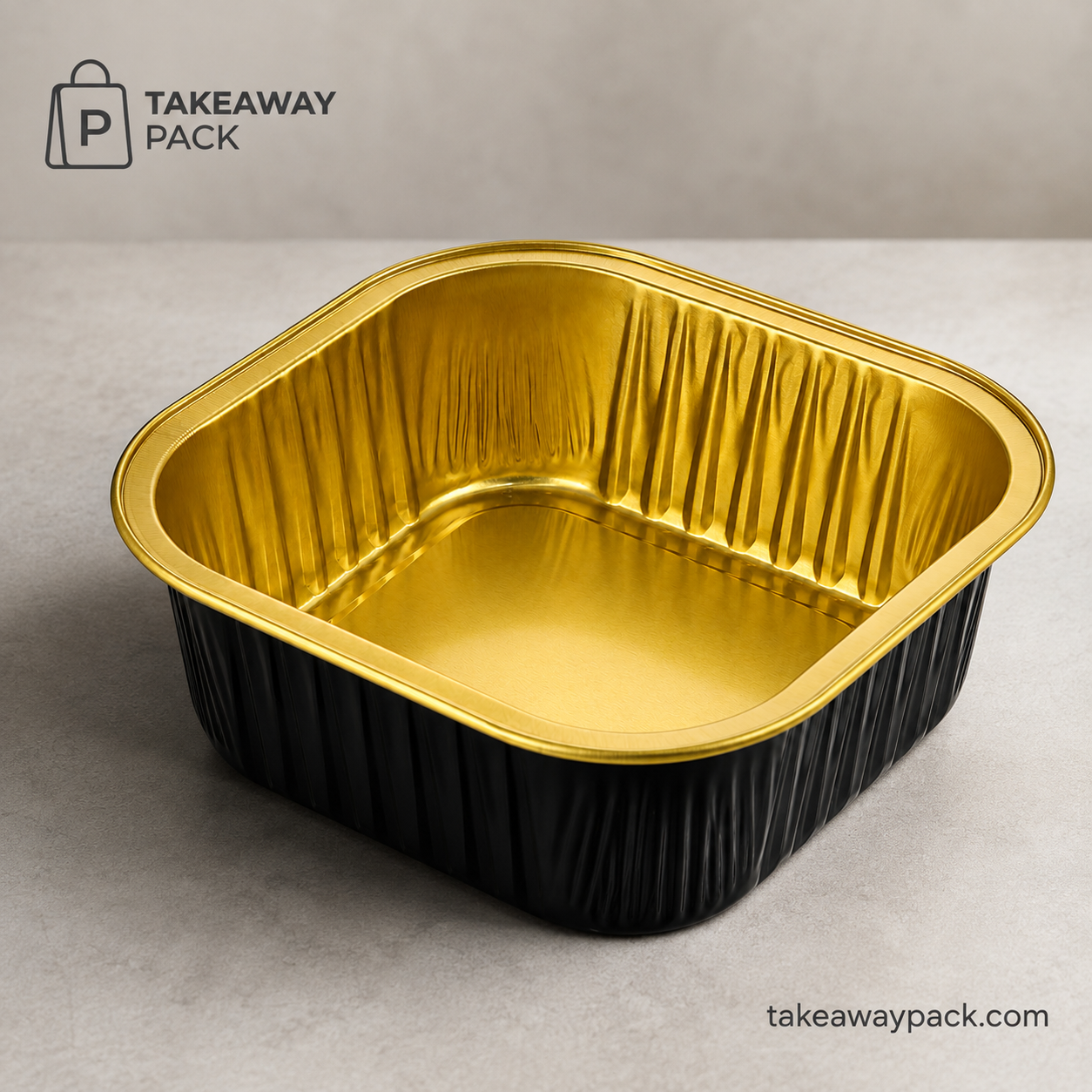
Aluminium containers are useful when the food journey includes oven finishing, baking, or very high heat. They can be a practical option for baked pasta, lasagne, gratins, catering trays, and warm desserts that are prepared or reheated in an oven. They also provide a strong barrier to grease and do not depend on a clear wall for product presentation.
The trade-off is straightforward: aluminium is opaque and is not a microwave option. If the customer must see the product, use a suitable separate lid or a different display format. If microwave reheating is required, choose a validated alternative rather than assuming the tray can serve both reheat methods.
**Good starting applications**
- Oven-baked meal trays
- Greasy baked foods
- Catering and shareable portions
- Desserts that remain in a baking format
**Check before approval**
- Whether the exact tray, lid, and any sealing film are rated for the intended oven conditions
- Rigidity after filling and during transport
- A safe, practical closure for sauce or cooking juices
- Clear customer instructions for oven versus microwave use
A practical menu-to-material map
Treat the lid as part of the material decision
Many packaging failures are closure failures. A strong bowl paired with a loose lid can still leak; a clear lid can still fog; and an oven-suitable base may need a different lid for transport than for heating. Source and test the base, lid, sealing method, and any venting as one system.
Run a short trial using the hottest, greasiest, and most liquid-heavy version of each dish. Fill to the intended level, close it as staff would during service, hold it for the real delivery duration, stack it, and simulate the movement of delivery. Record leaks, deformation, condensation, temperature retention, and customer-facing appearance. This gives purchasing a repeatable decision rather than a generic material assumption.
Turn the framework into a clearer RFQ
For every candidate container, specify the food type, fill temperature, expected contact duration, sauce and oil level, reheat method, lid requirement, target market, and planned claims. Keep the material, liner or coating, lid, print, and SKU together in the approval record. Food-contact support and environmental or recycled-content claims must be reviewed for the finished configuration and intended use, not inferred from a broad material label.[2]
Where packaging EPR obligations may apply, identify the exact configuration and the party placing it on the destination market; do not use a supplier statement or product image as proof of local approval.[3]
TakeawayPack can use those details to discuss container structure, coatings, capacity, print, lid matching, and export handover during an RFQ. Start with the menu-item matrix above, then request samples or specifications for the exact combinations that must survive your real service and delivery conditions.
Sources
[1] https://www.takeawaypack.com/blog/best-packaging-for-hot-meals-and-delivery — The Best Packaging for Hot Meals and Delivery Depends on the Food and Journey
[2] https://www.takeawaypack.com/blog/us-foodservice-packaging-documentation-2026-buyers-guide — U.S. Foodservice Packaging Documentation in 2026: A Buyer’s Guide to FDA, FSC, GRS, and BPI
[3] https://www.takeawaypack.com/blog/south-korea-packaging-epr-a-practical-readiness-guide-for-foodservice-buyers