How to Design a Digital-Only Quesadilla Meal: Menu Logic, Compartments, and Delivery Control
Chipotle’s digital-only quesadilla shows why a delivery-first menu item should be designed as one system: digital choices, kitchen sequencing, food shape, compartment layout, and the opening experience must agree. The practical lesson is not to copy a tray. It is to make the menu promise match what the package and operation can reliably deliver. For a quesadilla meal with two or three dips, start with a constrained digital menu, a stable main-item zone, and a sauce plan that keeps wet and cold components away from the hot tortilla. Then validate the whole system through timed delivery tests before expanding the offer.
2026-09-01 - 8 min read
Summary
Chipotle’s digital-only quesadilla shows why a delivery-first menu item should be designed as one system: digital choices, kitchen sequencing, food shape, compartment layout, and the opening experience must agree. The practical lesson is not to copy a tray. It is to make the menu promise match what the package and operation can reliably deliver.
For a quesadilla meal with two or three dips, start with a constrained digital menu, a stable main-item zone, and a sauce plan that keeps wet and cold components away from the hot tortilla. Then validate the whole system through timed delivery tests before expanding the offer.
What Chipotle’s digital-only quesadilla actually changed
Chipotle introduced its hand-crafted quesadilla as a digital-only item in March 2021 after a limited pilot in Cleveland and Indianapolis. The format paired a pressed, triangular-cut quesadilla with a choice of three sides or salsas in a compartmented package.
The useful insight is operational. A quesadilla can interrupt a conventional service line because it has a separate cook step and then needs sides. Digital ordering gives the restaurant an order record before production starts. That makes it easier to route the item to a dedicated station, sequence the cook time, and assemble the sides without asking a counter employee to leave and rejoin the line.
For a mini-program or delivery-platform launch, treat that control as the reason for digital exclusivity—not simply as a marketing restriction.
Build the digital menu around the physical pack
A digital menu should not offer combinations that the kitchen or package cannot execute consistently. Start with the container layout and work backward into the interface.
Use a short decision path
A strong first version usually needs only three decisions:
- **Choose the quesadilla.** Offer a compact set of fillings rather than an open-ended build.
- **Choose the dip set.** Let the number of selectable dips match the number of usable sauce positions.
- **Choose controlled add-ons.** Put drinks, a side, or an extra sealed dip here.
If the delivered meal has one main zone and three sauce zones, show one main choice and three clearly labeled dip choices. Do not imply unlimited sauces if they will arrive in a crowded or improvised pack.
Give every choice a production rule
Each digital option should answer three questions before launch:
- Which station prepares it?
- How long does it add to the order?
- Where does it sit in the package?
This turns menu configuration into an operating specification. It also makes it easier to remove a low-performing option when it causes slow assembly, spill risk, or customer confusion.
Keep customization useful, not endless
Digital ordering can make a menu feel highly personal without adding a long list of free-form requests. A defined “choose three dips” structure can give customers agency while keeping portions, labels, and packing positions predictable. Extra sauces can remain a paid, separately sealed add-on if the core tray is already full.
Design the quesadilla as a hero item with a separate sauce system
The main item and the dips have opposite needs. The quesadilla needs structural support and a path for steam management. Cold or wet dips need separation, stable containment, and easy access at the point of eating.
Protect the main-item zone first
The main compartment should be sized around the cooked quesadilla, not the uncooked tortilla. Check that it can:
- hold the pieces without large empty gaps that encourage sliding;
- keep the folded or pressed edges supported during handling;
- avoid direct contact with wet sauces;
- allow the customer to remove a piece without dragging it through a condiment; and
- close without crushing the top surface.
The food itself matters as much as the tray. A sealed fold and a firm press can reduce the chance of filling escaping during transport. Cutting should create pieces that are easy to pick up and dip, rather than fragile wedges that bend under their own filling.
Make the dip layout intentional
Two- and three-dip meals need more than dividers. Specify the purpose of each zone:
| Zone | Job | Packaging question to test |
|---|---|---|
| Main-food zone | Keep the quesadilla intact and accessible | Does the item slide, split, or get compressed? |
| Dip 1 | Signature sauce | Is its portion easy to reach and dip into? |
| Dip 2 | Familiar or cooling sauce | Does heat from the main item affect it? |
| Dip 3 | Seasonal, premium, or optional dip | Can it remain sealed and correctly labeled? |
Partitions should create real separation, not merely visual lines. The objective is to stop liquids and condensation from reaching the tortilla, while keeping the dips accessible enough that customers use them.
Avoid loose components unless they have a job
Loose sauce cups can be appropriate for a paid extra or a portion that needs its own seal. But every extra component adds packing time, label risk, movement inside the delivery bag, and an additional opening action for the customer. Use integrated sections when they fit the product and the validation results support them; use separately sealed cups where liquid containment or temperature separation requires it.
A practical packaging brief for a quesadilla-and-dips meal
Before asking a supplier for samples, write a one-page brief that separates requirements from assumptions.
Required inputs
- Finished food footprint: length, width, height, and cut pattern
- Filling load and the weakest edge after cooking
- Dip count, target portion range, and whether each dip is hot, chilled, or ambient
- Maximum planned hold and delivery time
- Expected carry conditions: bicycle, scooter, car, stacked bag, or pickup
- Desired closure, tamper approach, labeling area, and bag orientation
- Whether the launch needs standard stock packaging, a customized format, or a staged combination of both
Tests that turn the brief into a decision
Run the exact menu and exact packing sequence, not an empty-container test.
- **Pickup test:** pack, hold briefly, then inspect crispness, piece integrity, portion presentation, and ease of opening.
- **Normal delivery simulation:** use the typical delivery time and motion profile. Check movement, sauce migration, closure performance, and whether the main item remains easy to lift.
- **Worst-case test:** extend the hold time and stack the order as a courier bag might. Record whether the meal still meets the quality standard you would show in the app.
- **Assembly test:** time the pack-out and observe whether staff can choose the correct dips, fill sections cleanly, apply labels, and close the order without rework.
Photograph the meal at packing and immediately after opening. Pair the images with a simple scorecard for integrity, moisture, temperature, leakage, presentation, and assembly time. A product that sells well in a digital test but fails this scorecard is not ready to scale.
Use a stage-gate launch rather than a full rollout
Chipotle’s pilot-to-launch sequence is a useful model: test the operating system before making the menu item broadly available.
Gate 1: Kitchen and package fit
Use staff orders or a limited internal test. Confirm that the menu choices map cleanly to the pack, the cooking station can keep up, and the assembly sequence is understandable.
Gate 2: Limited digital market
Launch in one store, delivery area, or customer cohort. Measure completed orders, preparation time, dip selection patterns, refund or complaint reasons, and repeat purchases. Read customer comments alongside photos of returned or failed orders.
Gate 3: Expand only the proven choices
Keep the combinations that perform well. Simplify or remove choices that create bottlenecks. Add seasonal sauces only after the base meal remains reliable at peak volume.
The point of the pilot is learning, not proving that every original idea must survive. A smaller menu with repeatable packaging is more valuable than a broad menu that produces inconsistent delivery quality.
Common mistakes to avoid
- **Treating the package as a final purchasing detail.** It should shape the menu and prep flow from the first prototype.
- **Putting wet dips beside the tortilla without a validated barrier.** This can turn the main item soft before the customer opens it.
- **Offering more dips than the pack can clearly support.** The result is usually inconsistent portions and packing errors.
- **Testing only a five-minute handoff.** Delivery meals need real hold-time and movement tests.
- **Using a generic large box with loose cups as the default answer.** It may work for a pilot, but it hides the quality and labor costs that appear at volume.
- **Promising a material, certification, heat tolerance, or leakproof result before it has been verified for the selected item and use case.** Specify the performance target, then validate it with the supplier and real food.
Choosing a packaging path with Takeawaypack
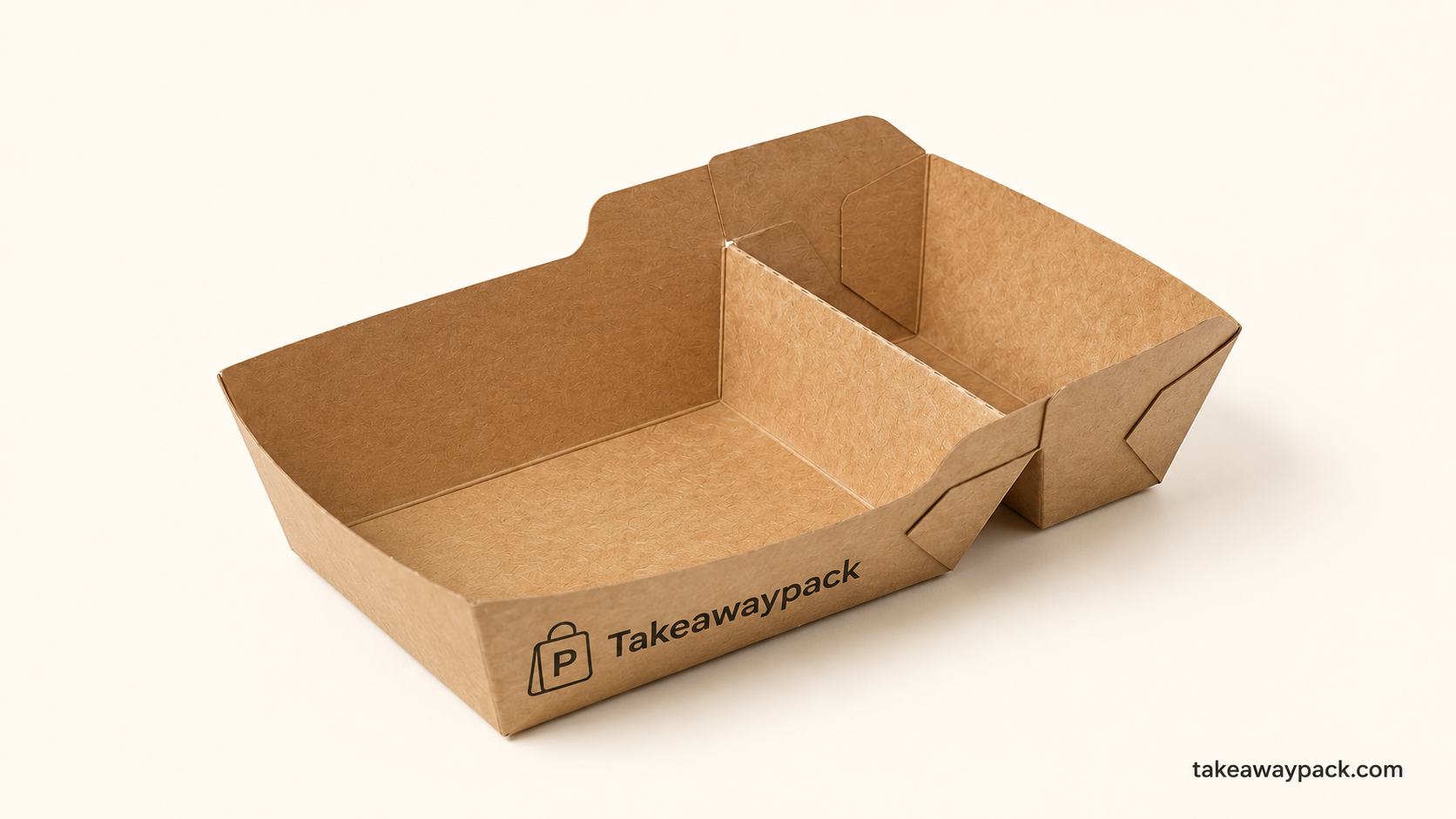
For a quesadilla meal, the right answer may be a compartmented clamshell, a tray-and-lid set, or a main-food pack paired with separately sealed dip cups. The choice should follow the food dimensions, sauce volume, delivery profile, and test results—not a one-size-fits-all template.
Takeawaypack’s product catalog includes compartmented food-container formats and compartmented sauce-cup options, while its company materials describe custom-printed packaging and flexible small-batch sourcing through its own printing factory and partner packaging-factory network. If you are defining a digital-only meal, bring the finished-food dimensions, dip plan, and delivery-test criteria to the conversation at Takeawaypack.