How to Evaluate Insulated Delivery Bags as Part of a Complete Food Packaging System
An insulated delivery bag should be evaluated as one part of a complete delivery system, not as a stand-alone purchase. The practical question is whether the proposed bag, containers, closures, food mix, loading sequence, handling routine, and delivery route can be defined and tested together for the intended operation.
2026-08-16 - 8 min read
Summary
An insulated delivery bag should be evaluated as one part of a complete delivery system, not as a stand-alone purchase. The practical question is whether the proposed bag, containers, closures, food mix, loading sequence, handling routine, and delivery route can be defined and tested together for the intended operation.
Start with usable capacity rather than an advertised bag size. Then document how orders are loaded, keep hot and cold items in separate zones when the route requires it, establish a cleaning routine, and run controlled route trials. Record the configuration and results so that a later menu, container, bag, or route change triggers a new review. This is an operational evaluation method; it does not establish the thermal performance, food safety, regulatory status, or suitability of any specific bag or packaging SKU.
Why an insulated bag is only one part of the delivery system
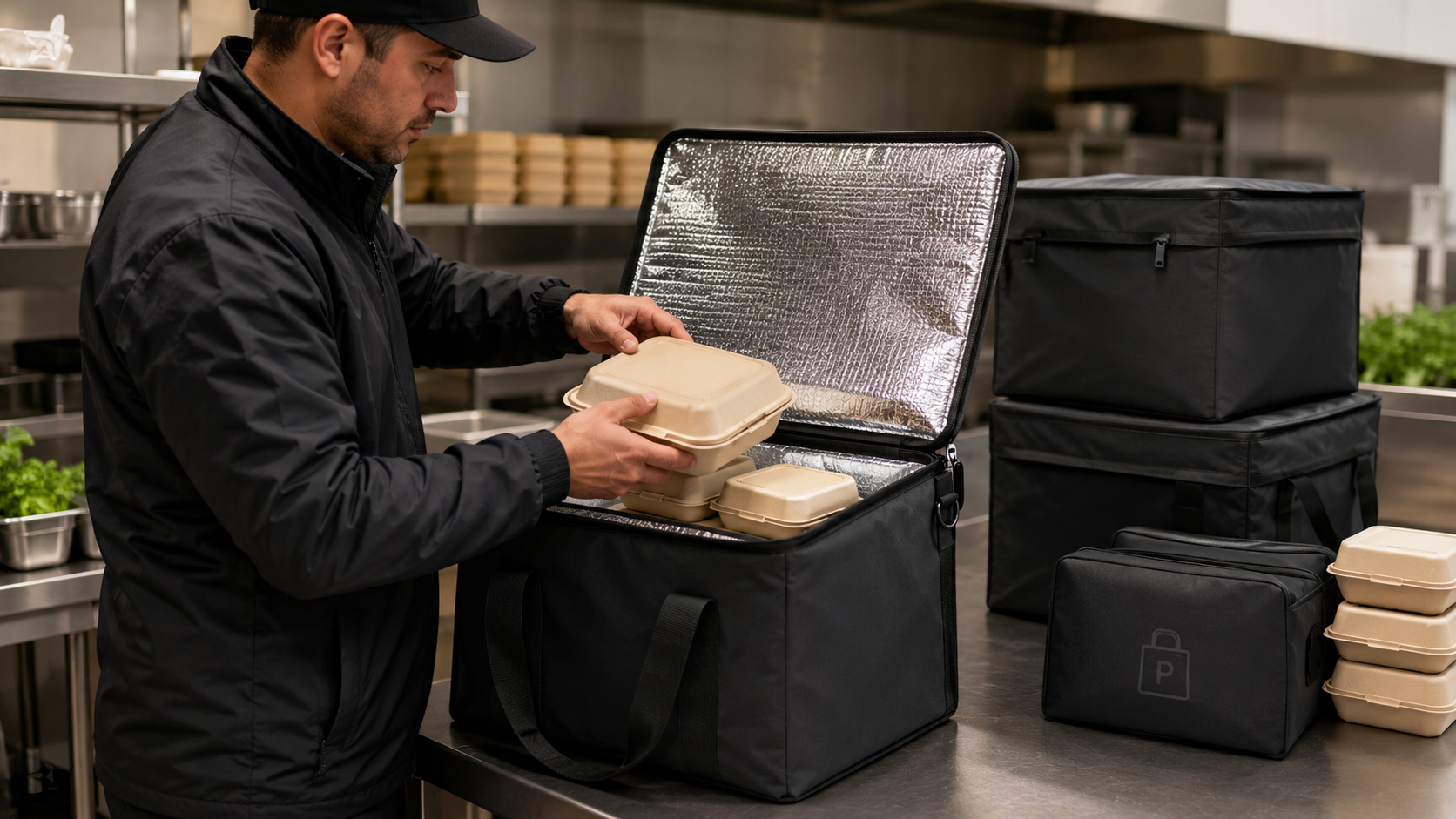
A delivery bag interacts with everything placed inside it. A bag that appears large enough when empty may be awkward once different container footprints, drinks, side dishes, sauces, inserts, and order labels are included. Likewise, a loading pattern that works for flat boxes may not work for tall bowls or mixed-temperature orders.
For that reason, evaluate the bag with the actual order architecture. Define the food types, proposed containers and closures, expected order mix, dispatch sequence, delivery method, and route profile before deciding that a system is ready for routine use. A single trial with one menu item is useful information, but it should not be treated as a blanket conclusion for every order.
Start with usable capacity, not nominal dimensions
Nominal dimensions are a starting point. Usable capacity depends on the internal space after inserts, dividers, shelves, cold packs, or other accessories are in place, as well as the shapes of the containers being carried.
Build an order-profile capacity map
Create a small set of representative order profiles rather than testing only the largest or smallest item. For each profile, list:
- Container and closure format, including the footprint and height
- Number of hot items, cold items, beverages, sauces, and sides
- Any secondary bag, tray, divider, or stabilizing insert
- Whether items must stay upright or be kept separate
- The maximum number of orders expected in one delivery cycle
- The loading orientation and removal order at handoff
Load each profile into the proposed bag exactly as a driver or dispatcher would. Note unused voids, compression points, unstable stacks, difficulty closing the bag, and whether the last item loaded becomes the first item that must be removed. These observations help the team decide whether it needs a different bag format, a defined loading rule, or a different order grouping.
Check the loading style against the order flow
Top-loading and side-loading access can support different workflows. The important point is not to assume that either format is better in every operation. Compare the proposed opening, internal layout, and access path against the way staff actually build and hand off orders.
A useful trial asks simple questions: Can a packed order be loaded without disturbing items already inside? Can the driver remove the correct order without lifting or tilting unrelated items? Is the bag easy to close after the final item is added? Can the team identify an order quickly when several orders share the same bag? Document the answers for each order profile.
Set a documented loading sequence
A good loading sequence reduces improvisation at the pass and makes route trials repeatable. It should be a short operating instruction, not an unwritten preference that changes from person to person.
Define the sequence before the bag is packed
For each common order type, define the following:
- Which items are packed first and where they sit in the bag.
- Which items require an upright position or extra separation.
- Where beverages, sauces, and cold components are placed.
- When the bag is closed and who confirms the order label.
- How the order is removed at delivery without mixing items between orders.
Photographs or simple loading diagrams can make the instruction easier to follow. If containers are changed, the menu changes, or a new delivery vehicle is introduced, repeat the loading review instead of assuming the old instruction still applies.
Treat closures and secondary packaging as connected decisions
The delivery bag does not replace a properly defined primary pack. During the trial, record the specific container, lid or closure, secondary carrier, and any inserts used. Do not generalize an observation from one bowl-and-lid combination to another configuration with a different height, fit, material, or filling pattern.
This is also where teams can spot handling risks, such as an order that cannot be removed without tipping it or a container that lacks a stable base in the planned arrangement. The result may be a revised packing rule, a different internal divider, or a request for clarification—not an unsupported claim about the bag or container.
Separate hot and cold items deliberately
Mixed-temperature orders deserve a separate design decision. Placing all items in one insulated space may be convenient, but convenience alone does not show that the arrangement is appropriate for the menu or delivery duration.
Use zones, separate bags, or defined exceptions
For each order profile, decide whether hot and cold components will travel in separate bags, separate compartments, or a documented layout within a shared carrier. Record the reason for the choice, the expected route duration, and the components included in the trial.
A team may also need to identify exceptions. A cold drink, dessert, salad, or chilled sauce can change the packing plan even if most of the order is hot. If there is no tested arrangement for a mixed order, use a clarification or hold status rather than treating the standard hot-order layout as automatically applicable.
Avoid broad thermal or quality assurances
Words such as “keeps food hot,” “prevents sogginess,” or “maintains safe temperatures” should not be used as general product claims unless the organization has configuration-specific evidence for the exact use case. Food condition can be affected by recipe, fill level, moisture, container design, closure, dispatch delay, route conditions, and handling, in addition to the bag.
A route trial can reveal what happened in the defined test; it does not prove an outcome for all menus, routes, seasons, or bag configurations. Keep the record specific about what was packed, how it was handled, and how long the trip lasted.
Create a cleaning and inspection workflow
A delivery bag is a reusable operating asset, so its condition needs a visible routine. The routine should be based on the bag manufacturer’s care instructions and the operator’s own hygiene and quality procedures.
Make cleaning records practical
The workflow can include a pre-use inspection, a defined cleaning trigger, a responsible role, and a record of corrective action. Keep the checklist focused on observable conditions, such as spills, residue, odour, damaged seams, worn closures, damaged lining, or components that can no longer be cleaned as intended.
For each bag or bag group, record a unique identifier, inspection date, issue found, action taken, and return-to-service decision. If a bag has damage or a condition that the team cannot assess internally, remove it from the normal rotation until the responsible person has decided what to do next.
Do not represent a liner, treatment, or cleaning step as antimicrobial, food-safe, or compliant without evidence applicable to the specific product and intended use.
Validate the system on real routes
Bench loading is necessary, but it cannot substitute for route validation. A route trial should mirror the intended operation closely enough that the results are useful for a launch decision.
Design route trials around realistic variables
Select representative routes and document the conditions rather than trying to simulate every possible trip. Include the expected dispatch-to-handoff time, delivery mode, number of stops, order profile, loading sequence, weather conditions if relevant, and any waiting time before pickup or handoff.
Use a consistent observation form. The team may inspect order arrangement at handoff, note whether containers remained in their planned positions, capture driver feedback, and record customer-service issues connected to the defined trial. Where temperature or product-quality measurements are part of the organization’s process, define the method, instruments, responsible person, and acceptance decision before testing.
Run additional trials when a variable changes materially: a new bag model, a changed container or closure, a revised menu, a different route zone, a new vehicle, or a different order mix. A prior result should remain linked to the configuration actually tested.
Keep records that support operational decisions
A small evidence file is more useful than a verbal assurance. It lets operations, procurement, and quality teams see what has been tested, what remains unknown, and when revalidation is needed.
Minimum fields for a delivery-system record
For each approved or pending configuration, keep:
- Bag make, model, size, and identifying number, if available
- Container, closure, secondary packaging, and accessory details
- Order profile and loading diagram or photographs
- Hot/cold separation plan and exceptions
- Route and time profile used for the trial
- Date, tester, observations, and any measurement method used
- Cleaning and inspection requirements
- Open issues, decision owner, and next review date
- Change triggers requiring a new trial
This record should distinguish an operational observation from a product specification, compliance conclusion, or supplier guarantee. If the evidence is incomplete, mark the configuration as pending clarification and avoid using it as a sales or food-safety assurance.
TakeawayPack discussion for defined delivery-packaging projects
When a project requires a defined packaging discussion, TakeawayPack can be contacted through an RFQ or customization conversation. Provide the product category or SKU, intended container configuration, quantity, destination, and the operational requirements discovered during capacity mapping and route trials.
That discussion can help organize project-specific information. It is not a claim that any particular TakeawayPack item, bag, container, or combined system will meet a stated thermal result, cost target, food-safety requirement, or regulatory requirement. Those points should be evaluated for the specific configuration, order, intended use, and destination.