How to Keep Fried Takeout Food Hot and Crispy Without Trapping Steam
Fried takeaway food is easier to protect when moisture release, oil management, and transport security are treated as separate packaging jobs. Match the format to the food, keep wet components apart where possible, and test a packed order under the same holding and delivery conditions your…
2026-09-15 - 6 min read
Summary
Fried takeaway food is easier to protect when moisture release, oil management, and transport security are treated as separate packaging jobs. Match the format to the food, keep wet components apart where possible, and test a packed order under the same holding and delivery conditions your customers experience.
Estimated reading time: 3 minutes
Treat crispness and leak control as two separate jobs
Hot fries, chicken, and other fried items release moisture after they leave the fryer. When that moisture collects on the lid or walls and returns to the coating, the surface can soften. A pack for a crispy item should therefore give warm moisture a controlled route away from the food instead of assuming that the tightest closure is always the best choice.
Oil creates a different problem. It can collect beneath the portion, transfer to the outside of the pack, and overwhelm an unsuitable board or liner. A practical selection needs to consider the food-contact surface, the base of the pack, and the closure as well as the openings. An operator may need both controlled vapor release and appropriate grease management, but should validate each requirement on the chosen SKU.
Do not assume that one label resolves every transport concern. Review the package around the actual food, route, and order layout.
Choose the format around the food, not the stockroom habit
Use the menu item, portion shape, and wet additions—not stockroom habit—to choose the format.
Fries and small fried sides
For fries, wedges, onion rings, and similar dry fried sides, consider a format that does not close tightly around the food. An open-top fry carton, scoop-style box, or tray may provide room above the portion while still making it easy to carry. The important point is not the format name; it is whether the selected structure leaves usable space for moisture to move away from the food.
Avoid overfilling. Food pressed against a lid, flap, or crowded bag surface has less headspace. Review whether the portion sits flat and whether the customer can remove it without crushing the container.
Fried chicken, tenders, and larger portions
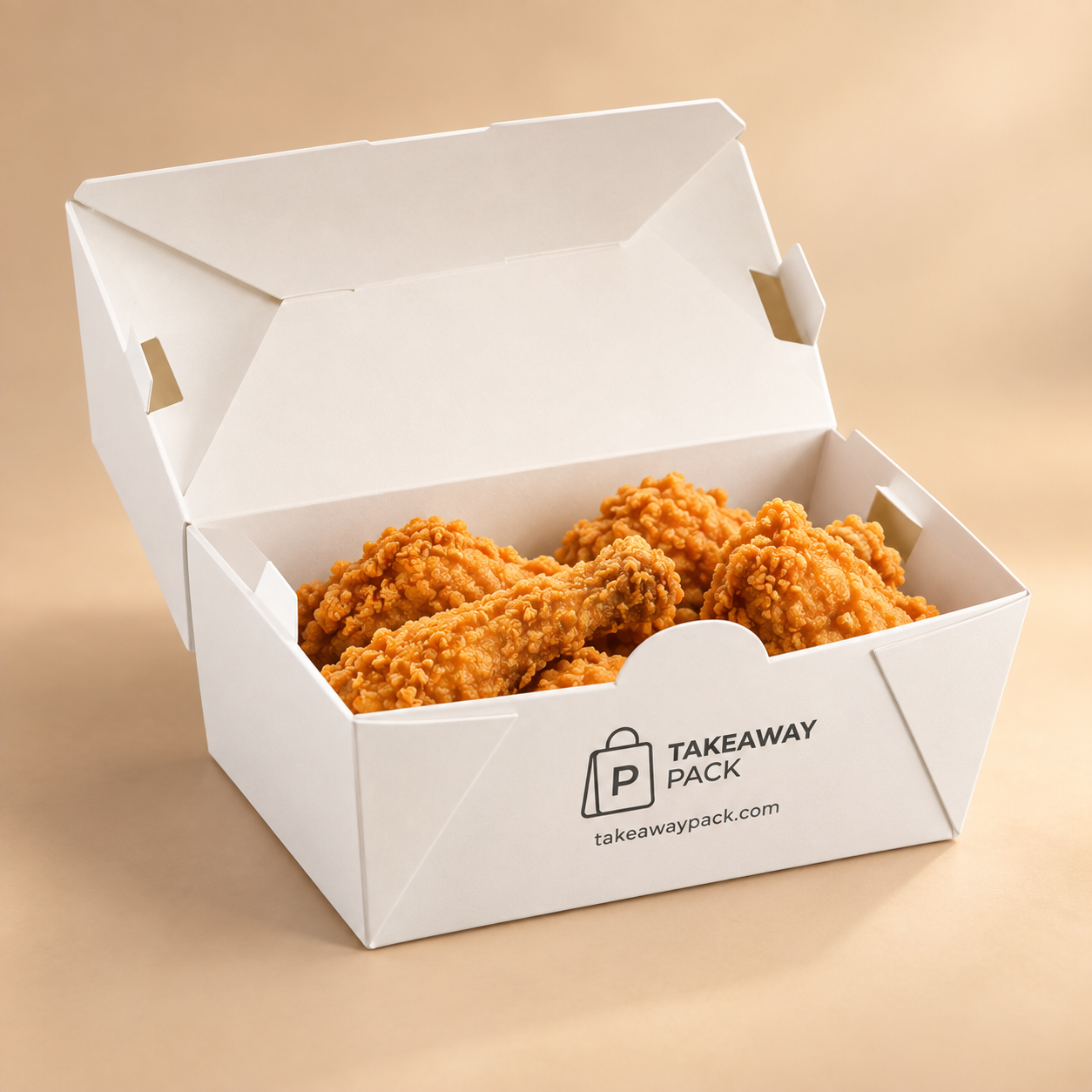
Larger fried portions often need more protection from movement, so a clamshell or box with intentional openings can be worth testing. The closure should keep the portion together during pickup and delivery without turning the pack into a sealed sauce container. A format that works for a few dry fries may not provide enough stability for chicken, sides, and a liner in the same order.
Close a filled sample and place it in the normal delivery bag. Check whether openings stay exposed and whether the food touches the lid when carried.
Sauces, sides, and wet additions
Keep sauces, gravies, and wet toppings away from the crisp item whenever the menu allows. A separate closed sauce cup can protect the fried portion from direct liquid contact and lets the main pack be chosen for texture rather than for liquid containment. It also makes it clearer which component needs a tighter closure and which component needs space for moisture to leave.
For a combo meal, review the whole order. Fries beside a saucy entrée or a sauce cup that tips inside the main pack can limit the benefit of a well-chosen fry format.
Specify the venting details before you order
“Vented” is a starting point, not a complete specification. Ask to see the closure, openings, internal space, and base construction on a filled sample.
Use a filled pack to answer practical questions:
- Are the intended openings still exposed after the lid is closed and the order is placed in its normal bag?
- Is there enough headspace above the fried food for warm moisture to move away from the coating?
- Does the food-contact surface and base appear appropriate for the menu item’s expected grease exposure?
- Will the closure hold the portion securely without creating an airtight chamber?
- Does the selected size leave room for the food without compressing it against the lid or another component?
For oily items, inspect the base as well as the sidewalls. If oil gathers during a service test, review the portion, structure, compatible liner, or the separation of wet and dry components; do not automatically add more openings.
Build the packing routine around the container
A suitable format can still underperform if the packing routine blocks airflow or mixes wet and dry components. Pack fried items in the intended orientation, keep sauces in their assigned container, and do not press the order flat in its delivery bag.
Test the same routine customers receive. Pack a finished order with its usual sides and sauce cups, place it in the normal delivery bag, and review it after the typical hold and route. Note visible condensation, oil transfer, closure security, coating condition, and ease of carrying.
Repeat when the route, portion, bag, menu combination, or packing sequence changes. A result from one configuration is not a performance guarantee for another.
Turn food-and-route details into a usable brief
A useful supplier brief describes the real order rather than only naming a generic box. Include the fried item, portion size, whether sauces travel with it, the expected route and holding conditions, the degree of grease exposure, and any need for printing. State that controlled moisture release and suitable grease management must be checked on the proposed SKU and use case.
Takeawaypack’s foodservice packaging range includes boxes, containers, trays, lids, bags, cups, bowls, and cutlery. Its RFQ process can capture the product category, material, size or capacity, estimated quantity, and print requirements. That gives a buyer a way to share the results of a menu-and-route test and discuss an appropriate structure rather than selecting a container only by appearance. If a change affects the proposed format, bring it back to the sample test before finalising the RFQ.
For a fried-food packaging brief tailored to your menu and route, visit https://takeawaypack.com