How to Use Packaging Bundles to Increase Add-Ons When Marketplace Discounts Lower Average Order Value
When a marketplace promotion raises order volume but reduces profit per order, do not answer with more discounting or more packaging. Build a small set of packaging-led bundles that make a genuinely incremental snack, dessert, or multi-drink order easier to understand, pack, and deliver. Cost the full bundle—including food, packaging, labor, marketplace fees, and waste—then test the few configurations that improve contribution rather than simply moving existing spend into a lower-priced deal. Marketplace promotions can create a misleading win: orders rise while the money left after commission, food, packaging, and promotion costs falls. Delivery should therefore be measured as its own channel P&L, not as an extension of dine-in sales. The practical goal is not “a higher ticket” at any cost. It is a higher-value order with incremental items and a repeatable packing process.
2026-09-01 - 8 min read
**Summary:** When a marketplace promotion raises order volume but reduces profit per order, do not answer with more discounting or more packaging. Build a small set of packaging-led bundles that make a genuinely incremental snack, dessert, or multi-drink order easier to understand, pack, and deliver. Cost the full bundle—including food, packaging, labor, marketplace fees, and waste—then test the few configurations that improve contribution rather than simply moving existing spend into a lower-priced deal.
Marketplace promotions can create a misleading win: orders rise while the money left after commission, food, packaging, and promotion costs falls. Delivery should therefore be measured as its own channel P&L, not as an extension of dine-in sales. The practical goal is not “a higher ticket” at any cost. It is a higher-value order with incremental items and a repeatable packing process.
Start With the Right Bundle Question
Before selecting a cup, box, carrier, or label, define the customer occasion and the extra item that the occasion makes credible:
- **Solo meal:** a main plus a single dessert or snack.
- **Duo lunch:** two mains, two drinks, and one shareable side.
- **Office or group order:** several mains plus a drink grouping and one clearly portioned add-on.
- **Treat occasion:** a meal paired with a dessert that is easy to add at checkout.
This avoids a common failure mode: putting items in a bundle that customers would have bought anyway. A bundle is worthwhile only when the add-on, mix, and price leave more contribution than the likely alternative. Also avoid treating a generic “bundle uplift” percentage as a planning assumption; take-up and incrementality are the variables to test locally.
Use Packaging as the Physical Proof of the Occasion
Packaging should make the bundle easier to recognize and easier to hand off—not create a second product line for every promotion.
1. Build one snack-box upgrade
Use one box format for a defined side or sharing add-on. The menu language can be simple: **“Add a shareable snack box”** rather than a vague “extras” category. Give the bundle a fixed build, a clear component list, and a packing location in the line.
The operational rule is important: do not add a new box until the snack is selected. A main-only order receives the existing main pack; the snack box appears only when the incremental snack is sold. That links packaging consumption to incremental revenue instead of making it a default cost.
2. Make dessert a finished, protected add-on
A dessert cup works best when it has a distinct role in the order: a single-serve finish for a solo meal or a two-unit finish for a duo. Keep the dessert prompt adjacent to the main or at checkout, where the choice is still easy.
Do not claim that a clear lid, premium appearance, or a particular material will raise conversion without your own evidence. Instead, test whether the dessert is more often attached when it is presented as a named completion of the meal and packed as a separate, easy-to-identify component. Delivery menus use modifiers, bundle structures, and menu sequence as substitutes for the in-person upsell environment, so each prompt should have a specific job.
3. Use a carrier only for a true multi-drink order
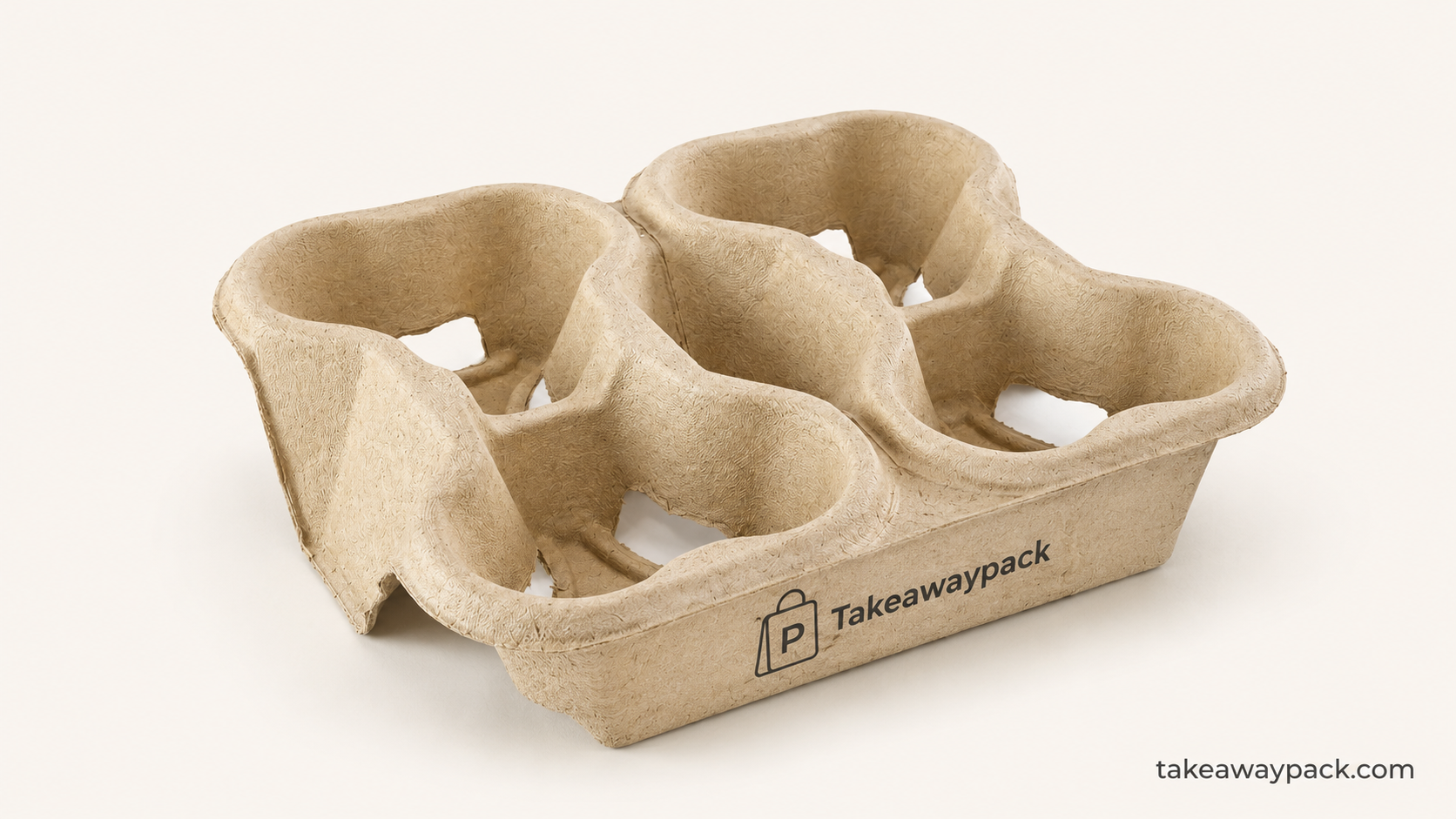
A drink carrier is a group-order tool, not a free upgrade for every beverage. Set a trigger such as a defined multi-drink bundle, then make the carrier part of that named offer. This prevents the carrier from becoming an automatic packaging cost on one-drink orders.
Design the menu and packing SOP together. If drinks have poor travel performance in a particular channel or route, do not use a drink-led bundle merely to lift AOV. Select the add-on that travels reliably for that menu instead. Delivery-specific bundles must account for transport, not just the visual idea of a combo.
4. Let a low-complexity label do the merchandising
A label or sleeve can identify a proven bundle without requiring a unique printed box for every campaign. Use it to show the **bundle name** and the **contents**—for example, “Lunch Duo: 2 mains + 2 drinks + shareable side”—rather than unsupported claims such as “best value” or an unverified savings amount.
The label should support fulfillment too. Add an internal pack check such as “2 drinks / 1 side / 2 mains,” and place it where the packer can see it before bag sealing. This reduces ambiguity without increasing material use.
A Four-Format Bundle System
Start with no more than four formats. The point is to create a system that staff can recognize, buyers can quote, and managers can measure.
| Format | Customer use case | Incremental add-on | Packaging trigger | What to avoid |
|---|---|---|---|---|
| Solo Finish | One main | One dessert | Dessert cup only when selected | Giving away dessert packaging on main-only orders |
| Shareable Side | One or two mains | Fixed snack or side | Snack box only when selected | Multiple custom side-box sizes at launch |
| Lunch Duo | Two mains | Two drinks and/or one side | Carrier only at the defined drink count; a label identifies the build | Using the same carrier for every drink order |
| Group Meal | Several mains | Defined shareable items | Standardized box mix plus a pack-check label | A bespoke pack for every possible menu combination |
A package becomes sales-enabling when it is tied to a fixed, sellable configuration. A package becomes waste when it is added before the customer chooses the configuration or when the kitchen must overpack to cover every possibility.
Cost the Bundle Before It Reaches the Marketplace
Use one worksheet or POS report for each proposed bundle. Include:
- A la carte selling prices and quantities for every included item.
- Current food cost for the actual bundle portions.
- Every packaging component used once per bundle: box, cup, lid, carrier, label, bag, and any insert.
- Incremental labor or handling that only the bundle creates.
- Marketplace commission, promotion funding, and any channel-specific fee.
- The bundle selling price and the difference from buying the same items separately.
- The expected waste or remake cost, if the format adds a known risk.
The basic calculation is straightforward: bundle profit equals bundle selling price minus food cost, packaging, and other bundle-specific costs. That is necessary but not sufficient for marketplace orders; account separately for commission and other channel costs because a combo calculator may not include them. The decision should compare contribution per order and total incremental contribution, not redemption count or sales alone.
Run a Controlled Packaging-and-Menu Test
Do not launch all formats across every marketplace at once. Test one occasion in one channel, location, or daypart against a clear baseline.
**Set a baseline first.** Pull recent data for the same platform, location, and daypart: net sales, order count, AOV, add-on attach rate, bundle share, packaging cost per order, refunds or remakes, and contribution per order. AOV should be segmented by platform and location rather than blended into one portfolio number.
**Run one change at a time.** For example, launch the Lunch Duo with a fixed carrier trigger and a pack-check label. Do not simultaneously change the main price, add five modifier groups, and replace all boxes; the result would not identify the cause of any change.
**Review both customer and operations signals.** Track:
- bundle order share;
- snack, dessert, and multi-drink attach rate;
- net AOV and contribution per order;
- packaging units per order and packaging cost per order;
- packing time, missing-item incidents, and remakes;
- whether customers trade down from a higher-value existing order.
**Keep, revise, or stop.** Keep a configuration only if it delivers acceptable contribution after the real channel costs and the added packing work. Revise a bundle if adoption is weak but operations are sound; stop it if it mainly discounts items that were already being purchased or if it introduces avoidable waste.
Specify Packaging Without Overclaiming
For a buyer-facing packaging brief, state the menu item, intended portion, transport conditions, required components, quantity, print requirement, and destination. Do not assume that a material, certification, food-contact status, or sustainability claim applies to every SKU; those points require confirmation for the specific product, order, and market.
TakeawayPack’s public catalog lists foodservice packaging categories including cups, boxes, containers, trays, lids, bags, and cutlery. Its RFQ process asks buyers to define the product, material, size, quantity, customization, and destination, which is the right starting point for a bundle-specific packaging inquiry.
A practical next step is to choose one tested bundle architecture—such as a snack-box upgrade, dessert finish, or labeled Lunch Duo—and request matching product, material, capacity, print, and packing options at takeawaypack.com.