How to Verify Leak-Resistant Takeout Containers for Soup and Saucy Deliveries
For soup, curry, noodles, and sauce-heavy meals, a takeaway container should be assessed as a complete delivery system: container, lid, food temperature, fill level, handling, and transport. Ask for samples, confirm the intended lid match, and run a simple scenario-based test before committing to a larger order. TakeawayPack can discuss container structure, coatings, capacity, lid matching, and carton packing during an RFQ, helping buyers define the specifications that need to be validated.
2026-08-11 - 5 min read
**Summary:** For soup, curry, noodles, and sauce-heavy meals, a takeaway container should be assessed as a complete delivery system: container, lid, food temperature, fill level, handling, and transport. Ask for samples, confirm the intended lid match, and run a simple scenario-based test before committing to a larger order. TakeawayPack can discuss container structure, coatings, capacity, lid matching, and carton packing during an RFQ, helping buyers define the specifications that need to be validated.
Why “leak-proof” needs a delivery context
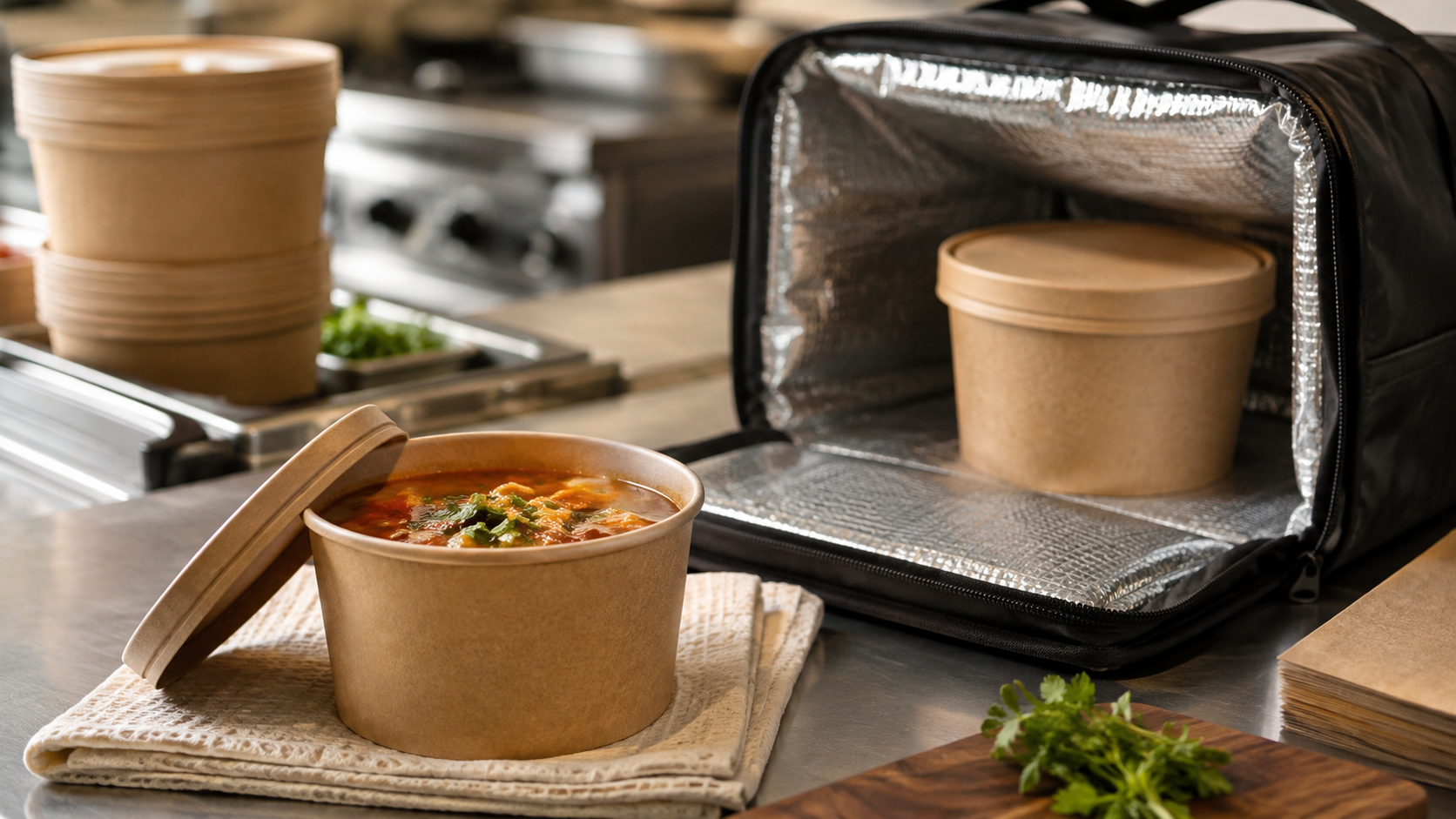
A container that looks secure on a counter can behave differently after it is filled with hot food, carried at an angle, stacked in a bag, or exposed to vibration on a scooter. Soup and saucy dishes create pressure at the lid line, while oil can make outside surfaces slippery. The useful question is not simply whether a container has a lid; it is whether the chosen container-and-lid combination remains suitable for the specific menu item and delivery route.
For cloud kitchens, virtual brands, and delivery-only operators, this distinction matters because the customer experiences the meal only after transport. A spill can affect food presentation, delivery bags, and adjacent orders at the same time.
Start with the food, not the catalog photo
Specify the actual dish before selecting packaging. Record the serving volume, approximate fill level, serving temperature, sauce or broth level, and whether the meal includes a separate cold component. A container with comfortable headspace is often easier to close consistently than one filled to the brim.
Also identify how the order travels. Short, level car trips and longer scooter deliveries create different handling conditions. If the meal will be stacked, tilted, or carried in an insulated bag, include those conditions in the evaluation.
Check the container and lid as one system
A suitable closure depends on compatibility, not appearance alone. Confirm that the lid is intended for the selected container size and rim profile. Check that it seats evenly all the way around and that staff can apply it consistently during busy service.
Before ordering, ask the supplier to clarify the available choices for the container structure, coating, capacity, and lid match. These details create a practical specification that can be reviewed against the menu rather than relying on a generic claim.
Use a simple, repeatable sample test
Samples provide a more useful answer than an unverified marketing promise. Test the exact container-and-lid combination with a representative food or liquid at the expected serving temperature. Use the intended fill level and close it as line staff would.
A basic in-house protocol can include the following checks:
- Inspect the rim and lid after closing for gaps, distortion, or uneven engagement.
- Hold the filled container at several controlled angles over a tray and inspect the lid line and corners.
- Place the closed container in the same bag or carrier used for delivery and simulate normal stacking and movement.
- Check for leakage, lid movement, exterior oil transfer, and any loss of food quality after the test.
- Repeat the test with several samples instead of judging from a single unit.
Document the result with the food type, fill level, test conditions, container specification, lid specification, and observations. This gives purchasing and operations teams a comparable record when evaluating alternatives.
Look beyond leakage alone
A delivery-ready choice should also be reviewed for grease management, temperature needs, and operational fit. A container may remain closed yet still be difficult to grip after oil contact, too large for the delivery bag, or slow for staff to close correctly. Where tamper-evident presentation is needed, review how the chosen closure or secondary sealing method fits into the packing workflow.
The goal is not to assume that one package works for every menu item. Build a small approved list by dish type: brothy foods, thick sauces, dry meals, and sides can each have different requirements.
Turn test findings into an RFQ
A clear request for quotation makes verification easier. Include the product category, material, size or capacity, estimated quantity, printing or logo requirements, destination country or port, and the dish characteristics that must be evaluated. For a soup or sauce application, state the desired lid match and ask for samples before finalizing the order.
TakeawayPack’s online range includes cups, bowls, boxes, containers, trays, lids, bags, and cutlery. During an inquiry, its team can discuss product structure, coatings, capacity, lid matching, printed customization, and carton packing. For custom printing, TakeawayPack prepares a digital proof from the customer’s files and begins production only after written approval.
A practical next step for delivery kitchens
For soup and saucy deliveries, choose packaging through a sample-based, menu-specific check rather than a broad “leak-proof” label. Define the route conditions, test the exact container-and-lid set, and retain the results as an operating standard.
To discuss samples, drawings, lid matching, packaging details, or a custom RFQ for your menu, visit TakeawayPack.