How to Keep Fries and Fried Chicken Crispy During a 30–45 Minute Delivery
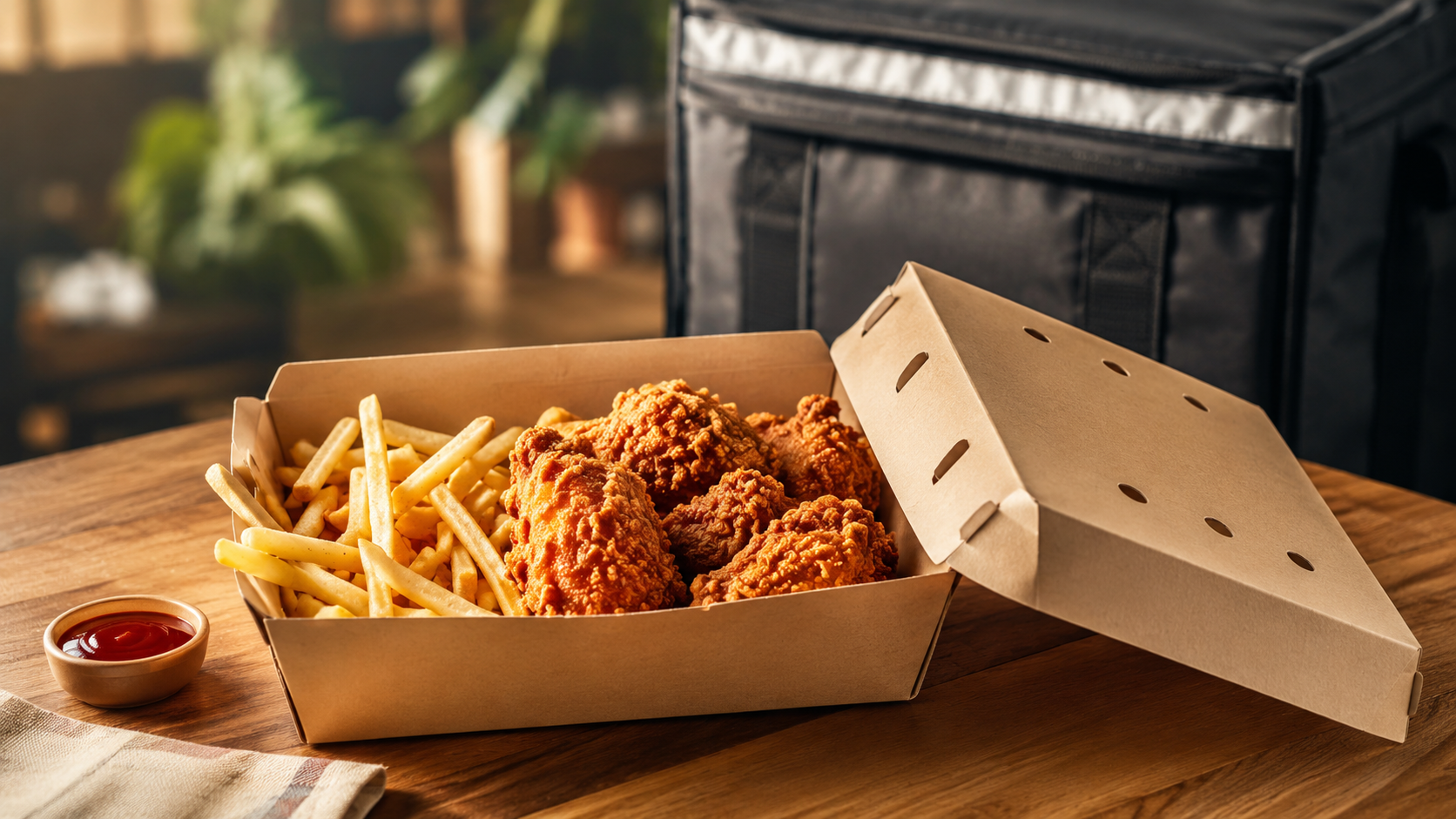
For fries and fried chicken, the best starting point is a rigid takeout box with controlled high-level ventilation, enough headspace to keep food away from the lid, and a closure that stays secure during the ride. The vents must release steam without exposing the food so much that it cools too quickly.
2026-08-11 - 7 min read
Summary
For fries and fried chicken, the best starting point is a rigid takeout box with controlled high-level ventilation, enough headspace to keep food away from the lid, and a closure that stays secure during the ride. The vents must release steam without exposing the food so much that it cools too quickly.
There is no universal box or vent pattern that can guarantee crisp, hot food after 30–45 minutes. Results depend on the food, portion size, drain time, container geometry, vent area, bagging method, weather and delivery route. Choose a small group of candidate box-and-lid systems, then test them with the exact menu item and route.
Why Fried Food Becomes Soggy in Delivery
Freshly fried food continues releasing heat and water vapor after it leaves the fryer. In a tightly sealed container, that vapor condenses on the lid and food surface. A crisp crust then absorbs moisture and softens.
Opening the package completely is not the answer. Excessive airflow speeds heat loss and can expose the food during handling. Delivery packaging therefore has to balance two competing goals: release enough moisture to protect the crust while retaining enough heat for the intended journey.
Fries are especially sensitive because many thin pieces create a large surface area and are commonly packed close together. Fried chicken has a heavier, oilier crust and pieces of different sizes, so trapped moisture and uneven cooling can occur in the same box.
What Kind of Box and Vented Lid Should You Use?
Start With a Rigid, Purpose-Vented Box
Look for a box or clamshell that holds its shape when stacked and carried. A crushed lid reduces headspace, touches the crust and can obstruct vents. The base should also remain stable under the weight and oil load of the portion.
Purpose-designed vents are preferable to random holes added during service. High vents in the lid or upper sidewalls give rising vapor an exit path while reducing the chance that oil reaches an opening. The closed package should still protect the food from direct exposure.
Match the Material to the Food and Route
Vented paperboard or fiber boxes can be useful when the structure remains rigid and the food-contact surface manages grease for the full journey. Their performance depends on the board, any coating, the folds and the closure—not simply on a “paper” label.
Rigid plastic containers can provide strong shape retention and grease resistance, but a non-absorbent interior makes deliberate venting and headspace particularly important. A plastic material name alone does not show that a specific container-and-lid combination will control condensation.
Whatever material you consider, evaluate the finished box, matching lid and actual food together. Do not treat a generic material property as proof of delivery performance.
Use Enough Headspace, but Avoid an Oversized Box
Food should not be compressed against the lid. Contact transfers condensation back to the crust and can damage the coating during movement.
An excessively large box creates its own problems: the portion can slide, collide and lose heat faster. The practical target is a stable single layer where possible, modest headspace above the food and minimal empty floor area.
Separate Foods With Different Moisture Loads
Do not pack fries beneath fried chicken. The chicken’s heat, vapor and oil can move into the fries, while stacking also crushes the fry surface.
For a combination meal, separate compartments or separate containers usually provide more control than one crowded box. Sauces, pickles and other wet components should travel in closed cups away from the fried crust.
How Much Ventilation Is Enough?
More ventilation is not automatically better. Too little traps steam; too much can cool the food before delivery. The useful vent area depends on the amount and temperature of food, the moisture released, the container volume and the expected ride.
A sensible development process compares at least three controlled configurations: a low-vent option, a medium-vent option and a higher-vent option. Keep every other variable the same. This reveals the point at which additional moisture release begins to cause unacceptable heat loss.
Vents also need to remain functional in real use. Check whether a label, tamper feature, delivery bag or stacked container covers them. Inspect the package after tilting and vibration to confirm that openings do not create a grease or contamination route.
Packing Steps That Matter as Much as the Box
Allow excess frying oil and surface steam to escape briefly before packing, using a time defined by the kitchen’s recipe and food-safety procedures. Packing immediately into a sealed box can load the headspace with vapor; waiting too long can sacrifice serving temperature.
Avoid overfilling. A large hot portion releases more vapor and leaves less headspace, so a package that works for one portion may fail for two.
Close the box consistently and keep vents clear. Place wet accompaniments in separate sealed cups. Load the order so the fried-food container stays level, and avoid placing a steaming item directly beneath it inside the delivery bag.
Tamper evidence should secure the order without blocking the ventilation design. The chosen label or band must be tested as part of the complete package, not added after the vent pattern has been approved.
How to Test Packaging for a 30–45 Minute Courier Ride
Reproduce the Actual Order
Test the exact fry cut, chicken pieces, coating, portion weight and cook process. Use food at the real pack-out temperature and follow the normal draining, salting and sauce procedures.
Record the box, lid, vent configuration, closure, tamper feature and outer delivery bag. A test is not repeatable if these details change between runs.
Reproduce the Actual Journey
Hold and move the order for both 30 and 45 minutes. Include realistic stacking, turns, stops, vibration and ambient conditions. Test winter and summer conditions separately if they are relevant to the service area.
Keep the package in the orientation used by riders. Include a tilt check and inspect for grease migration, closure movement, crushing and blocked vents.
Score Heat and Crispness Separately
Temperature and crispness are different outcomes. Record food temperature using the kitchen’s approved method, and use a consistent sensory score for crust crispness, interior texture and condensation.
Open each package at the planned delivery time and photograph the lid, food surface and base. Compare results across repeated runs rather than choosing a design from a single successful order.
Define an Acceptance Standard
Decide in advance what counts as acceptable for temperature, crispness, leakage, grease resistance, package integrity and tamper evidence. Follow applicable food-safety rules and the restaurant’s own holding limits.
If no candidate meets the standard at 45 minutes, change the service promise, portion, recipe, pack-out method or delivery radius. Packaging alone cannot correct every menu and route mismatch.
A Practical Specification for Supplier Discussions
When requesting samples or quotations, provide the food type, portion weight, pack-out temperature, target delivery time, box dimensions, preferred material, vent location, approximate vent area, lid or closure style and tamper-evidence requirement. Also state the destination market and any documents that must be confirmed for the specific product and order.
TakeawayPack’s online catalog includes foodservice packaging categories such as boxes, containers and lids. Its RFQ process can cover structure, coating, capacity, printing, lid matching and carton packaging, while the exact product, material, size and availability remain subject to the relevant SKU and quotation.
Use that discussion to shortlist complete box-and-lid systems, then validate each one with your food and delivery route. To start a packaging inquiry, visit https://takeawaypack.com.