How to Keep Large-Format Drinks and Fruit Teas Stable in Delivery: A Complete Packaging Guide
Adding 1-liter sharing drinks and fresh fruit teas to your menu is a proven way to boost average order value, but it introduces real delivery risks — cups tip, seals burst, and lids pop open under pressure.
2026-09-07 - 12 min read
Summary: Adding 1-liter sharing drinks and fresh fruit teas to your menu is a proven way to boost average order value, but it introduces real delivery risks — cups tip, seals burst, and lids pop open under pressure. This guide breaks down the specific challenges of large-format beverages, explains how to choose the right cups, sealing films, cup carriers, and takeaway bags as a coordinated system, and gives practical sourcing advice for US-based bubble tea shops, juice bars, and cafes scaling up their delivery operations.
Why Large-Format Drinks and Fruit Teas Are Harder to Deliver Than Standard Cups
A standard 16 oz iced coffee is fairly predictable. A 1-liter sharing drink or a freshly shaken fruit tea behaves very differently in transit — and the difference matters the moment a delivery driver hits a curb or a speed bump.
Larger liquid volume means more momentum. A 1-liter cup holds roughly four times the volume of a standard 12 oz drink. When the driver brakes, the liquid surges forward with proportionally more force. That force pushes against the cup wall, the lid, and the seal much harder than a smaller drink would. Even a well-sealed 1-liter cup can deform or bulge under sudden deceleration if the packaging isn't designed for that load.
Fruit teas add complexity. Fruit pieces, tapioca pearls, jelly cubes, and ice move independently inside the liquid, so the cup's center of gravity shifts unpredictably. A cup that feels stable when packed can go top-heavy minutes later as contents settle.
Condensation is a hidden danger. Cold fruit teas make the cup sweat, and a wet cup loses friction against whatever holds it — a carrier slot, a bag wall, another cup. That slipperiness is a leading cause of tipped drinks in the last mile.
Sealing pressure works against you. Many fruit teas are film-sealed rather than lidded. Hot-fill teas generate steam that expands inside the sealed cup, and if the film isn't heat-rated or isn't bonded cleanly to the rim, it bulges, leaks, or bursts in transit.
No single packaging upgrade fixes all of this. It takes a coordinated system: the right cup matched with the right closure, carrier, and outer bag.
What Every Large-Format Drink Delivery Depends On
Before reviewing individual packaging components, it helps to define the properties that matter most when transporting beverages in the 750 ml to 1,000 ml range.
A low center of gravity in the carrier. Cup slots must hold the drink low enough that the carrier stays stable despite the cup's height. Tall carriers with high handles create a lever effect that makes tipping more likely.
Friction between the cup and its holder. Smooth plastic lets cups slide, especially when condensation is present. A textured surface or tight-fit slot is essential for keeping the cup in place.
A closure that withstands internal pressure. Whether you use a domed lid, a flat lid, or a peelable film seal, it must hold liquid inside during jostling and temperature changes. A seal that passes a static leak test in the shop may still fail after 15 minutes of delivery vibration.
Stable seating in the delivery bag. Carriers should fit snugly without tilting. If the bag is too wide, the carrier tips sideways; too tall, and the cups wobble at the top.
Scalability for multi-drink orders. Sharing sizes are frequently ordered in pairs, or as a large plus a standard size. The carrier and bag system must handle mixed-size orders without creating instability.
No single piece can compensate for a weak link in the chain.
Choosing Cups and Lids for 1-Liter Sharing Drinks and Fruit Teas
The cup is the first and most important packaging decision. Not all large-format cups are designed for the demands of delivery.
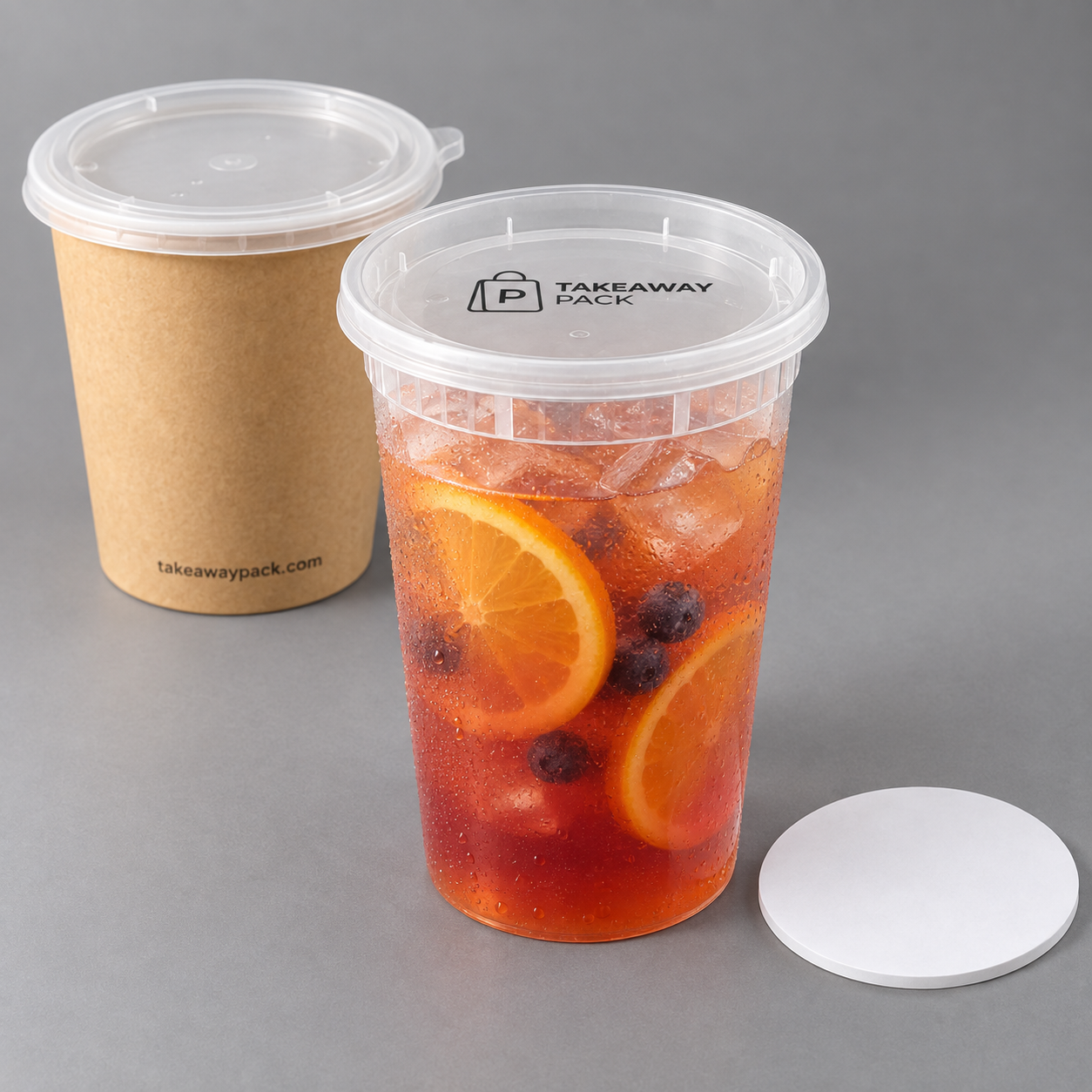
Material choice matters for clarity and strength. For cold fruit teas and iced drinks, clear PET (polyethylene terephthalate) cups are the most popular choice among US bubble tea shops because they are shatter-resistant, crystal clear for visual appeal, and rigid enough to hold their shape when full. PET cups in the 1,000 ml size are widely available and compatible with domed lids and sealing films. For hot teas, polypropylene (PP) cups with lock-on lids may be more appropriate since they handle higher temperatures without warping.
Cup rim design determines seal quality. Sealing film requires a flat, smooth rim with consistent width. If the rim is too narrow or has a rolled edge, the film cannot bond evenly, and leaks will occur. Cups intended for film sealing should have a flat flange profile. If you plan to use a lid instead of film, look for cups with a snap-fit rim that mates securely with the lid's inner ring.
Base diameter affects carrier compatibility. A 1-liter cup typically has a wider base than a standard 12 oz cup. Before ordering carriers, measure the base diameter of the cup you intend to use. The carrier slot must grip the cup firmly at the base — not just at the middle of the body — to prevent tipping.
Domed lids vs. flat lids vs. sealing film. Each closure type has a specific use case for large-format drinks:
- Sealing film is the best option for fruit teas with solid inclusions (fruit, boba, jelly). It creates a leak-proof, airtight seal and lets the drink be shaken without opening. It requires heat-seal equipment, and lighter films may not survive the steam pressure of hot-fill teas.
- Domed lids provide headroom for whipped cream, blended toppings, or oversized fruit slices. They are less secure than film because the lid can pop off under pressure.
- Flat snap-on lids are reliable for pure liquids. They seal tightly and open easily, but will leak if the cup is squeezed or inverted.
Best practice for fruit tea shops: Use a sealing film as the primary closure for all fruit teas with solid ingredients, and add a flat lid or dome lid on top for extra security during delivery. This double-seal approach is common among high-volume bubble tea chains for a reason — it works.
Cup Carriers: The Backbone of Stable Multi-Drink Delivery
For any drink above 500 ml, a plastic bag alone is not enough. The weight and height of the cup make it almost certain to tip. A cup carrier provides the structural support that keeps the cup upright.
Single-cup carriers are underrated. For 1-liter sharing drinks, a single-cup carrier with a deep, snug slot is often a better choice than relying on the bag alone. The carrier adds a rigid base that prevents the cup from tilting when the bag is set down or carried by hand.
Double-cup carriers are the most common delivery format. The majority of drink orders involve two beverages — two 1-liter teas, or one large plus one standard. A double-cup carrier with a low center of gravity and textured grip slots keeps both cups stable. Look for carriers where the cup slots are deep enough to hold at least half the cup's height.
Four-cup carriers cover group orders. Choose one that stays rigid even when slots are partly empty. Individual cell walls prevent cups from contacting each other, reducing the domino effect if one shifts.
Material matters. Molded pulp carriers (recycled paper or bagasse) are the common choice among US delivery-focused beverage brands: natural friction, low profile, and they hold shape when wet from condensation. Rigid plastic carriers work for hot drinks but lack fiber's grip.
Matching carrier size to cup size. A carrier designed for a 12 oz cup will not securely hold a 1-liter cup. If you are adding large-format drinks to your menu, you need carriers specifically sized for the base diameter and height of the new cups. Suppliers like takeawaypack.com offer a range of cup carrier options, including single and double carriers compatible with larger beverage containers, and can advise on the right carrier for your specific cup dimensions. For custom-printed carriers with your branding, minimum order quantities typically start around 500 to 1,000 units.
Sealing Film and Lids — Matching the Closure to the Beverage
The closure is the most failure-prone point in any drink delivery. Getting it right requires matching the closure type to the beverage's temperature, contents, and delivery distance.
Sealing film is ideal for fruit teas and bubble teas. The heat-seal process creates a bond that is stronger than any snap-on lid. The film prevents the cup from leaking even if it is turned sideways or upside down — a common occurrence during delivery. For drinks with fruit chunks or tapioca pearls, the film also prevents the solid contents from escaping into the bag.
Film material and thickness matter. Not all sealing films are created equal. Standard PET film is suitable for cold drinks, while thicker multi-layer films (often PET/PE or PET/AL/PE) are needed for hot-fill beverages that generate steam. The film must also be compatible with the cup material — PET film bonds to PET cups, but may not bond reliably to PP cups. Check material compatibility with your cup supplier before committing to a film type.
Lids suit drinks without solid inclusions. For plain iced teas, lemonades, or cold brew, a flat or domed lid is enough. Look for a tight inner ring that snaps into the rim rather than a friction fit. Spouted lids can be taped shut for delivery — simple and effective.
Tamper-evident features add value. Seals or stickers over the lid or film add a mechanical barrier and reassure customers the drink wasn't opened in transit. A branded sticker across the lid edge does double duty as security and marketing.
The double-closure method. For high-value sharing drinks, consider using both a sealing film and a lid. Seal the cup with film, then snap on a flat lid. The film provides the primary leak protection; the lid prevents the film from bulging or being pierced by other items in the delivery bag. This approach adds minimal cost per unit but dramatically reduces spill rates.
Takeaway Bags and Delivery Bags — The Outer Layer That Holds Everything Together
Even the best cup and carrier combination can fail if the outer bag is not suited to the task.
Paper bags with reinforced bottoms. For single drinks or lightweight orders, a standard paper bag with a flat, reinforced bottom works well. The bag should be wide enough to accept the cup carrier without cramping, but not so wide that the carrier slides around inside. Custom-printed paper bags also serve as a mobile advertisement for your brand.
Kraft paper bags for heavier loads. For two or more large-format drinks, a kraft paper bag with a gusseted bottom and side seams provides the strength needed to handle the combined weight. The bag should have a flat base that supports the cup carrier evenly. Bags that taper toward the bottom force the carrier to tilt, which defeats the purpose of using a carrier in the first place.
Insulated driver bags are the final layer. The interior must be tall enough to clear the lids without compressing them and wide enough to hold the carrier flat. A bag that's too small forces the carrier to fold or the cups to lean — a direct cause of spills.
Sizing the bag to the carrier. Measure the carrier's footprint and add at least an inch of clearance per side so it sits flat without being forced in. For double-cup carriers holding 1-liter cups, roughly 10 inches wide by 8 deep by 10 tall is a common starting point.
Handles carry real weight. Twisted paper or flat ribbon handles are standard. For heavier loads, double-ply handles or die-cut handle holes distribute weight better. Avoid handles attached only to a single top ply — they tear under two 1-liter drinks.
A Practical Sourcing Strategy for Shops Adding Large-Format Drinks
If you are preparing to introduce 1-liter sharing drinks and fresh fruit teas to your delivery menu, the following sourcing sequence will help you avoid common mismatches.
Step 1: Finalize your cup dimensions first. Choose the cup — size, material, rim profile, and base diameter — before ordering anything else. Everything else (film, lid, carrier, bag) depends on the cup's measurements. Order samples of at least two cup options and test them with your sealing equipment and your chosen carrier.
Step 2: Match the closure to the cup. If you are using sealing film, confirm that the cup rim is compatible with your film sealer and that the film material is rated for the beverage temperature. Order a roll of film at the same time as the cups so you can test the seal quality immediately.
Step 3: Source carriers based on the cup's base diameter. Measure the cup's base at its widest point. The carrier slot should be slightly smaller than that measurement so the cup is held firmly by friction. Carriers that are too loose allow the cup to wobble; carriers that are too tight may not fit at all.
Step 4: Choose the takeaway bag to fit the carrier footprint. Once you know the carrier's dimensions, select a bag that can accommodate the carrier flat. Order a small quantity first to test the fit with a fully loaded carrier.
Step 5: Test the full system under real conditions. Fill a 1-liter cup with water and ice, seal it, load it into the carrier and bag, then simulate a delivery — brisk walking, stairs, sudden stops, then the same by car or bicycle. Weak points show up within the first few runs.
Step 6: Order in bulk with consistent specifications. Once you have validated the system, place your production orders for all components at once. Sourcing cups from one supplier, film from another, and carriers from a third can lead to dimensional inconsistencies. Suppliers like takeawaypack.com offer multiple packaging categories under one roof, making it easier to maintain consistency across cups, carriers, lids, and bags. Custom printing on cups, carriers, and bags with your logo can be done with minimum runs as low as 500 to 1,000 units.
Conclusion — A Coordinated Packaging System Is the Key to Spill-Free Delivery
Adding 1-liter sharing drinks and fresh fruit teas to your delivery menu is a smart business move. These items command higher prices, encourage group orders, and differentiate your brand. But they also demand a higher standard of packaging.
The failures that hurt most — cups tipping, seals bursting, lids popping — are rarely one component's fault. They come from mismatched parts that were never designed to work together. A carrier sized for a 12 oz cup will not hold a 1-liter drink. A film rated for cold tea fails under hot-fill steam. A narrow bag forces the carrier to fold, and a folded carrier protects nothing.
Design the packaging system around the drink, not the other way around. Start with the cup, match the closure to the liquid and temperature, choose a carrier that grips the base, and finish with a bag that supports the whole assembly. Test it as a unit before you scale.
Ready to upgrade your drink delivery packaging? Takeawaypack.com offers a full range of cups, sealing films, cup carriers, and custom-print paper bags designed for US-based beverage businesses — from bubble tea shops to juice bars to coffee roasters. Contact their team at takeawaypack.com/contact to discuss your specific drink sizes and get matched with the right packaging system for your menu.