Late-Night Takeout Packaging: How to Cut Complaints from Dark Lobbies, Transport Vibration, and Long Courier Waits
After 10 p.m., the packaging problem changes shape. Courier waits get longer and less predictable, the trip involves more bumping and tilting, and the handoff often happens in a dim lobby where nobody can read a small label.
2026-09-03 - 10 min read
Summary: After 10 p.m., the packaging problem changes shape. Courier waits get longer and less predictable, the trip involves more bumping and tilting, and the handoff often happens in a dim lobby where nobody can read a small label. Most late-night complaints — cold food, leaks, wrong bag, missing sauce — trace back to four packaging decisions: how the lid locks, how the seal shows tampering, how the bag carries weight, and how the order identifies itself without being opened. This article works through each of those decisions as a purchasing question: what to specify, which container formats actually solve which failure, and how to keep your SKU list from exploding while you do it. It also covers the two hard constraints you cannot design around — food-safety holding temperature and, in California, a legal tamper-evident sealing requirement.
Why late-night orders fail differently
Daytime delivery has a short, fairly predictable gap between the kitchen and the customer. Late-night delivery does not. Fewer couriers are working, so an order sits staged longer after it is packed. Delivery radii widen. And the last few meters — the part you never see — usually happen in a stairwell or an unlit apartment lobby, with the customer or courier holding a phone in one hand.
That produces a specific complaint mix:
- Cold or soggy food, because the order sat for 20 minutes before pickup and then rode 25 more.
- Leaks, because a snap-on lid that holds on a flat counter pops or seeps when a scooter hits a curb.
- Wrong order collected downstairs, because two bags looked identical under a dim lobby light.
- "Missing item" claims, because nobody could verify contents without breaking the seal.
Each of those is fixable at the specification level. None of them is fixable by writing a better apology.
The hard constraint: holding temperature and time
Before packaging choices, know the boundary you are working inside. The USDA's Food Safety and Inspection Service defines the "Danger Zone" as 40 °F to 140 °F, the range where bacteria multiply fastest — doubling in as little as 20 minutes. FSIS guidance is to keep hot food at or above 140 °F, to never leave food out of refrigeration more than two hours, and to reheat to an internal 165 °F.
The practical reading for a late-night operation: the clock that matters starts when the food leaves the heat source, not when the courier arrives. Packaging cannot add heat. It can only slow the loss and control the moisture that ruins texture. If your staging window is regularly long, the fix is partly operational — mark the order ready only when it is genuinely sealed and staged — and partly structural, which is what the rest of this article covers.
Sealing: lid lock first, tamper evidence second
These are two different jobs and buyers often conflate them.
Lid lock is a leak problem
A lid that locks with consistent rim contact is what survives vibration. Snap-on lids with a properly matched rim are fine for dry and semi-dry items; for anything saucy, soupy, or gravy-based, you want a container designed as a closed system rather than a tray with a cover placed on top.
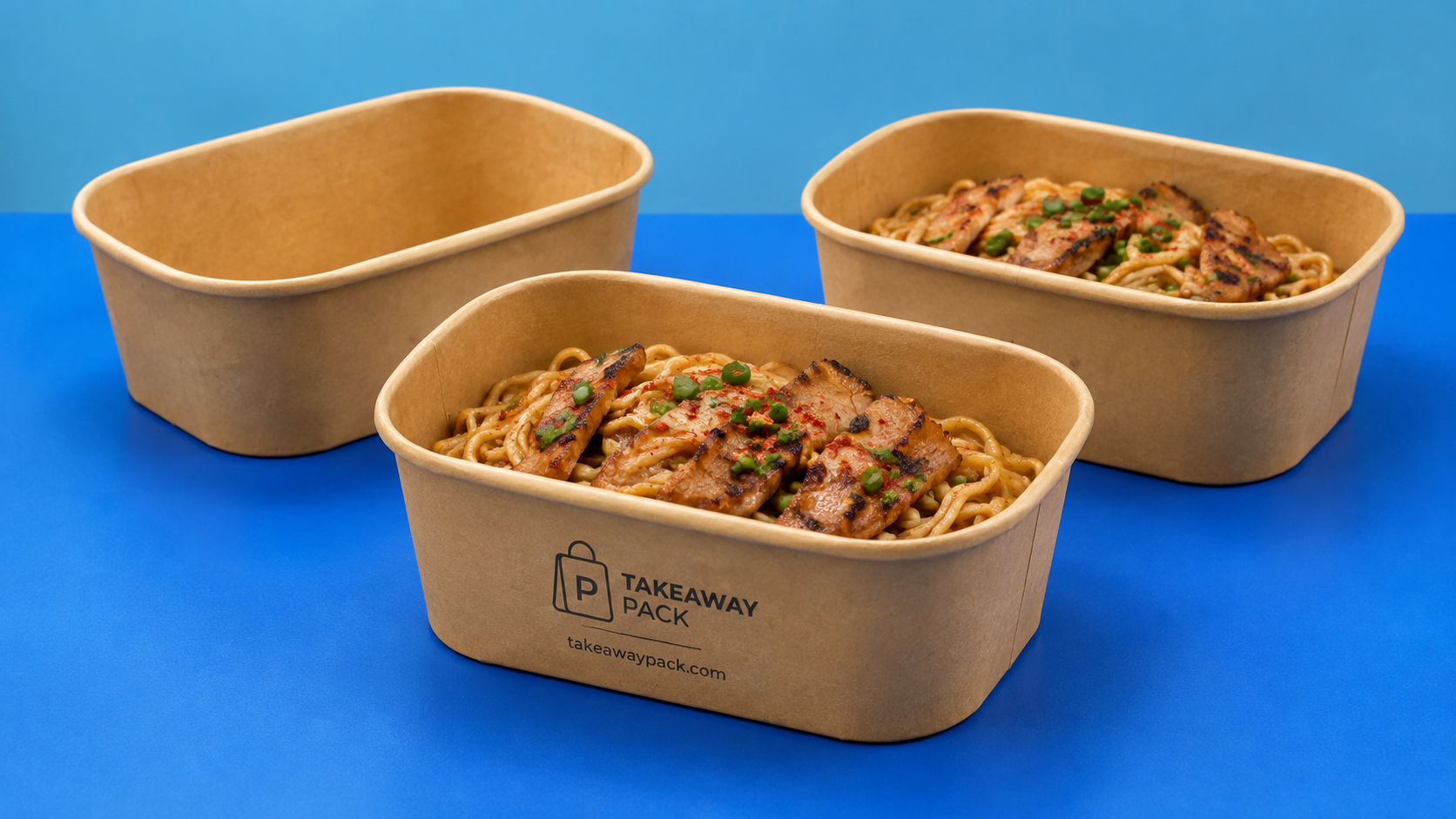
Two formats in the Takeawaypack catalog map directly onto this split. Round polypropylene tamper-evident containers run from 250 ml through 3500 ml, so a single structural design covers everything from a dipping portion to a family-size curry. Square tamper-evident formats sit at 1000 ml (222 × 147 × 56 mm) and 1350 ml (223 × 147 × 70 mm) for flat-packed rice, noodle, and mixed-plate orders that should not tumble. For soups and congee specifically, polypropylene soup tubs from 8 oz to 32 oz use a snap-on lid and a tapering base that nests, which matters when your late-night volume is concentrated in a 90-minute burst.
Tamper evidence is a trust and, sometimes, a legal problem
In California, sealing is not a nice-to-have. Assembly Bill 3336, chaptered in September 2020, amended Health and Safety Code section 113982 to require that all bags or containers of ready-to-eat food handed to a third-party delivery platform be closed by the food facility with a tamper-evident method before the deliverer takes possession. The statute does not prescribe a specific product, and it puts the obligation on the food facility, not the platform. Charitable feeding and food-bank donations are exempted from the bag requirement.
Outside California, no identical statewide statute is in force, but the operational logic is the same everywhere: a seal that visibly breaks is the only thing that ends a "my order was opened" dispute. Containers with tamper features built into the structure remove a manual step from your packing line — no sticker to place crookedly, nothing for a rushed closer to skip at 1 a.m.
Vent where crispness matters more than heat
The counter-intuitive part: a perfectly airtight container is the wrong choice for fried food. Trapped steam condenses on the lid and drips back onto the crust. For fries, fried chicken, tempura, and anything battered, a vented lid releases steam while the walls still slow the temperature drop. Vented-lid white cardboard lunch boxes are available at 1400 ml (175 × 140 mm top) and 3000 ml (225 × 165 mm top), built from 300 gsm food-grade white cardboard with a PE lamination.
The rule of thumb worth writing into your packing standard: seal tight for liquid, vent for crisp, and never put the two in the same container.
Handles and bag structure: designing for a one-handed carry in the dark
A courier at midnight is holding a phone, a door, and your order. A customer collecting downstairs is doing roughly the same. Thin loop handles fail under that load — either they tear or they dig in and the carrier tilts the bag to relieve the pressure, which is how sauce ends up on a lid.
Three things to specify:
Carry integrated into the container, not only into the bag. Paperboard noodle boxes with a folded carry handle come in 240 ml, 480 ml, 760 ml, 960 ml, and 1850 ml formats in 300 gsm food-grade paperboard, and they ship fold-flat, which saves storage space you probably do not have behind the line. A container that can be carried on its own is a container that does not have to be re-bagged for a single-item order.
Bags sized to the order, not to the maximum order. An oversized bag lets containers slide, and sliding is what breaks seals. Handled polyethylene carrier bags for beverages are made in a single-cup format (H 28 cm × W 16 cm, 20 cm handle section, 4.5 cm bottom gusset) and a double-cup format (H 28.5 cm × W 31 cm, 20.5 cm handle), where the gusset is what keeps cups upright rather than leaning.
Weight distribution as a written rule. Heavy and hot at the bottom, drinks separated, fragile above. This costs nothing and prevents a large share of vibration complaints. Molded pulp four-cup carriers, in both separable and non-separable versions, exist precisely so drinks stop being the thing that tips over.
Identification: make the order readable at arm's length in bad light
The lobby handoff is a matching problem, and matching under low light needs contrast and size, not more information.
- Put the order number on the outer bag, large enough to read from a few feet away, and on the top-facing surface — bags sit on floors and counters, and labels on the side become invisible.
- Add the customer's first name or initials as a second check.
- Use a clear lid where the menu allows it. Being able to see the contents without breaking a seal resolves most "missing item" disputes before they start. Square polypropylene containers with a crystal-clear snap-on lid, including a 48 oz format (top 21.5 × 21.5 cm, base 16 × 16 cm), are worth reserving for multi-item orders where verification matters most.
- Colour-code by category rather than writing more text. Tamper-evident square containers are available in multiple base-and-lid colour pairings — black with silver, white with red, green, purple, silver, white with gold — which lets you build a visual system (spicy, vegetarian, drinks) with zero extra labelling steps.
- Keep sauces in hinged sauce cups with an attached lid, from 1 oz to 5 oz, so the lid cannot get separated from the cup in a bag. A separated sauce lid is a leak and a complaint at the same time.
Keeping the SKU count under control
The obvious objection to all of the above is that it multiplies your inventory. Two levers keep that in check.
Universal lids. One lid reference that fits 380 ml, 500 ml, and 650 ml round containers, another covering 900 ml through 1750 ml, and another covering 2000 ml through 3500 ml, means you stock three lid lines instead of ten. Fewer lid lines also means fewer wrong-lid errors during a rush, which is a leak cause in its own right.
Insert trays instead of new containers. A clear insert tray for a 500 ml round tamper-evident container turns one container into a two-compartment container. You separate a sauce or a side without adding a second sealed unit to the bag.
For hot beverages, double-wall paper cups in 8 oz, 10 oz, 12 oz, 16 oz, and 22 oz use an air-gap construction for thermal insulation, and kraft paper soup tubs are available in 8 oz and 12 oz with both 90 mm and 97 mm rim diameters — the rim dimension is the number to check, because it determines lid compatibility across your range.
What to test before you commit to a spec
Do not switch a whole menu at once. Run a two-week test on your highest-volume late-night items:
- Measure the staging gap. How long does a packed order actually wait for a courier after 10 p.m.? That number drives every insulation decision.
- Measure internal temperature at 15, 30, and 45 minutes in the packaging you are considering, at realistic night-time ambient temperature.
- Run a vibration check. Pack a typical order, carry it down stairs, and put it in a vehicle for the length of your average route. Look for seepage at the rim.
- Count the complaint categories separately. "Cold," "leaked," "wrong bag," and "missing item" have different fixes. Aggregated complaint counts hide which change worked.
Then adjust by menu category rather than searching for one container that does everything. A packaging kit per order type beats a universal container every time.
Sourcing this without over-committing
Late-night packaging changes tend to stall at the purchasing stage, because a menu-by-menu approach means several formats at once, and most suppliers price that as several separate orders.
Takeawaypack works as a foodservice packaging supply chain partner rather than a single-line manufacturer — an own printing facility plus multiple partner factories, serving buyers across North America, Europe, Australia, and the Middle East. The catalogue spans cups, bowls, boxes, containers, trays, lids, bags, and cutlery, which is what makes a mixed late-night specification practical: the tamper-evident containers, vented-lid boxes, handled noodle boxes, soup tubs, sauce cups, and carrier bags discussed above can be quoted together rather than chased across five vendors.
A few things worth knowing before you send a request:
- MOQ is flexible rather than fixed. Standard catalogue items commonly start around a thousand units; bags carry a higher minimum because of how they are produced. The applicable minimum is confirmed per product in the quote, not assumed.
- Custom printing runs on a buyer-approved proof. A digital proof is produced from your artwork, and production starts only after you confirm it in writing. If you are printing order-number panels or colour-coded category blocks, this is the step where you check that the contrast actually works.
- Food-contact documentation is confirmed per SKU, order, and destination market. Specify your destination market early, because the applicable document set depends on it.
- Rim diameter and lid compatibility are the specs to pin down first. Most late-night leak complaints originate in a mismatch there, not in the container body.
If you are rebuilding a late-night packing standard and want the container, lid, and bag formats matched to your actual menu categories and destination market, the current catalogue and request process are at takeawaypack.com — bring your item list, your typical staging gap, and your target capacities, and the specification conversation gets a lot shorter.