How to Launch a Bring-Your-Own-Cup Program at Your Coffee Shop: What Starbucks' Nationwide Rollout Teaches Small Operators
Customers increasingly expect to fill their own reusable cups — at the counter, through mobile ordering, and at the drive-thru. When Starbucks became the first national coffee retailer to accept personal cups across all order channels in January 2024, it put years of testing behind a simple set of r…
2026-09-07 - 13 min read
Summary: Customers increasingly expect to fill their own reusable cups — at the counter, through mobile ordering, and at the drive-thru. When Starbucks became the first national coffee retailer to accept personal cups across all order channels in January 2024, it put years of testing behind a simple set of rules: accept any clean cup, build drinks against standardized measures, hand the cup back in a contactless vessel, and never rinse customer cups in the shop's sinks. This article turns the Starbucks playbook into a practical blueprint for small and mid-sized coffee shops, covering cup compatibility, hygiene-safe handoffs, mobile-order workflows, team training, incentives, and how to pilot the program before committing. It also covers the one thing the reusable trend doesn't change: your shop still needs reliable disposable packaging for to-go orders and walk-ins without cups — which is where a supplier like takeawaypack.com comes in.
Why Bring-Your-Own-Cup Programs Are Moving from Niche to Normal
For decades, bringing your own cup to a coffee shop was something only the most committed regulars did. That has changed quickly. A growing share of coffee drinkers now expect the option, and the biggest brands have made reusable cups a first-class ordering choice rather than a special request.
The clearest proof came in January 2024, when Starbucks announced that customers at all company-operated stores and participating licensed locations across the U.S. and Canada could use their own clean personal cup for every visit — in café, at the drive-thru, and through the Starbucks app. That made Starbucks the first national coffeehouse in the U.S. to accept personal cups for mobile orders, and the first in Canada to accept them for mobile orders across every drink and every size. The company framed it as part of a commitment to cut waste 50 percent by 2030: the most sustainable cup is the one customers already own.
Why does this matter to an independent shop or a small regional chain? Because customer behavior is shaped by the experiences people have elsewhere. When a national chain normalizes "just bring your cup," your regulars start asking why you don't do the same. You don't need Starbucks' scale to meet that expectation — you only need a clear, safe, repeatable procedure.
What Cup Types Are Compatible: Keep the Rules Simple
The first decision a shop owner faces is which cups to accept. Starbucks' answer is deliberately broad: any clean, personal cup. No approved-brands list, no gatekeeping by cup maker. The message was even framed as "now every cup can be a Starbucks cup."
That simplicity is the point. A long list of restrictions creates friction at the register, confuses customers, and forces baristas into judgment calls during peak hours. Instead of defining acceptable cups, define the conditions:
- The cup must be clean. Starbucks states this plainly and backs it with policy: baristas will not rinse customer cups, and dirty cups are not accepted. Requiring a clean cup is a hygiene rule, not a customer service policy.
- The lid comes off at handoff. In both the drive-thru and mobile-order workflows, customers hand over the cup without the lid. This lets baristas see the cup's condition and fill it without wrestling with a lid they can't easily sanitize.
- Any size and format works if you can build to it. Starbucks accepts all standard sizes and beverage formats — hot, iced, and blended. The mechanism that makes this possible is standardization on the shop's side, not the customer's side (more on that below).
For a small shop, the pragmatic version of this rule is: accept any clean, liddable cup up to a practical maximum size you're comfortable building. The goal is welcoming the 90 percent of cups that are standard tumblers, thermoses, and travel mugs. One extra planning note: iced and blended drinks in personal cups create condensation and spills that hot drinks don't, so give your handoff counter a dry spot and towel.
The Hygiene Question: Contactless Handoff Without Cross-Contamination
The single biggest operational concern for any operator considering a BYOC program is food safety. Starbucks' solution rests on a few explicit guardrails that translate directly to a small shop.
Never rinse customer cups in your sinks. Starbucks was unambiguous: baristas cannot rinse personal cups in Starbucks equipment sinks, and no dirty cups will be accepted. This is critical for your own health-code compliance — your three-compartment sink and hand-washing station are for your operation, not for washing customer property. If a cup arrives visibly dirty, decline politely and offer a shop-provided cup instead.
Use a contactless vessel for the handoff. In the drive-thru, Starbucks baristas collect the customer's personal cup without the lid using a contactless vessel — a transfer container that keeps the barista's hands and the customer's cup from touching — and return the finished beverage the same way. For a smaller operation, the equivalent is a dedicated food-grade vessel reserved for personal cups, used only for that purpose and cleaned on a schedule.
Keep the handoff visible and one-directional. The cleanest workflow is a single designated spot where the cup is received, filled, and returned, so a customer cup never travels unmonitored through your prep zone. Baristas should treat a personal cup like any customer-contact surface: clean hands, no rim contact.
These four guardrails — no rinsing, contactless transfer, clean hands, and a dedicated handoff spot — are the entire hygiene story. They're cheap to implement and easy to train, which is exactly why Starbucks could roll them out across thousands of stores in a day.
Standardizing the Build: How Baristas Get the Right Size Every Time
Here is the operational trick that makes BYOC workable: the barista doesn't measure the customer's cup. Starbucks' baristas build the beverage using standardized craft smallware with measurement lines for each size, then pour the finished drink into the customer's personal cup and add toppings.
Steal this idea outright. It solves the two problems that otherwise sink personal-cup programs:
- Accuracy. Customers order by size ("grande latte," "medium iced coffee"), but their personal cup has no markings — every drink would be a guessing game.
- Speed. Measuring in the customer's cup is slow and awkward; building against a marked vessel you already know is fast.
The small-shop version is a set of marked mixing cups or pitcher-style vessels — one per size you sell — that baristas fill to the line, then pour into the personal cup. If you serve 12-, 16-, and 20-ounce drinks, you need three marked vessels per station, not an inventory of mystery volumes. As a bonus, standardized build vessels become a quality-control point: baristas learn exactly what a correct 16-ounce latte looks like before it reaches a customer's cup, which improves consistency across all orders.
The Three Order Channels: Counter, Drive-Thru, and Mobile
Starbucks structured its rollout around three distinct handoff workflows. Your shop may only have one or two of these channels, but mapping each one explicitly is worth it.
In café (counter service). The customer tells the barista at the point of order that they brought their own cup and hands it over. The barista builds the drink, pours it into the personal cup, and hands it back. The whole transaction happens in one place, which makes this the easiest channel to launch. If you offer dine-in service, you can also offer a reusable ceramic or glass cup for customers who sit and stay.
At the drive-thru. This is the channel that generated the most skepticism, and the one Starbucks tested most rigorously before scaling. The workflow: the customer orders normally, tells the barista they brought their own cup, and at the pickup window hands over the cup without the lid, using the contactless vessel. The barista builds the drink and returns it the same way.
The lesson for shops with a drive-thru is that this channel needs a tested script, not an improvisation. Decide exactly when the cup changes hands (at the window, through the exchange vessel, lid off), who receives it, and where it sits while the drink is built. If your window has no natural spot for a transfer vessel, add a small shelf or tray before launch — that's the whole solution.
Mobile orders (app or online). This is the channel Starbucks pioneered among national coffeehouses, and the one with the most process risk for a small operator. The flow: the customer selects "Personal Cup" in the customization options when ordering, then on arrival connects with the barista at the pickup area and hands over the clean cup without the lid. The barista builds to the order, pours, and returns the drink in the contactless vessel.
For an independent shop using a mobile-order platform, the practical equivalent is a checkbox or note field that flags personal-cup orders. The key question is where the handoff happens: a designated pickup spot with a barista present beats a shelf where a cup could sit unclaimed. Set the expectation in the app that the customer must hand the cup to a barista.
Incentives: What Gets Customers to Actually Participate
A BYOC program that nobody uses is just extra process. Starbucks paired its rollout with two incentives: a $0.10 discount on the beverage for every customer, and 25 Bonus Stars for U.S. Starbucks Rewards members (capped at three redemptions per day).
The ten-cent discount is small enough to be sustainable and big enough to be a visible gesture. If you have a loyalty program, a points bonus is even more effective — it costs you nothing marginal and pulls the customer back for another visit. If you don't, a discount is your simplest lever: a dime off every personal-cup order is a rounding error on most beverage margins and a strong signal to eco-minded regulars.
Two design notes from the rollout: cap the benefit so it can't become an abuse vector (three times a day is the Starbucks cap); and promote it at the point of order, not just on a sign — the barista asking "bringing your own cup today?" is your highest-converting prompt.
Pilot First, Then Scale: The Test-and-Learn Approach
The most important structural lesson from the Starbucks rollout is that it did not happen all at once. Before going national, Starbucks ran a personal-cup test at 200 drive-thru stores across Colorado, informed by pilots at its Tryer Innovation Lab and locations across the U.S., with store partners helping co-design the craft smallware that made the system work. One partner who worked at a Colorado pilot store put it this way: as long as the team follows the procedures, the program doesn't add time — and customers are happier.
That quote is the whole business case in miniature: a well-run BYOC program is not slower, and it builds goodwill. But the only way to find the rough edges is to run it on a small scale first. A small, measurable pilot:
- Pick one store (or one shift at your single location) and one channel — counter service is the easiest starting point.
- Run it for two to four weeks, long enough to see regulars repeat the behavior.
- Measure what matters: average order time before and after, the share of orders using personal cups, and drink-quality complaints.
- Let your baristas co-design the workflow. Frontline staff find the problems management never anticipates — the awkward counter height, the missing spot for the transfer vessel, the rush-hour bottleneck.
Only after the pilot is smooth should you expand to the drive-thru and mobile channels, then to the rest of your locations. Scaling a broken process just multiplies the breakage.
The Packaging Reality: Reusables Reduce, They Don't Eliminate
Here is the part operators sometimes miss. A successful BYOC program reduces your disposable cup usage — it does not eliminate your need for disposable packaging. The same customers who bring their tumbler on Tuesday will grab a to-go cup on Wednesday when they're in a hurry, order delivery on Thursday, or send a colleague to pick up five drinks that can't travel in personal cups. Walk-ins without cups need service, and drinks still need lids, sleeves, and carriers to arrive intact.
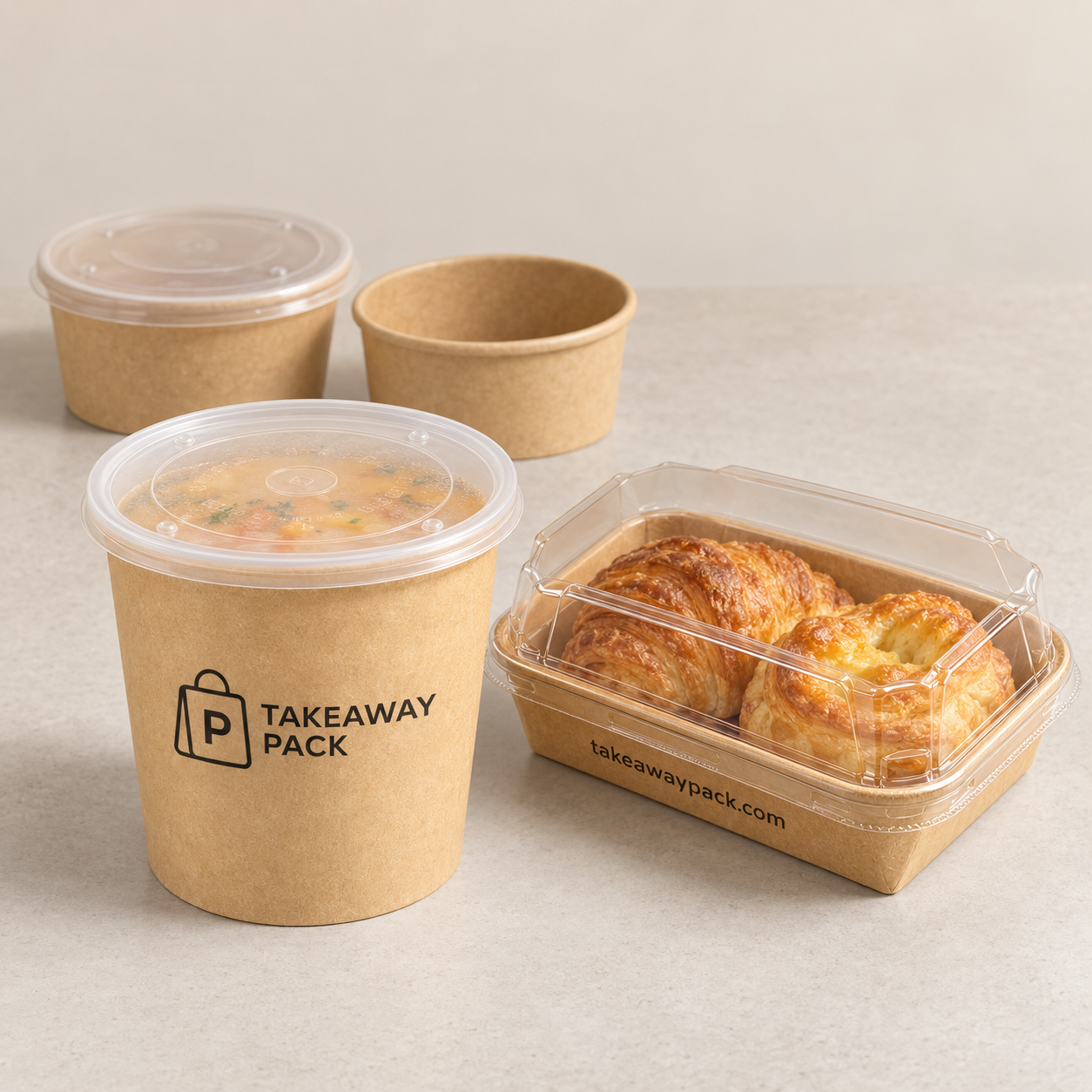
This is where a packaging partner like takeawaypack.com earns its keep. Takeawaypack is a U.S.-based custom disposable food packaging supplier serving restaurants, coffee shops, food trucks, ghost kitchens, bakeries, and caterers across the country, with custom printing available at minimum order quantities as low as 500 to 1,000 units. For a cafe, that means hot cups and lids with your logo, single and double cup carriers for iced orders, kraft soup tubs with PP lids for seasonal soups, compartment trays for breakfast bowls, tamper-evident containers for grab-and-go items, window boxes for pastries, cake boxes, pizza boxes if you run a lunch program, and custom-print paper bags — all printed consistently with your identity. A catalog of more than 950 packaging SKUs means one supplier can cover nearly everything your shop puts food or drink in.
The strategic point: run the BYOC program as your sustainability story, and run the custom-print disposables as your brand story. They serve different customers at different moments, and both need to work well.
Frequently Asked Questions
Do we have to accept every cup a customer brings?
No. You can set a reasonable maximum size and decline visibly dirty cups — Starbucks sets the same precedent with its clean-cup and no-rinsing policy. What you shouldn't do is gate-keep by brand.
Can we rinse a customer's cup?
No. Rinsing customer cups in your sinks creates a food-safety and health-code exposure. Accept only clean cups and offer a disposable alternative when one isn't.
How do we know we're filling the right size?
Build every drink against your own marked vessels (the "smallware" approach), then pour into the personal cup. Never guess from the customer's cup.
Do reusable programs cost us money?
The incremental cost is a small discount (Starbucks uses $0.10) and a few marked vessels. Measured properly, the program typically runs neutral on time and builds loyalty — Starbucks' 200-store Colorado test showed no added time when procedures were followed.
Which channel should we launch first?
Counter service. It's the simplest handoff, it's where your regulars are, and it builds the habit before you tackle drive-thru and mobile complexity.
What if we're a drive-thru-only operation?
The Starbucks model applies directly: order normally, tell the barista, hand the cup over lid-off via a contactless vessel at the window. Add a dedicated transfer vessel before launch and train the exact script.
Start Small, Start Clean, Start Now
The reusable cup trend is not a fad — it's a customer expectation that the largest coffee retailer in the country has now normalized across every ordering channel. The good news for smaller operators is that the playbook is public, proven, and cheap to copy: accept any clean cup, build against standardized measures, hand off contactlessly, never rinse customer cups, incentivize participation, and pilot before you scale. Run it well and you'll gain exactly what the Starbucks pilot stores reported — happier customers, no lost time, and a reputation for being ahead of the curve.
And when your customers do take a to-go cup, or order delivery, or send someone for five drinks at once, make sure the disposable side of your shop is as polished as the reusable side. A single U.S.-based supplier with low-minimum custom printing — like takeawaypack.com — can put your logo on cups, carriers, boxes, and bags so every order carries your brand. Ready to design your cafe's packaging lineup? Reach the team at takeawaypack.com/contact or info@takeawaypack.com, or call +1 636-298-3606.