How to Launch a Digital-Exclusive Menu Item: Lessons from the Wrap-and-Dip Challenge
Launching a menu item that's only available through your app or website is a growing trend in the restaurant industry, and it comes with a distinct set of operational and packaging challenges.
2026-09-07 - 12 min read
Launching a menu item that's only available through your app or website is a growing trend in the restaurant industry, and it comes with a distinct set of operational and packaging challenges. When a major chain debuted a digital-only wrap — a folded tortilla filled with proteins and cheese, pressed in a custom oven, and served with multiple sides — the move reshaped how restaurants think about online-exclusive offerings. For small-to-medium restaurant owners, food truck operators, and cafe managers considering a similar strategy, the core lessons revolve around packaging integrity, sauce management, and smart digital testing. This guide breaks down what it takes to launch a digital-exclusive wrap or burrito-style item successfully, with practical advice on keeping your main dish intact and your dips and sauces secure.
The Rise of Digital-Only Menu Items
In early 2021, a major fast-casual chain with over 2,750 locations introduced a Hand-Crafted Quesadilla as a digital-only entree — its first new customizable item in 17 years, available only through the brand's app and website. It was a direct response to years of customer demand on social media and a play on the growth of digital ordering.
The logic was simple: a digital-only item lets you test a product without crowding a menu board, train staff on one workflow, and collect precise preference data before a full rollout. For smaller operators the principle holds. A wrap, burrito, or folded sandwich offered only through your online channel becomes a menu lab — a way to gauge demand and refine the recipe without the overhead of a full launch.
Digital-exclusive items also create urgency. Anyone who wants the new item has to open your app or website, which drives repeat visits and builds your customer list. The chain paired its launch with a limited-time $0 delivery fee — a tactic any small operator can adapt with a modest discount or a free-side offer.
Why Your Restaurant Needs a Digital-Exclusive Offering
The restaurant industry is increasingly two-channel: in-person and digital. A digital-exclusive item lives squarely in the second channel, and that's a feature, not a bug. Here's why it matters for a small-to-medium business:
Operational focus. One channel means your team masters one preparation method — no confusion between dine-in plating and to-go assembly. The chain built its Quesadilla in a dedicated "Digital Kitchen." You don't need a separate kitchen, but a single dedicated station cuts errors sharply.
Data clarity. Every digital order is tracked: units sold, most-picked protein, most-chosen side, order origin. The chain tested its Quesadilla in Cleveland and Indianapolis before going national — a stage-gate process of test, learn, iterate, scale. You can do the same in one location or one delivery zone.
Marketing buzz. "Only available on our app" is a story that shares itself. The chain's Quesadilla had been one of the most requested items on its social channels for years before launch, and exclusivity turned that demand into app downloads.
Lower risk. If the item flops, you haven't reprinted menu boards or retrained the whole front of house. You pause the digital listing and move on.
The Packaging Challenge: Keeping Wraps Intact for Delivery
The single biggest technical challenge of a digital-exclusive wrap or folded item is making sure it arrives at the customer's door looking and tasting the way it left the kitchen. A quesadilla, burrito, or wrap that's been pressed, folded, and cut is vulnerable to three specific delivery hazards: moisture buildup, structural collapse, and temperature loss.
The chain used a custom oven that pressed and melted the cheese inside the tortilla, producing a sealed, cohesive item. The item was then cut into triangular pieces and served in a compostable box wide enough that the pieces didn't stack or crush each other, in a material that could handle grease from the cheese and proteins.
For a restaurant launching its own wrap or burrito-style item, the packaging has to solve three problems:
Moisture control. A hot wrap straight from the press generates steam. If that steam condenses inside a sealed container, the tortilla becomes soggy and the fillings leak. The solution is a container with venting — either a small steam vent in the lid or a material that allows some moisture to escape. Lock-lid PP bowls and compartment trays with vented lids are excellent options. A supplier like takeawaypack.com carries lock-lid and tamper-evident PP bowls from 750ml to 2000ml, plus compartment trays, which give you a rigid base to work from.
Structural integrity. The container needs to be rigid enough to survive stacking in a delivery bag. Thin, flimsy boxes collapse under the weight of a second bag or a drink carrier. A molded pulp clamshell or a corrugated paperboard box provides the necessary rigidity. The chain used a compostable fiber-based box. For a small restaurant, a kraft paperboard box with a secure locking tab or a compartment tray with a domed lid can provide the same protection.
Portion fit. The container should be sized to the item. Too much empty space and the wrap slides around; too tight and the wrap gets crushed. The ideal container has a snug fit — just enough room for the wrapped item plus a small gap for the sauces or sides. takeawaypack.com's window boxes, clear PET containers, and molded pulp clamshells come in a range of dimensions, and custom printing with MOQ as low as 500-1000 units makes branded packaging accessible even for smaller operations.
Accommodating Sides and Sauces in Digital Orders
A wrap or quesadilla is rarely ordered alone. Customers want salsa, sour cream, guacamole, or a dipping sauce on the side. When the chain launched its Quesadilla, it allowed customers to pick three salsas or sides, including fresh tomato salsa, sour cream, and hand-mashed guacamole. The packaging had to accommodate these extras without leaks, spills, or cross-contamination.
This is where the "2-3 dip cups" problem becomes critical. A digital order that includes a main wrap plus two or three sauces needs a container system that keeps everything separated. The three standard approaches are:
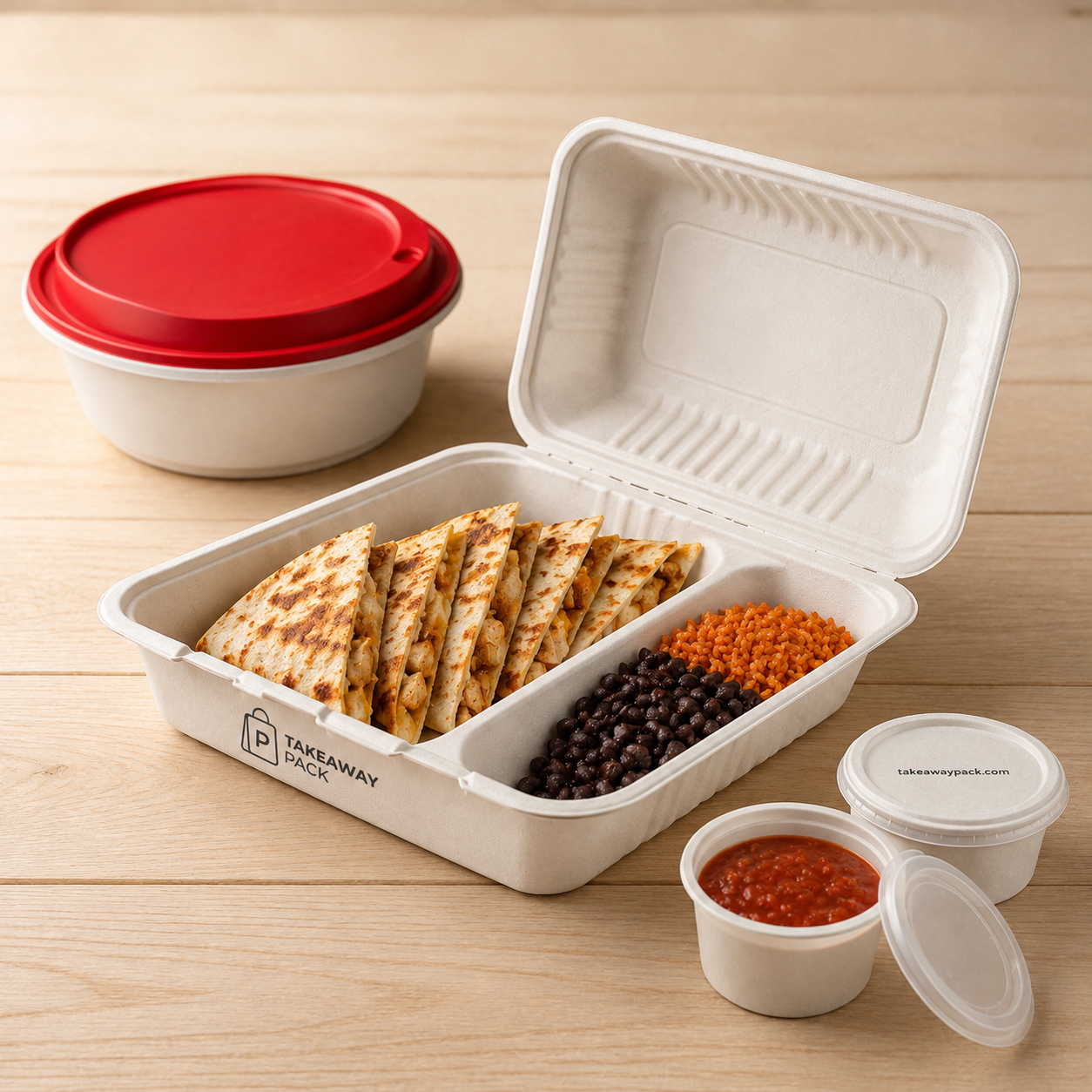
Integrated compartments. A compartment tray with a large main well and two or three smaller wells for sauces. This is the cleanest solution — one container, one lid, everything stays in place. Takeawaypack's compartment trays are built for exactly this purpose, pairing a main well with smaller wells so a wrap and two or three dips travel in one piece.
Separate sauce cups in a carrier. If you prefer to use the same main container for all orders, you can add a separate cup carrier. Double and single cup carriers keep sauce cups upright and prevent them from tipping over in the delivery bag. The chain's compostable packaging included a spot for three sides. For a practical equivalent, a single or double cup carrier can hold sauce cups securely; takeawaypack.com stocks both, along with sauce cups and matching lids.
Nested packaging. A main box with a recessed lid area that holds sauce cups above the food, separated by a rigid divider. Common in Asian takeout, and it presents well for a premium digital-exclusive item, though it costs more than flat-packed boxes.
Whichever route you take, test it under real delivery conditions. Fill a sauce cup with the real product, seal it, put it in a delivery bag with a hot wrap, and drive around for 15 minutes. If the lid pops off or the cup leaks, go back to the drawing board. Takeawaypack supplies sauce cups with matching lids, as well as seals and stickers you can use to secure a lid before it goes in the bag.
Testing Your Digital Menu Item Before Scale
The chain's approach to testing the Quesadilla was textbook. In the summer of 2020, it piloted the item in two markets — Cleveland and Indianapolis — as a digital-only offering. This was a deliberate stage-gate process: listen to customer feedback, study the data, refine the recipe and workflow, and then decide on a national launch. The result was a product that had been vetted by real customers in real operating conditions before it was deployed across 2,750 locations.
For a small restaurant, the same principle applies at a smaller scale. Here's a practical testing framework:
Phase 1: Internal test (1 week). Make the item for your staff. Get their honest feedback on taste, assembly time, and packaging fit. Time the process from order to bag. If it takes longer than your other digital items, you need to simplify the workflow.
Phase 2: Soft launch (2 weeks). List the item on your app or website but don't promote it heavily. Let it be discovered by your regular customers who browse the full menu. Track how many orders come in, what substitutions are requested, and what the feedback says. This is your Cleveland-and-Indianapolis moment.
Phase 3: Promotional launch (2-4 weeks). If the soft launch data looks good, run a promotion — free delivery, a discount on the first order, or a "buy one get one" deal. The chain offered $0 delivery for 10 days. You can offer a 15% discount or a free side with the purchase of the new item.
Phase 4: Evaluate and iterate. After the promotional period, look at the numbers: total orders, average check size, repeat purchase rate, customer ratings, and refund requests. If the refund rate is high, the packaging likely needs work. If repeat purchases are low, the item may need a recipe tweak or a better visual presentation on the menu.
Throughout this process, your packaging is the most visible variable. If customers are posting photos of a crushed wrap or a leaked sauce cup on social media, you have a packaging problem, not a food problem. Suppliers like takeawaypack.com can provide sample packs of different container sizes and materials so you can test before committing to a full order.
Optimizing the Kitchen Workflow for a New Digital Item
The chain's Quesadilla was made in a "Digital Kitchen" — a dedicated preparation area for online orders. This separation of digital and in-person workflows reduced friction, sped up assembly, and allowed staff to focus on one order stream at a time. For most small restaurants, a full Digital Kitchen isn't practical, but the principle of workflow separation is.
When you add a digital-exclusive wrap to your menu, consider these operational tweaks:
Dedicate a station. Even if it's just a corner of the prep table, designate a specific area for digital-exclusive items. Stock it with the packaging, the protein, the cheese, the tortillas, and the sauce cups. This prevents your staff from walking back and forth to the main line and reduces assembly time.
Batch the press. If the item is folded, pressed, and cut, batch it. Fold several tortillas at once, press them in sequence, cut them together. The chain's custom oven made pressing faster and more consistent; a panini press or a flat-top with a weight gets a small kitchen most of the way there.
Stage the packaging. Pre-assemble containers before the rush — tabs folded, liners in, sauce cups within reach. Every second spent fighting a box that doesn't fit is a second off the next order.
Compostable and Custom Packaging for the Digital Era
The chain's Quesadilla was served in 100% compostable packaging. That wasn't only an environmental choice — it was a brand statement, consistent with a company that had built its identity around responsibly sourced food. The lesson for any operator is the same: your packaging is part of your product.
Fiber-based options have matured. The key is matching material to food:
- Wraps and quesadillas (hot, oily, pressed): molded pulp clamshells or kraft paperboard boxes. Fiber breathes slightly, which cuts condensation, and the natural look reads as eco-conscious.
- Sauces and dips: portion cups with secure lids, sealed with a sticker or seal so nothing pops open in transit.
- Combination meals: compartment trays with separate wells for the main dish and the dips.
Takeawaypack offers custom-print packaging across these formats, with MOQs as low as 500-1000 units. For a small restaurant launching a digital-exclusive item, this means you can order a run of branded boxes, sauce cups, and paper bags specifically for the new item without committing to thousands of units. Custom printing on the boxes — your logo, the item name, perhaps a QR code linking to your app — turns every delivery into a marketing touchpoint.
How to Start Your Own Digital-Exclusive Menu Test
If you're ready to launch a digital-exclusive wrap or folded item, here's a step-by-step action plan:
Step 1: Choose your item. Pick one wrap, quesadilla, burrito, or folded sandwich you can make consistently with ingredients you already stock. The chain chose a Quesadilla because it was the most requested item on social media — ask your own customers what they want.
Step 2: Select your packaging. Order samples of rigid containers that fit your item's dimensions. Include a main container plus a sauce cup system. Test with a hot, freshly made item in a real delivery scenario. If you're unsure where to start, takeawaypack.com carries 950+ items covering lock-lid PP bowls, kraft soup tubs, compartment trays, window boxes, molded pulp clamshells, sauce cups, cup carriers, and custom-print paper bags — enough variety to find a match for almost any wrap size.
Step 3: Set up your digital listing. Add the item to your app and website. Use a clear photo that shows the item in its packaging — this sets customer expectations for what they'll receive. The chain's launch imagery showed the Quesadilla in its compostable box, which helped customers understand the portion size and presentation before ordering.
Step 4: Soft launch. Run the item for two weeks without promotion. Monitor order volume, customer feedback, and packaging performance. If you see a pattern of complaints about leaks or crushed items, address the packaging before the promotional launch.
Step 5: Promote and scale. If the soft launch goes well, run a promotion and start collecting data. Use the insights to refine the recipe, the packaging, or the pricing. When you're ready to scale, consider adding a second digital-exclusive item or expanding the offering to your in-store menu.
Conclusion: Your Digital-Exclusive Menu Starts with the Right Package
The chain's Quesadilla launch showed that a well-executed digital-exclusive item can drive app engagement, generate buzz, and open a new revenue line while keeping operational complexity manageable. What made it work was attention to every link: the recipe, the kitchen workflow, the staged testing, and the packaging.
The same playbook works at your scale. Start with one item, test it in one channel, iterate on real data. Your packaging doesn't need to be custom-molded or high-tech — it needs the right size, the right material, and the right fit. A wrap that stays intact and dips that don't leak are the two non-negotiables.
If you're planning a digital-exclusive menu launch and need packaging that keeps your wraps secure and your sauces separate, check with a supplier like takeawaypack.com. Their range of compartment trays, lock-lid bowls, sauce cups, cup carriers, and custom-print paper bags is built for exactly this challenge — and with custom-print MOQs as low as 500-1000 units, you can build a branded packaging experience that matches the quality of your food. You can also reach the team directly at info@takeawaypack.com or +1 636-298-3606. Ready to get started? Visit takeawaypack.com/contact to discuss your packaging needs with a team that understands the digital-first restaurant landscape.