Leak-Proof Soup Containers for Scooter Delivery: How to Test Lids, Seals, and Samples
A soup container does not become reliable for delivery just because it is described as “leak-proof.” Hot liquid, steam, vibration, tilting, stacking, and imperfect lid closure all place stress on the package. For soup, curry, broth, and sauce-heavy meals, buyers should evaluate the container and lid as one delivery system: the sealing interface, material stability, body structure, fill level, and actual delivery route all matter.
2026-08-11 - 7 min read
Summary
A soup container does not become reliable for delivery just because it is described as “leak-proof.” Hot liquid, steam, vibration, tilting, stacking, and imperfect lid closure all place stress on the package. For soup, curry, broth, and sauce-heavy meals, buyers should evaluate the container and lid as one delivery system: the sealing interface, material stability, body structure, fill level, and actual delivery route all matter.
Before committing to a bulk order, ask for product drawings or samples, confirm which lid matches the selected container, and test the complete pack with your own food and delivery conditions. The practical goal is not a generic claim; it is a documented, repeatable result for the menu and route you operate.
Why “Leak-Proof” Is Not a Complete Specification
Many food containers hold liquid when they are upright on a shelf. That alone does not predict performance during a 30- to 45-minute scooter delivery.
A delivery pack may be tilted in a rider bag, compressed by other orders, exposed to heat, or jolted at stops and turns. Hot soup can also create steam inside the headspace. These conditions can reveal a small mismatch between the lid and the rim, a flexible base, or a closure that was not fully engaged.
For this reason, a useful purchasing question is not simply “Is this container leak-proof?” Ask instead: **Under what fill level, food temperature, lid combination, orientation, stacking load, and route conditions has this pack been tested?**
The Main Reasons Soup Containers Leak
A lid and rim do not create a consistent seal
The most common leak path is the joint between the lid and container. A lid that appears to fit may still be incompatible with the rim geometry. A reliable closure needs consistent contact around the full rim and enough resistance to opening when the container is tilted or shaken.
Specify the container and lid as a matched set. Do not assume that two parts with the same nominal diameter will seal in the same way.
Heat changes the package shape
Hot filling can affect both the container body and the lid. If a package softens or distorts under the intended food temperature, its sealing geometry can change. The risk is not only an obvious crack; even a small change in the rim or base can reduce lid contact.
Ask suppliers to identify the material and the intended food-contact and temperature-use conditions for the exact SKU. Then validate the pack with the actual serving temperature of your soup or sauce.
Steam and movement add pressure at the closure
A tightly closed container may still face internal pressure from hot food and repeated movement. During transit, liquid repeatedly hits the lid edge and sidewall. The pack must tolerate this combination without allowing residue to escape into the delivery bag.
Do not use a general material statement as a substitute for a test of the assembled, filled package.
The container body flexes under load
Buyers often focus only on the lid. The body matters too. A base or sidewall that flexes after filling can change the force applied to the lid, especially when containers are stacked or carried unevenly.
Review the container profile, rim, base, capacity, and expected stacking arrangement. A sample should be evaluated while filled, lidded, bagged, and handled as it will be in service.
Choose a Pack System, Not a Single Feature
A strong soup-delivery specification connects five parts of the system.
1. The matched container and lid
Request the exact SKU references for both parts. Confirm the supplier’s intended lid match, rather than selecting lids by visual fit. For a custom project, request drawings or relevant dimensions before approving production.
2. The food and fill level
Soup, oily broth, curries, and sauces behave differently during movement. Leave appropriate headspace rather than filling to the brim. An overfilled pack puts liquid directly against the seal whenever it tilts.
Record the target serving temperature and fill weight in your test protocol. That makes comparisons between samples meaningful.
3. The route and handling method
A bench test is useful, but it is not the final answer. Include the delivery bag, expected stacking, and typical ride duration. If riders use scooters, test the orientation that occurs in their bags and run a route or controlled movement simulation that reflects real handling.
4. The kitchen closing process
An excellent container can fail if the lid is only partly pressed into place or if a non-matching lid reaches the packing line. Train staff to check the closure around the entire rim and establish a simple visual or tactile check before bagging.
5. The evidence you keep
Keep a record of the sample SKU, lid SKU, food temperature, fill quantity, route duration, test result, and any observed residue. This gives your team a basis for choosing a package and for resolving future quality questions with a supplier.
A Practical Leak-Test Sequence Before Bulk Ordering
Use samples to narrow the choice before placing a larger order. The following sequence is simple enough for a restaurant, cloud kitchen, or delivery brand to repeat.
Start with a filled-and-inverted check
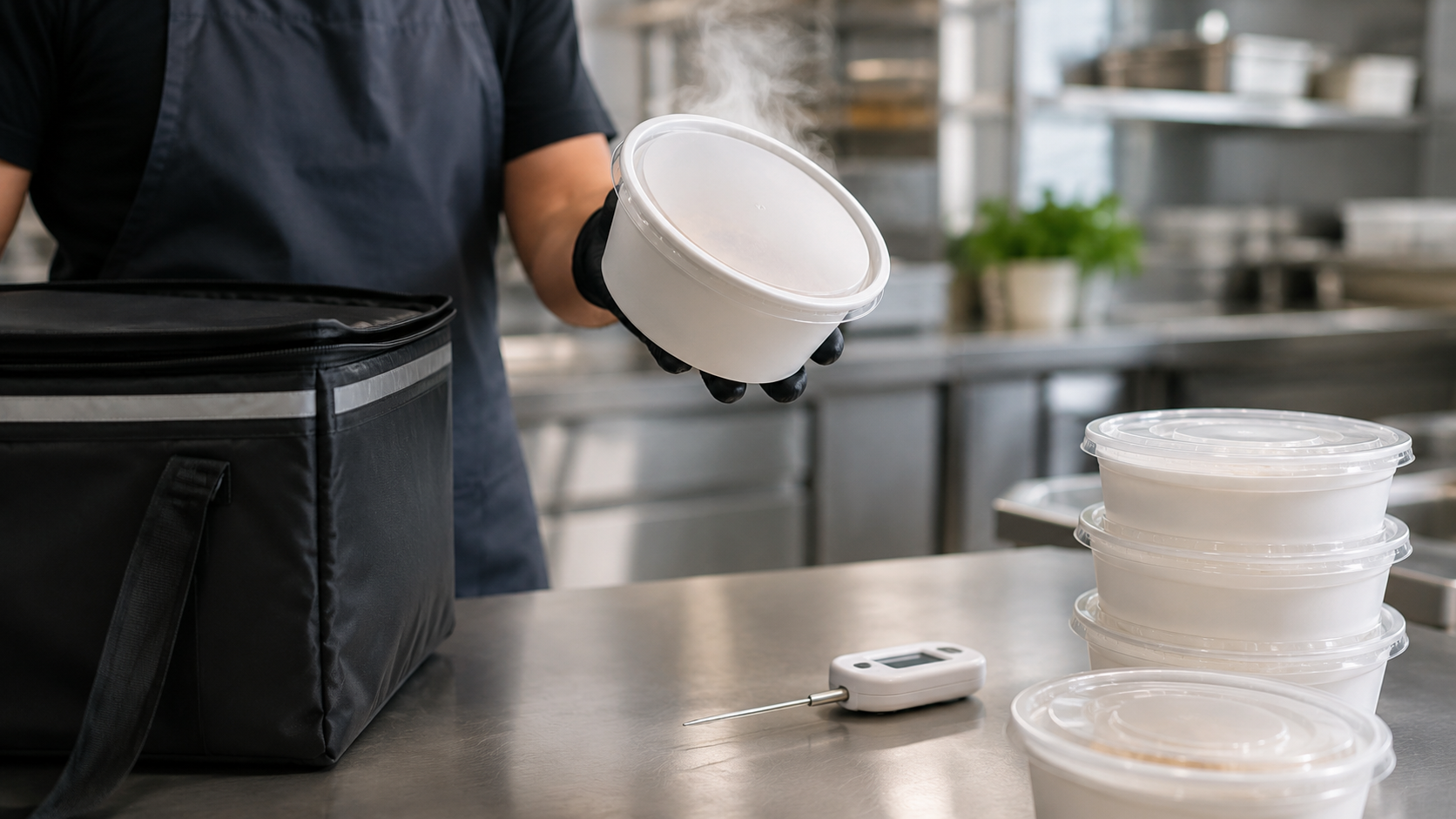
Fill the pack to the intended operational level, attach the matched lid, and inspect the rim. Place clean absorbent paper beneath it, invert it for a defined period, and check for liquid residue. If the closure fails here, there is no reason to proceed to a more demanding route test.
Repeat with hot food or a hot liquid proxy
Use a test liquid that reflects the temperature and viscosity of the menu item. Observe the lid, rim, and base after filling and again after a short hold. Note any deformation, steam escape, or seepage.
Test the complete bagged delivery setup
Put the sealed container into the same bag, carrier, and stacking arrangement used in normal service. Simulate movement or conduct a monitored trial route. Inspect the outside of the container and the bag at the end of the test.
Compare results by SKU, not by memory
Photograph or log each sample with its SKU. A clear table of results is more useful than a general impression that one bowl “felt better.” It also helps prevent a later reorder from substituting a different lid or container.
Common Operating Errors That Create Leaks
Not every spill is caused by a manufacturing defect. Three operational problems are especially common:
- **Overfilling:** leaving no headspace sends liquid against the seal whenever the pack tilts.
- **Incomplete lid engagement:** a lid can look closed from above while one section of the rim remains unsealed.
- **Mixed components:** a lid may sit on a container but still not be the engineered match for that rim.
These risks should be checked alongside the package design. A short packing-line check can prevent repeated refunds, remakes, and damaged customer experiences.
What to Ask a Packaging Supplier for Soup and Saucy Dishes
A useful supplier conversation should produce details that can be verified, not only a broad performance claim. Ask for:
- the container and lid SKU pair;
- material information and intended food-contact, temperature, or use conditions for the exact product;
- available drawings, capacity, and relevant dimensions;
- samples for your intended filling and route test;
- clarification of what the supplier has tested, including test method and conditions where available;
- packaging and export-hand-off details if you are planning an international order.
If you need printed packaging, include the container, lid, printing, and packing requirements in the same approval process. A visual design should not be approved separately from the structure that must carry the food safely.
Work With TakeawayPack on a Verifiable Packaging Inquiry
TakeawayPack is a foodservice packaging brand and procurement coordinator working with multiple packaging manufacturers. Its online categories include bowls, containers, lids, boxes, cups, trays, bags, and cutlery.
For a soup or sauce-heavy delivery project, you can use a TakeawayPack RFQ to share the product category, material, size or capacity, expected quantity, printing or color requirements, and destination country or port. During an inquiry, TakeawayPack can discuss structure, coating, capacity, lid matching, printing, and carton packaging. It can also support sample, drawing, or print-file alignment so that your team can test the exact proposed pack before moving forward.
The right next step is to define your menu, fill level, delivery time, and route conditions, then request a matched container-and-lid proposal that you can validate. Start your packaging inquiry at TakeawayPack.