Multi-Brand Kitchen Allergen Labeling: Who Is Responsible and What Must Go on Each Pack?
When several delivery-only brands share one kitchen, every order still needs accurate allergen information and an unmistakable brand identity. The operator that supplies food to the customer should set and control the food-information process; the shared kitchen, individual brand teams, packers, and suppliers all need defined tasks that make the information accurate at the point of handoff. The exact wording and label format depend on the market and on whether food is prepacked, prepacked for direct sale (PPDS), or non-prepacked. This guide gives multi-brand kitchens a practical operating framework for preventing wrong-brand packs, stale allergen information, and avoidable cross-contact risk.
2026-08-11 - 7 min read
Summary
When several delivery-only brands share one kitchen, every order still needs accurate allergen information and an unmistakable brand identity. The operator that supplies food to the customer should set and control the food-information process; the shared kitchen, individual brand teams, packers, and suppliers all need defined tasks that make the information accurate at the point of handoff. The exact wording and label format depend on the market and on whether food is prepacked, prepacked for direct sale (PPDS), or non-prepacked. This guide gives multi-brand kitchens a practical operating framework for preventing wrong-brand packs, stale allergen information, and avoidable cross-contact risk.
Why Multi-Brand Kitchens Need a Clear Ownership Model
A virtual kitchen can prepare orders for several brands from the same ingredients, equipment, and dispatch bench. That efficiency can also create a serious information problem: a meal may be packed under the wrong brand, sent with the wrong label, or described with allergen information that no longer matches the recipe.
No packaging design can transfer away the food business's responsibility to provide accurate information to its customer. In practice, the business selling or supplying the finished food should appoint a named owner for allergen data and establish written handoffs with the kitchen operator and each brand. That owner needs authority to stop a pack from leaving when the recipe, label, or order identity is uncertain.
For a shared kitchen, a useful responsibility map is simple:
- **Brand or food business:** owns the approved menu, recipe, ingredient list, customer-facing allergen information, and change approval.
- **Kitchen operator:** controls ingredients, storage, preparation, cleaning, staff training, and the records that show what was actually used.
- **Packing team:** checks the order, brand, meal, and current allergen information before sealing the pack.
- **Packaging supplier:** supplies the agreed packaging and approved artwork; it should not be treated as the party deciding food-allergen statements for a finished meal.
Contracts can allocate work and recovery between parties, but they should not replace a safe, documented process at the dispatch bench. Obtain local legal advice for the countries in which food is sold.
Start With the Food Category, Not the Sticker Design
The information required on a package differs by food category and market. Treating every delivery meal as the same type of packaged product is a common mistake.
In UK-oriented operations, a helpful starting distinction is:
- **Prepacked food:** food already packaged before it is offered for sale. It generally requires an ingredient list, with allergenic ingredients emphasized so consumers can identify them.
- **PPDS food:** food packed on the same premises before the customer selects it. Each individual PPDS item needs its own full ingredient list with allergens emphasized.
- **Non-prepacked food:** loose food and meals served by restaurants or takeaways. Allergen information must still be readily available, often through a menu, notice, or a reliable staff-information process.
These categories do not remove the need to verify the law that applies to your selling location, platform setup, and product format. A delivery brand that operates across countries should maintain a market-by-market requirements register rather than copying a single label template everywhere.
What Information Should Be Controlled on Every Multi-Brand Pack?
A pack does not always need to carry every piece of food information, but every dispatched order needs a controlled link to the right brand and the current allergen record. Build the workflow around the following checks.
**1. Brand identity and order matching.** Display the correct brand name or a distinct visual identifier, then match it to the order ticket before dispatch. The identifier must work in a busy kitchen, not only in a marketing mock-up.
**2. Product and recipe version.** The team should be able to identify the dish and the current approved recipe. If an ingredient, sauce, garnish, or supplier changes, review the allergen record before the item is sold again.
**3. Allergen information at the required point.** For PPDS items, place the required ingredient and allergen information on each individual pack. For non-prepacked delivery meals, make the approved allergen information accessible in the channel customers actually use and ensure staff can retrieve it accurately.
**4. Customer-specific allergy communication.** An order note is not a substitute for recipe control. Route allergy requests to a trained person, communicate the request through preparation and packing, and be honest when the kitchen cannot safely make a claim.
**5. Traceable records.** Keep approved recipes, ingredient specifications, supplier changes, label versions, and training records together. The goal is to answer, quickly and accurately, what was in a specific order and what information was available when it left the kitchen.
Prevent Cross-Contact Before Packaging Begins
Accurate labeling is essential, but it cannot make an unsafe preparation safe. The kitchen must control cross-contact while storing, preparing, cooking, and packing food.
Keep allergenic ingredients properly identified and stored in designated containers. Use separation, cleaning, and staff procedures that fit the hazards in your operation. Review shared equipment, utensils, work surfaces, fryers, and packing stations, because a process can fail even when the outer label is correct.
For a multi-brand operation, make the controls visual and repeatable:
- give each brand a defined packing station or clearly marked storage location;
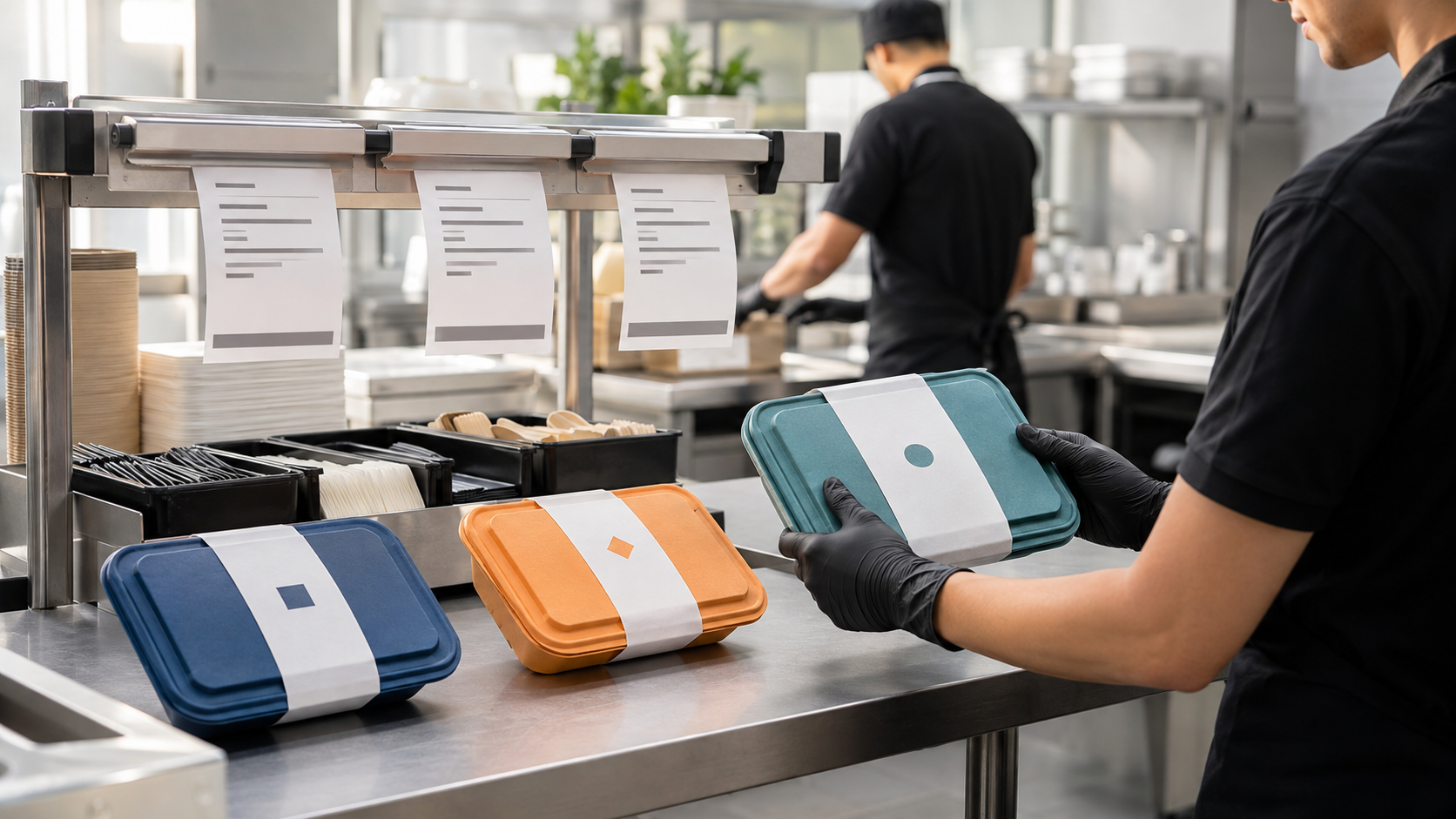
- use distinct packaging designs or color cues alongside readable brand text;
- keep the packing specification with the live order information;
- train staff on the difference between a brand cue and an allergen declaration; and
- stop and escalate any order where the recipe, allergy request, or packaging identity does not match.
Color alone is not an allergen-control system. It can help teams recognize a brand or workflow quickly, but it must be backed by written allergen procedures, training, and verification.
A Practical Dispatch Check for Shared Kitchens
Before a bag leaves the kitchen, use a short final check:
- 1. **Confirm the brand and order ticket.** Does the packaging and ticket identify the same brand and customer order?
- 2. **Confirm the meal and recipe.** Has the packer selected the correct dish, including sauces, sides, and requested changes?
- 3. **Confirm the allergen information route.** Is the correct current information on the individual pack when required, or available through the approved customer-facing method for this food type?
- 4. **Confirm special allergy handling.** Was the request seen, communicated, and completed according to the kitchen's procedure? If not, do not guess.
- 5. **Confirm the seal and handoff.** Has the correct pack been sealed, placed with the right order, and kept separate from another brand's dispatch?
Record recipe and artwork approval dates. This makes it easier to withdraw an obsolete label or pause an item when a supplier specification changes.
How Packaging Supports a Safer Brand-Segregated Workflow
Packaging is a practical part of the final control point. Different formats, colors, and print designs can make the correct brand easier to recognize at speed. They should support—not replace—the required food information and the kitchen's allergen controls.
TakeawayPack is a foodservice packaging brand and sourcing coordinator working with packaging manufacturers. Its online range includes cups, bowls, boxes, containers, trays, lids, bags, and cutlery. For a multi-brand project, buyers can discuss product category, material, size or capacity, expected quantity, printing or color requirements, logo customization, and destination market through an RFQ.
For custom printing, TakeawayPack prepares a digital proof from the customer's files and proceeds only after written customer approval. Use that approval stage to check brand names, artwork, order-identification cues, and the space reserved for any information your food business has determined is required. Food-allergen wording and legal compliance remain matters for the food business and its local advisors.
The Bottom Line
In a shared kitchen, the party serving the customer needs one accountable allergen-information process, while every partner has a defined operational role. Categorize the food correctly, keep recipes and ingredient records current, control cross-contact, and make the final pack easy to match to the correct brand and order. When the information or safety of a meal is uncertain, stop the order rather than relying on a label or a guess.
For distinct, custom-printed packaging that can support a clear multi-brand packing workflow, explore the product range and start an RFQ at TakeawayPack.