PFAS-Free Food Packaging: What Restaurant Owners Need to Know in 2026
A fiber bowl’s appearance, material name, or sustainability label cannot tell a restaurant whether it contains PFAS or meets a particular state rule. In 2026, the practical response is to identify the exact finished SKU, define where it will be sold or used, request a written supplier declaration th
2026-09-09 - 6 min read
Summary
A fiber bowl’s appearance, material name, or sustainability label cannot tell a restaurant whether it contains PFAS or meets a particular state rule. In 2026, the practical response is to identify the exact finished SKU, define where it will be sold or used, request a written supplier declaration that matches that configuration, and keep the supporting record with the purchase. California and New York use related—but not identical—legal tests, so one vague “PFAS-free” claim is not a complete compliance file.
This article is estimated to take 4 minutes to read.
Start with the exact package, not the category
Build a one-line description for every bowl under review: supplier, manufacturer if known, product name, SKU, size, substrate, lid or companion parts, printing, intended food, and destination market. Add the purchase-order number and production or lot information if it is available.
That level of detail matters because a document for a plain fiber blank may not necessarily cover the printed, coated, lidded package that reaches the customer. It also prevents a useful answer from being applied to the wrong item in a product family.
If a supplier cannot identify the exact item, do not convert an incomplete description into a “PFAS-free” conclusion. Ask for the item identity first.
California: a plant-fiber rule with two parts
California’s AB 1200 applies to covered food packaging made principally from paper, paperboard, or other plant fibers and intended for direct food contact. Since January 1, 2023, the law has prohibited the sale, distribution, or offer for sale of covered packaging containing regulated PFAS.
For this California rule, “regulated PFAS” includes intentionally added PFAS that have a functional or technical effect. It also includes PFAS present at or above 100 parts per million when measured as total organic fluorine. That means a California review should not stop at a broad marketing statement. The buyer should ask what claim the supplier is making for the exact package and what documentation applies to the ordered configuration.
California’s statutory language is specific to its covered plant-fiber packaging scope. Do not automatically turn its threshold into a universal rule for every material, every package, or every market.
New York: focus on intentionally added PFAS and retained certification
New York’s food-packaging restriction has applied since December 31, 2022. It addresses intentionally added PFAS in direct-contact packaging that is mostly made from paper, paperboard, or plant-derived material.
For restaurants and other foodservice businesses, the operational point is clear: determine whether the packaging is covered, then determine whether intentionally added PFAS are present. New York permits that decision to rest on a manufacturer’s or distributor’s compliance certification. The certification should be kept where it can be produced if requested.
This does not make every certificate equally useful. A document is stronger when it identifies the finished product or configuration, names the issuing company, states the applicable claim, is dated and signed by an authorized person, and matches the market where the package will be sold or used.
What to ask a supplier for
Send the request in writing and make it part of the sourcing file. A practical packet has five parts:
- Finished-product identity. Product name, exact SKU, material description, and the full configuration supplied to the restaurant.
- A clear PFAS statement. Ask the supplier to state whether PFAS are intentionally added and to identify the market or requirement addressed by the declaration.
- Authorization and date. The declaration should identify the manufacturer or distributor, the signer’s authority, and the issue date.
- Supporting documents, when available. A specification or report can help only if the sample, configuration, scope, and date correspond to the item being purchased.
- Change control. Ask the supplier to notify you before changing the fiber source, coating, barrier treatment, print system, adhesive, manufacturing location, or other component that could make the file outdated.
A generic email, an undated brochure, or a certificate that names only a product family should trigger follow-up. It is not a reason to infer the status of a bowl that the document does not identify.
Read test information in context
A laboratory result, a supplier declaration, and a legal compliance statement do different jobs. A report may describe what was tested; a declaration may state what the supplier represents; a state rule defines what the market requires. None should be detached from the exact finished package.
For California plant-fiber packaging, ask the supplier how its documentation addresses the state’s total-organic-fluorine condition as well as intentionally added PFAS. For New York, ask for documentation that supports the intentionally-added-PFAS determination for the covered package. If the product, destination, or evidence is unclear, obtain advice from the relevant authority or a qualified adviser before making a legal claim.
Do not use the bowl itself as the test result
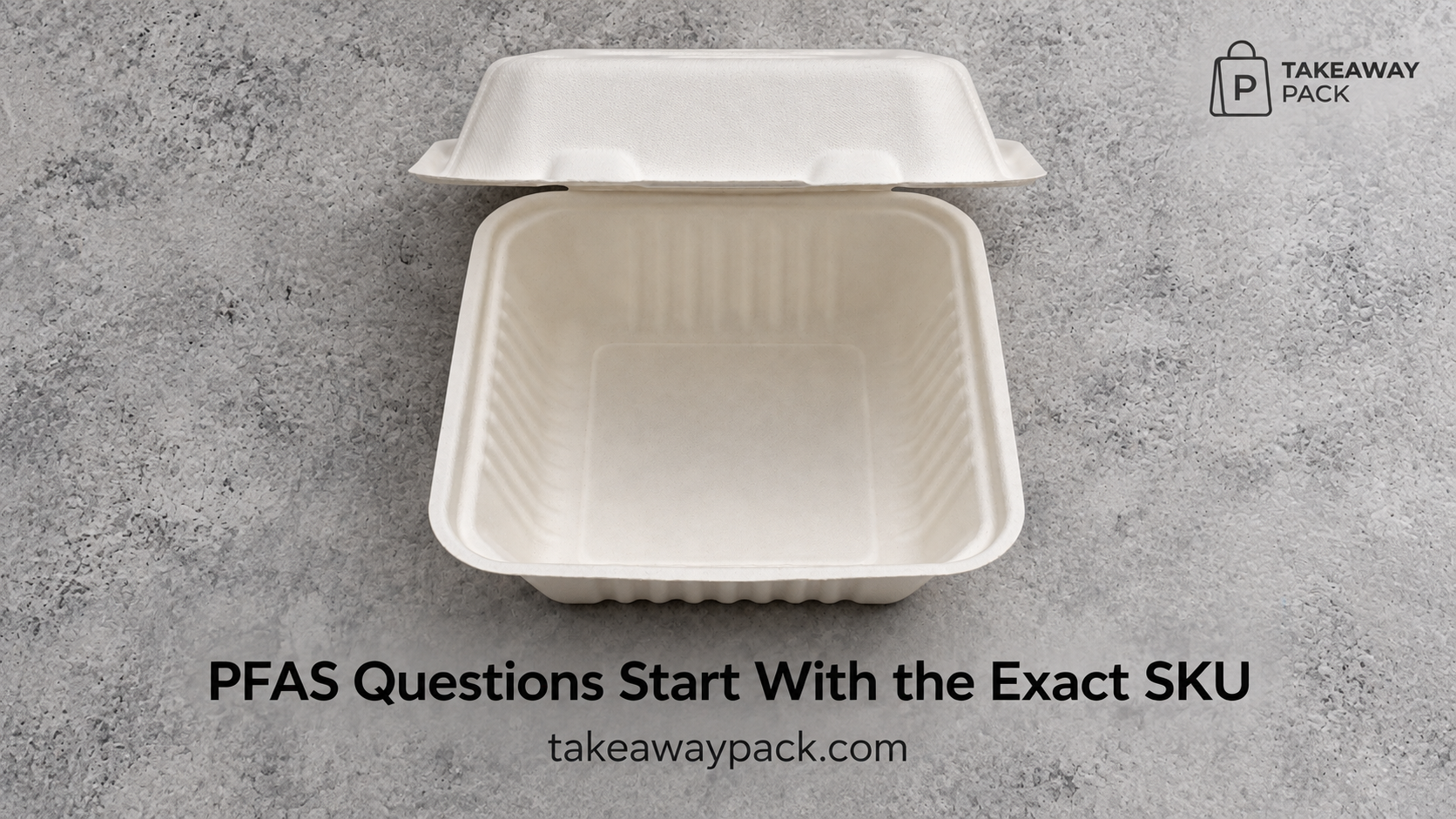
A beige bowl, a bagasse label, a compostability logo, or a claim that the bowl handles oily food does not establish PFAS status. The same is true in reverse: older inventory or a missing declaration can justify a closer review, but it does not prove that PFAS are present in a specific unit.
Use an evidence status instead of a guess:
- Documented: the current package has a matching, reviewable record for the relevant market.
- Incomplete: some documentation exists, but it does not yet match the product, configuration, or destination.
- Unverified: no usable documentation is available.
That classification gives a restaurant a manageable action list without making unsupported accusations about its current supplier or inventory.
Compare cost only after the specifications match
There is no defensible universal percentage for a “PFAS-free” price premium. Price depends on the finished package, order quantity, configuration, freight, destination, documentation requested, and the performance needs of the menu. A number from a different bowl or buying program is not a budget for yours.
Request like-for-like quotes. Keep capacity, shape, lid arrangement, print, order quantity, delivery terms, and required documentation consistent. Then evaluate the landed cost per usable unit alongside the evidence packet and the restaurant’s own product trial. A lower case price is not a clean comparison if the documentation does not cover the destination market or the package is not suitable for the intended menu.
A 2026 review routine for restaurant groups and venues
Restaurants that buy for several locations, concession stands, or event programs should centralize the file rather than asking each operator to reconstruct it. Maintain one version-controlled record for each SKU with the RFQ, approved specification, quote, declaration, supporting documents, correspondence, purchase order, and any later change notice.
Review the record before a reorder, a menu change, a new destination market, or a supplier change. That makes the question “Are these bowls PFAS-free?” answerable with documents rather than memory.
Put documentation into the next RFQ
Takeawaypack can structure an RFQ around the packaging category, material, dimensions or capacity, quantity, print requirements, intended destination, and documentation requested. Start at takeawaypack.com with the product details and market question already defined. PFAS status, food-contact documentation, certification, price, MOQ, lead time, and legal compliance should be confirmed for the specific SKU, order, and destination before they are represented as product facts.