PLA vs. Molded Pulp for Food Trucks: How to Specify Heat, Grease, and Stack Performance
For hot, greasy food-truck service, standard PLA deserves caution because published PLA literature places its glass-transition region around 60 °C. A properly specified molded-pulp container may be a better candidate, but neither material name guarantees performance. Resin grade, fiber furnish, basi
2026-09-09 - 7 min read
Summary
For hot, greasy food-truck service, standard PLA deserves caution because published PLA literature places its glass-transition region around 60 °C. A properly specified molded-pulp container may be a better candidate, but neither material name guarantees performance. Resin grade, fiber furnish, basis weight, geometry, coating or treatment, closure design, fill temperature, hold time, moisture, and stack load can all change the result. Choose the finished SKU by documented conditions and a test with your own menu—not by a “compostable,” “pulp,” or “PLA” label alone.
This article is estimated to take 4 minutes to read.
Short answer: compare finished containers, not material labels
For a hot menu, do not approve standard PLA merely because an empty sample feels rigid. Its thermal behavior creates a reason to demand a product-specific temperature rating and hold-time result. Molded pulp is worth testing for the same service, but the word pulp does not prove grease resistance, closure retention, stack strength, or suitability for a particular fill temperature.
The practical answer is therefore conditional:
- Hot, greasy, stacked meals: shortlist finished molded-pulp formats and any other products whose suppliers can document the required use conditions.
- PLA formats: keep them in consideration only where the exact product’s rated conditions cover the actual fill temperature, hold time, load, and closure requirement.
- Every candidate: run the same in-truck test before committing to volume.
This approach avoids turning a material tendency into a product guarantee.
Keep compostability separate from service performance
Compostability concerns an end-of-life pathway. Heat tolerance, grease resistance, lid fit, and stack strength concern use. One does not prove the other.
The distinction also matters within compostability claims. ASTM D6400 covers plastics and plastic-containing products designed for municipal or industrial aerobic composting where thermophilic conditions are achieved. That scope is not evidence that an item will compost in an ordinary home system. At the same time, it would be wrong to say every compostable claim means an industrial pathway: the FTC compostable-claims guidance also addresses claims substantiated for an appropriate home compost pile or device and requires qualification when relevant facilities are not widely available.
For procurement, request the exact certificate or substantiation for the finished item and its stated pathway. Then assess service performance with separate evidence.
Turn the menu into four purchase specifications
A useful request for quotation replaces adjectives with conditions that can be reported and repeated.
1. Fill temperature and hold time
Record the temperature at the moment food enters the container and the longest realistic time before the customer opens it. Ask the supplier for the finished SKU’s rated fill temperature and the duration attached to that rating. A brief peak exposure is not the same as a closed, steamy hold.
2. Grease and liquid exposure
Describe the food, contact temperature, volume, and duration. Ask for a named test method or a condition-based result rather than a bare “grease-resistant” statement.
A published molded-pulp study illustrates why the conditions matter. In that study, uncoated and chitosan-coated samples produced different oil-barrier results, and the coated sample was evaluated with hot oil at 95 ± 5 °C over a 30-minute observation period (specific molded-pulp coating study). Those findings belong to the tested formulation and samples; they do not establish the performance of another container. The procurement lesson is the reporting format: identify the specimen, treatment, liquid, temperature, duration, and pass/fail criterion.
3. Closure retention
Specify whether the pack uses a hinged lock, separate lid, film seal, or another closure. Define the failure you need to prevent: a lifted corner, an opened latch, or liquid reaching the seam. Test after the real hold period and a representative route, not only on a stationary counter.
4. Stack load and dimensional fit
Record the maximum number of filled packs normally staged together. Include portion mass, box orientation, and hold time. Also verify that the chosen footprint works in the truck’s shelf, hot-hold area, pass window, and delivery bag. A nominal capacity alone does not answer those questions.
Why PLA’s 60 °C figure is a warning, not a universal failure point
A peer-reviewed review reports a low glass-transition temperature of approximately 60 °C for PLA and identifies this as a limitation in high-temperature or prolonged-heat environments (PLA-based bio-packaging review). That supports caution; it does not prove that every PLA container fails at 60 °C or that every hot-filled pack deforms.
Glass transition is not a finished-container certification. Resin grade, crystallinity, additives, wall thickness, geometry, manufacturing history, fill temperature, exposure time, and steam conditions can change behavior. If the intended use approaches or exceeds the product’s documented range, softening or deformation may affect wall stiffness or lid fit. The correct response is to request a SKU-specific result and reproduce the intended use—not to infer a guaranteed outcome from one material number.
Why molded pulp still needs SKU-level proof
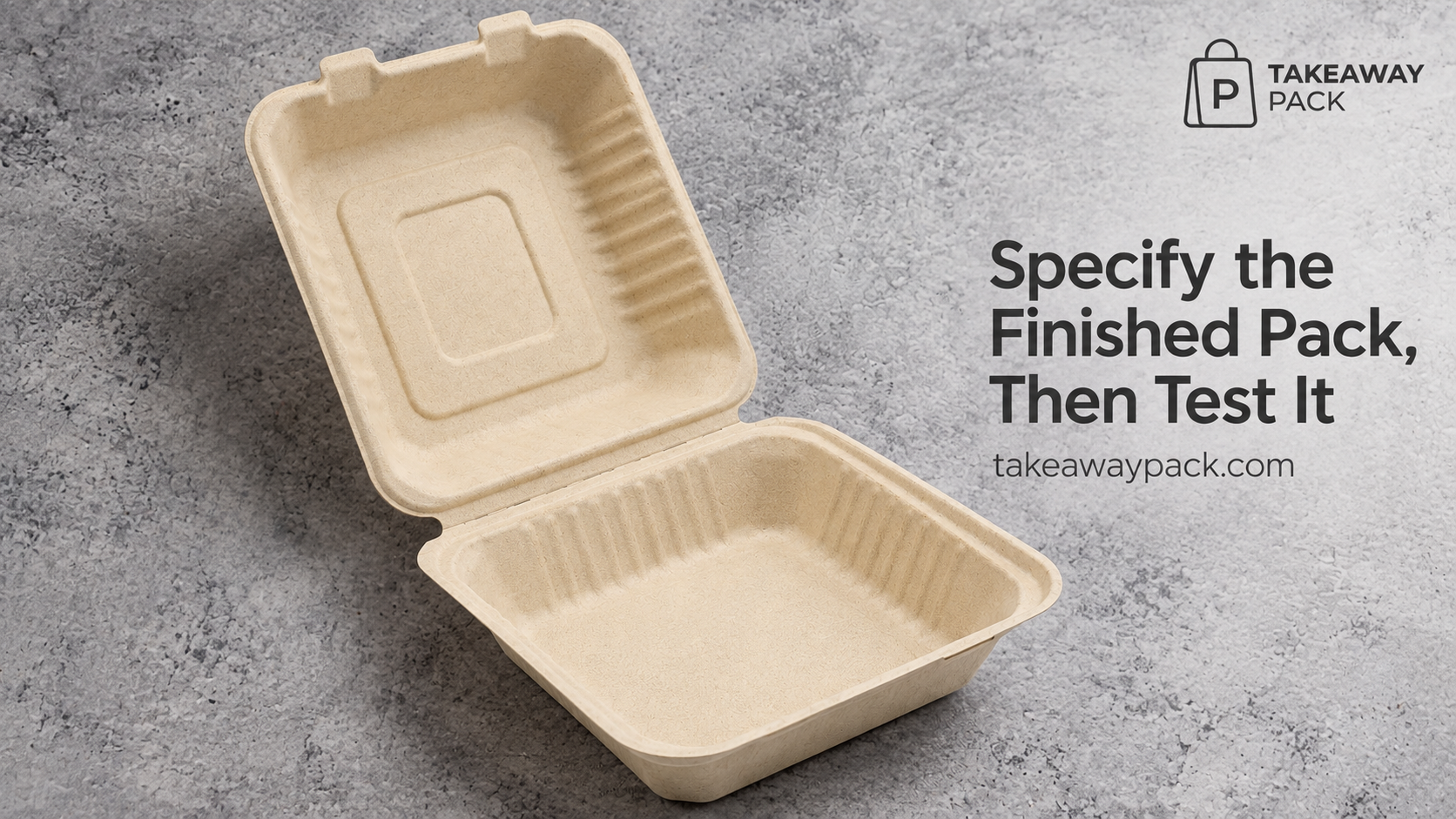
Molded-pulp formats avoid relying on standard PLA’s thermal behavior, which makes them reasonable candidates for hot-food trials. But molded pulp is not one uniform product. Fiber furnish, basis weight, pressing, rib geometry, moisture, surface treatment, coating, and closure design can differ.
Do not infer any of the following from “plant fiber,” “bagasse,” or “molded pulp” alone:
- a maximum fill temperature or hold time;
- oil or liquid resistance;
- closure retention or stack strength;
- PFAS status;
- food-contact compliance for a destination market; or
- compostability of the finished item.
If one of these points matters to the order, put it in the specification and ask for evidence tied to the exact finished item. Where evidence is unavailable, treat the statement as unconfirmed and let the truck test determine only the observable service result. A service test cannot substitute for chemical, food-contact, or end-of-life documentation.
Run one reproducible in-truck test
Use the menu item most likely to expose a weakness, then record the setup so another shift can repeat it.
- Measure and record the food’s fill temperature and portion mass.
- Fill and close the container exactly as staff would during service.
- Hold it for the longest realistic pickup or delivery window.
- Stack the normal number of filled packs for that interval.
- Carry or drive the normal route without changing the handling method.
- Inspect and record bottom sag, wall deformation, grease or liquid penetration, seam wetting, closure position, and any damage to the food.
- Repeat with a second menu item if it presents a different risk, such as more free liquid or a heavier portion.
Set acceptance criteria before the test. Photographs taken at fill, after hold, and after transport make comparisons between samples more consistent. Passing this test supports the tested menu and conditions only; it is not a general certification.
Request a document pack for the exact item
Before moving from samples to a larger order, ask for:
- the product code, drawing, dimensions, material construction, and closure description;
- the rated fill temperature and hold time, with the test condition;
- the grease or liquid-resistance result, with the method and specimen identified;
- composition and coating information, plus PFAS evidence if that is a buyer or destination requirement;
- food-contact documentation applicable to the intended food type, use, and destination;
- compostability evidence only if a disposal claim is planned, including the item covered and the pathway stated; and
- document dates or revisions so the evidence can be matched to the offered item.
Do not convert a supplier’s brand-level certificate, catalog badge, or material description into a finished-SKU conclusion. If substitutions are possible, require written confirmation that the approved construction and supporting documents still apply.
Compare quotes on the same brief
Send every supplier the same food profile, test plan, size, closure, quantity, print requirement, destination, and document request. Compare delivered quotes only after those inputs match.
A format that passes more than one menu test may allow SKU consolidation, but the commercial outcome is not automatic. Compare the revised volume pricing, storage use, replenishment pattern, and dead-inventory risk for your own operation. Do not assume a fixed percentage of the menu or a guaranteed cost saving.
For a Takeawaypack RFQ, provide the actual fill temperature, hold time, grease or liquid profile, stack load, size or capacity, closure requirement, quantity, print needs, and destination. Its public process supports order-specific discussion of structure, coating, capacity, printing, lid matching, carton packing, digital-proof approval, MOQ, and documentation scope; final capabilities and documents still need confirmation for the exact SKU and order. Take that test brief to Takeawaypack and compare the returned quote and document pack against the same acceptance criteria.