Scaling Ramen Delivery: How to Keep Noodles Firm and Toppings Fresh Over a 7 km Radius
Expanding ramen delivery from 3 km to 7 km introduces real texture and presentation challenges — soggy noodles, cooled broth, and disheveled toppings. This article breaks down the packaging system that solves it: dual-compartment bowls for broth separation, vented lids to control condensation, insul…
2026-09-07 - 9 min read
Summary: Expanding ramen delivery from 3 km to 7 km introduces real texture and presentation challenges — soggy noodles, cooled broth, and disheveled toppings. This article breaks down the packaging system that solves it: dual-compartment bowls for broth separation, vented lids to control condensation, insulated outer bags to maintain temperature, and the procurement tests that validate every component before you scale.
Why Delivery Distance Changes Everything for Ramen Texture
A 3 km delivery run is forgiving. The bowl stays in the insulated bag for 10–15 minutes, the broth barely cools, and the noodles have little time to absorb liquid. At 7 km, transit time stretches to 30–45 minutes — sometimes longer in traffic. That extra time turns small packaging weaknesses into obvious quality problems.
The mechanics are straightforward. Steam condenses inside a sealed container and drips back onto the noodles, turning al dente strands into a soft, bloated mass. Broth continues cooking the noodles even after they leave the kitchen. Chashu slices lose their seared edge and become gray. The soft-boiled egg's jammy yolk sets into a hard disc. By the time the order arrives, the bowl looks and tastes nothing like what the customer expected.
These problems are not inevitable. They are packaging problems, and they have packaging solutions.
What Changes When You Double the Radius
Expanding your delivery zone means rethinking every component in the order. The broth needs to stay above 60 °C (140 °F) for the full trip. The noodles need to be kept dry until the customer is ready to eat. The toppings need to arrive with the same visual separation they had on the counter. And the entire assembly needs to fit inside a bag that a delivery driver can carry comfortably.
Restaurants that scale successfully treat the 7 km delivery as a different product — not simply a larger version of the same bowl. They separate the broth from the noodles, use vented containers to manage steam, and choose materials that retain heat without trapping condensation.
The Four-Component Ramen Delivery System
A complete ramen packaging system for extended delivery has four distinct parts. Each solves a specific problem, and the system only works when all four are chosen together.
1. The Broth Container: Heat Retention Without Condensation
The broth container is the most technically demanding piece. It must hold liquid at high temperature, seal completely to prevent leaks, and manage internal steam so it does not condense and flood back onto the noodles.
Lock-lid PP (polypropylene) bowls in the 750 ml to 1000 ml range are the industry standard for broth. PP withstands temperatures up to 120 °C (248 °F) without warping or leaching. The lock-lid design creates a positive seal that survives jostling in a delivery bag. When paired with a small vent hole in the lid (either factory-pierced or user-opened), steam escapes gradually rather than condensing on the lid surface and dripping back down.
Compostable fiber bowls with PLA lining are a strong alternative for operators who prioritize sustainability. They offer comparable heat retention and a more premium hand feel. However, fiber bowls typically have a shorter useful temperature window — most hold up well for 30–40 minutes, after which the PLA lining may soften. For a 7 km route, test each batch under actual conditions before committing.
2. The Noodle Compartment: Keeping Starch Dry
The single most important change for longer delivery is separating the noodles from the broth. This is not optional at 7 km — it is the difference between a customer who reorders and one who leaves a one-star review.
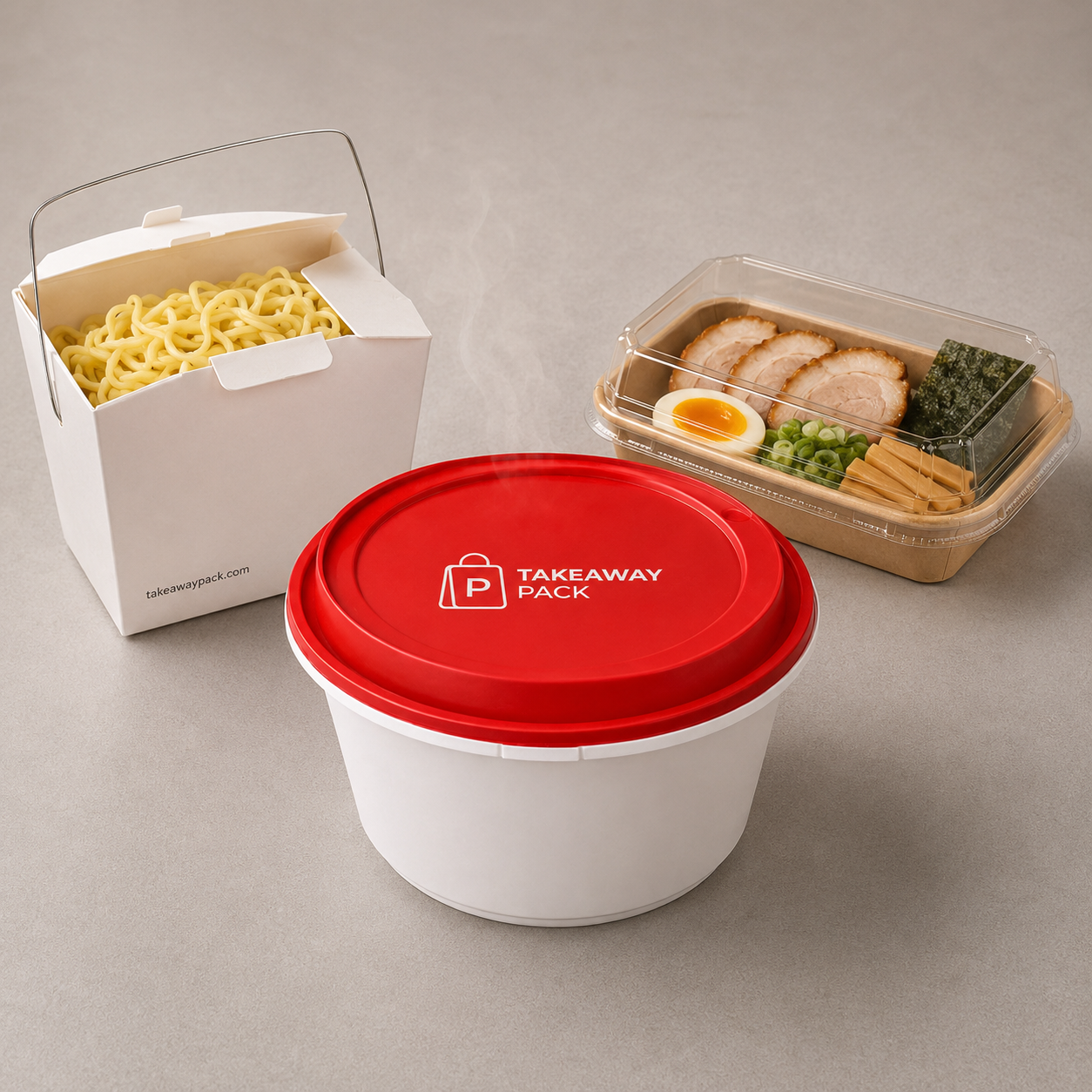
Dual-compartment containers or noodle baskets that sit inside the broth bowl keep the noodles suspended above the liquid. The noodles steam gently from the rising heat without soaking. Some designs use a perforated insert that allows steam to circulate while keeping the noodles dry.
For restaurants that prefer a simpler approach, wrapping the noodles in a separate kraft paper bag or placing them in a small compartment tray with a tight lid achieves the same result. The customer pours the broth over the noodles at home, mimicking the dine-in experience.
3. Topping Trays: Protecting Visual Presentation
Chashu, soft-boiled eggs, nori, scallions, and corn each have different tolerances for heat and moisture. Mixing them together in the same container guarantees that the crispy edges go soft, the egg yolk overcooks, and the nori loses its snap.
Multi-compartment trays — typically 2 or 3 sections — allow you to separate proteins, vegetables, and condiments. A 750 ml PP compartment tray with a snap-on lid is large enough for a full ramen topping set. The compartments keep the chashu and egg on one side, scallions and corn in another, and nori sheets on top where they stay dry.
For restaurants that want maximum flexibility, small sauce cups (30–60 ml) with peel-off foil lids let you portion sesame oil, chili paste, or extra tare separately. Customers add these to taste, which also improves the interactive experience of the meal.
4. The Outer Bag: Insulation That Buys Time
The outer delivery bag is the final thermal barrier. A single-layer plastic bag offers almost no insulation; a bag with foil-lined or foam-insulated walls can maintain internal temperature for 45 minutes or more.
Double cup carriers and single-bag insulated carriers are the two main options. For ramen, a single-bag carrier that holds the broth bowl, noodle compartment, and topping tray in one compact unit is preferable. The carrier should have a secure closure — velcro, zipper, or drawstring — to trap heat.
Some operators add a reusable heat pack or hot gel pack placed at the bottom of the bag. This adds 10–15 minutes of effective temperature retention, which can be the margin that saves a 7 km order.
How to Test Your Packaging Before Scaling
Procurement tests are the difference between guessing and knowing. Before you commit to a new packaging system for the expanded delivery zone, run these five tests.
Leak Test
Fill the broth container with water at 85 °C (185 °F). Seal it, shake it aggressively for 10 seconds, then tilt it at a 45-degree angle for 30 seconds. Any leakage at the lid seam or sidewall disqualifies the container. Repeat with the container held upside down.
Condensation Test
Seal the broth container with hot water (85 °C) and place the noodle insert or compartment on top. Close the lid and let it sit for 30 minutes — the maximum expected transit time for a 7 km delivery. Open and inspect the lid surface. Heavy condensation or pooling water means the container needs better ventilation.
Temperature Retention Test
Fill the broth container with 85 °C water. Seal it, place it in the delivery bag, and measure the temperature every 10 minutes for 45 minutes. The target: broth temperature should stay above 60 °C (140 °F) at the 30-minute mark. If it drops below 55 °C, the container or bag combination is not sufficient.
Topping Presentation Test
Prepare a full order with chashu, egg, scallions, and nori in the chosen topping tray. Seal the system and let it sit for 30 minutes. Open and photograph the result. Compare the chashu's sear, the egg's yolk consistency, and the nori's crispness against a fresh reference. Repeat with different packing configurations.
Assembly Time Test
The new packaging system should not slow down your kitchen. Time the full assembly — broth pour, noodle placement, topping arrangement, lid seal, bag insertion — for 10 orders. The average should be no more than 15 seconds longer than your current process. If it takes more, simplify the workflow.
Choosing the Right Packaging Materials
The material choice affects heat retention, leak resistance, cost, and customer perception. The table below compares the three most common options for ramen delivery.
| Factor | PP Plastic (Lock-Lid) | PLA-Coated Fiber | Molded Pulp |
|---|---|---|---|
| Heat retention | High | Medium-High | Medium |
| Leak resistance | High | Medium | Medium |
| Condensation control | Good (with vent) | Good (with vent) | Moderate |
| Eco-perception | Moderate | High | Very High |
| Cost per unit | Low | Moderate | Moderate |
| Best for | Broth, long routes | Premium branding | Dry compartments |
For a 7 km delivery system, the strongest combination is a PP lock-lid bowl for broth paired with a molded pulp or paper-based noodle compartment and a PLA-coated tray for toppings. This hybrid approach gives you the heat retention and leak resistance of plastic where it matters most, and the eco-friendly perception of natural materials where the customer sees them.
Building a System That Scales with Your Menu
A ramen shop with a single signature bowl has a simpler packaging problem than one with five varieties. But the same principles apply across the menu.
For tonkotsu or miso ramen (rich, fatty broth): The broth retains heat well, so the focus shifts to noodle separation and topping protection. A dual-compartment bowl with a tall broth chamber and a suspended noodle basket works well.
For shio or shoyu ramen (clear, lighter broth): The broth cools faster. Prioritize the most insulative broth container available and pair it with a foil-lined delivery bag. Consider adding a hot pack.
For tsukemen (dipping ramen) : The noodles and dipping broth are already separate by design — this is the easiest format for extended delivery. Use a wide bowl for the noodles and a small, sealed container for the concentrated dipping broth. The toppings can go in a separate compartment or on top of the noodles.
For mazesoba (brothless ramen) : No broth to keep hot, but the noodles still need to stay from clumping. Toss the noodles in a small amount of sesame oil before packing, and use a sealed container to prevent them from drying out.
Frequently Asked Questions
What is the minimum packaging investment needed to expand delivery to 7 km?
The minimum is a dual-compartment bowl system (broth bowl + noodle insert or separate container), a vented lid, and an insulated delivery bag. For a small shop, the initial investment is roughly 200–400 for a trial batch of 500–1000 units and a dozen insulated bags.
Can I use standard soup containers for ramen broth?
Standard soup containers typically lack the lid seal strength and heat tolerance needed for 30+ minute delivery. They work for 3 km runs but fail at 7 km. Upgrade to lock-lid PP bowls or equivalent.
How do I keep soft-boiled egg yolk from overcooking?
Separate the egg from the broth entirely. Place the halved egg in the topping tray, not in the broth. If the tray is sealed, the yolk will stay jammy for up to 40 minutes. For longer routes, consider serving the egg wrapped separately in the bag.
Do I need different packaging for winter vs. summer?
Yes. Ambient temperature affects broth cooling rate by 10–15 minutes. In winter, add a heat pack or upgrade to a thicker insulated bag. In summer, condensation is the bigger problem — ensure vents are open and the noodle separation is absolute.
Where can I find reliable ramen packaging for US delivery?
Suppliers like takeawaypack.com offer a range of lock-lid PP bowls, compartment trays, sauce cups, and insulated carriers specifically suited for ramen and other broth-based cuisines. Their product line includes 750–2000 ml lock-lid bowls, kraft soup tubs with PP lids, and multi-compartment trays — all usable for a 7 km delivery system. Contact their team at info@takeawaypack.com or +1 636-298-3606 to discuss your specific delivery radius and menu requirements.
The Metric That Matters: Repeat Orders
Every packaging decision you make for the 7 km delivery zone comes back to one number: the repeat order rate. If customers who order from the far edge of your zone order again within two weeks, your packaging system is working. If they do not, the problem is almost certainly in the bag — not the food.
Start with a dual-compartment system, test every component under real conditions, and treat the 7 km delivery as a distinct product that deserves its own packaging specification. The customers at that distance have the same expectations as your dine-in guests — they just need a little more help from the container to get there.
Ready to build your extended delivery packaging system? Visit takeawaypack.com or takeawaypack.com/contact to explore bowls, trays, lids, and insulated carriers designed for US-based ramen shops scaling their delivery radius.