Best Takeout Containers for Ramen and Noodle Soup (Separate Broth Design)
For ramen, pho, udon, and other noodle soups, the strongest starting point is to keep broth away from noodles until the customer is ready to eat. That can be done with an elevated insert inside one bowl or with two separate containers.
2026-09-09 - 6 min read
Summary
For ramen, pho, udon, and other noodle soups, the strongest starting point is to keep broth away from noodles until the customer is ready to eat. That can be done with an elevated insert inside one bowl or with two separate containers. The better choice depends on the real broth volume, noodle portion, topping layout, route time, and the exact bowl-and-lid combination—not on a generic material label or a supplier’s headline claim.
Estimated reading time: 6 minutes
What type of takeout container keeps ramen noodles from getting soggy?
Choose a system that keeps the noodles physically above or apart from the broth from packing through delivery. There are two practical formats.
Option 1: One bowl with a raised noodle insert
This format uses a liquid-holding base, an insert that sits above the working broth level, and a matching lid. Noodles, proteins, and some toppings go in the insert; broth remains below. It is a compact one-unit presentation, but only works if the insert stays clear of the broth at the actual fill line and remains stable when the order is handled.
Ask for the bowl, insert, and lid as one defined set. A bowl and lid that look compatible are not necessarily compatible in service.
Option 2: Two separate containers
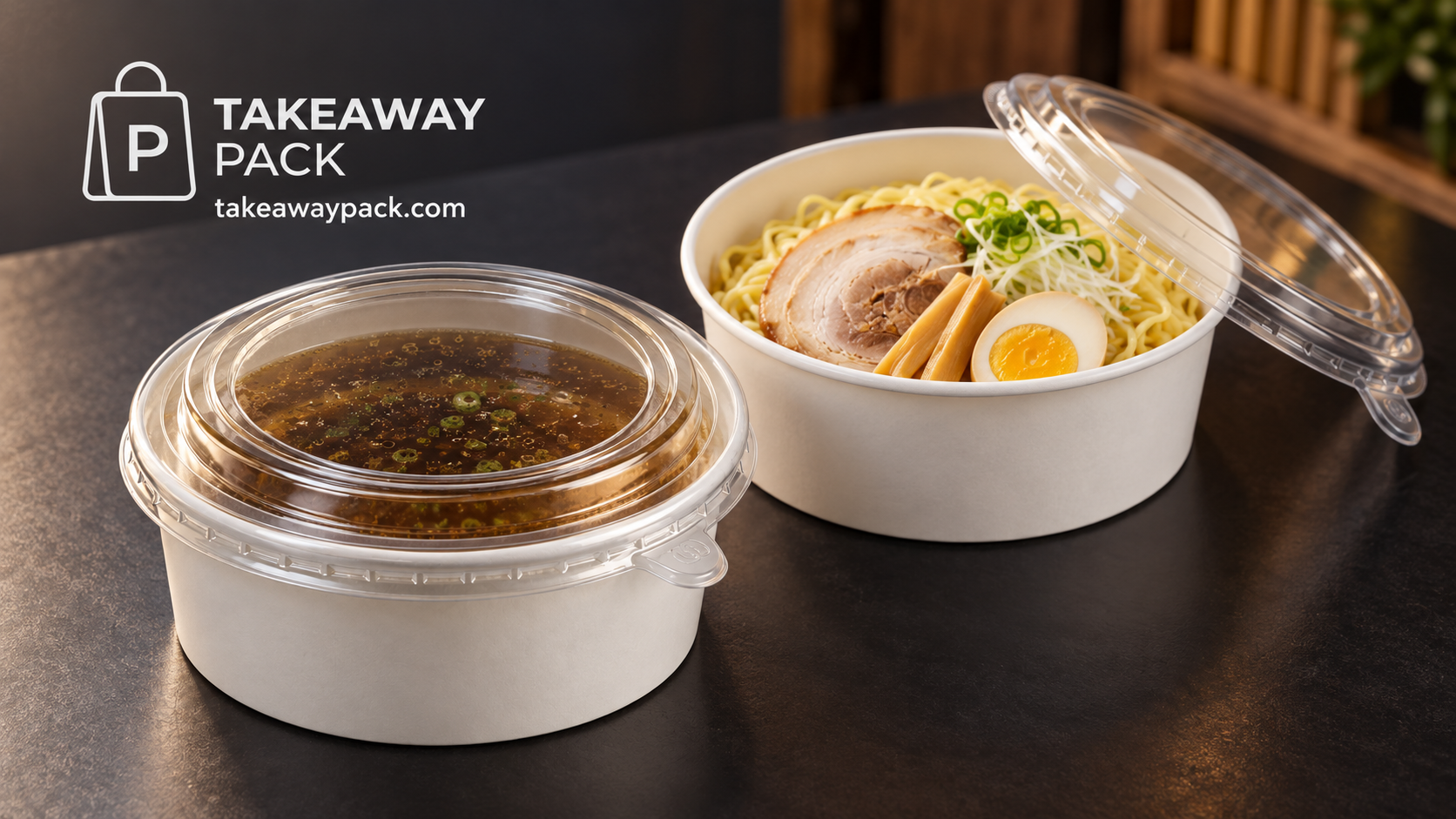
Here, broth is packed in one dedicated broth container while noodles and toppings go into a second, wider container. This creates the clearest dry-wet separation and gives the kitchen more freedom to protect toppings that should not sit in hot broth.
The trade-off is a larger packing routine: two containers must fit upright in the delivery bag, be clearly labeled for assembly, and be checked as one order. It is often the more sensible format when the route is long or the menu depends heavily on noodle texture.
Is an insert design better than packing everything in one soup bowl?
For a noodle soup that must arrive with springy noodles, an insert or a separate dry container usually gives a better starting point than putting noodles into the broth before dispatch. The key is not the insert by itself. The design must prevent contact with liquid during normal movement, stacking, and the expected holding time.
A single all-in-one bowl may still suit a short pickup journey or a menu item intended to be eaten immediately. It becomes a higher-risk choice when the noodle portion sits in broth while the order waits for a driver or travels across town.
Which container material should a ramen shop choose?
Material should be a screening question, not the final decision. A rigid plastic bowl, a paper-based bowl, or another foodservice format can only be evaluated with its exact matching lid, stated intended use, and a real menu test.
For broth, compare candidates as complete systems:
- the bowl’s shape and wall rigidity when filled;
- the exact lid that mates with that bowl;
- the insert or second container used for noodles;
- the practical fill line below the rim;
- the way the set sits in the delivery bag; and
- the condition of noodles, broth, and toppings after the longest normal route.
Do not transfer a claim from a material to every product made from that material. Likewise, do not assume a bowl is suitable for a hot, liquid-heavy order just because the catalog calls it a soup bowl.
What capacity should a separate-broth ramen package have?
Start from the restaurant’s measured portion, not from a popular ounce or millilitre number. Measure the broth separately from noodles, protein, vegetables, and any sauces. Then choose a broth container with enough usable room to avoid filling to the rim, plus a separate area sized for the dry components.
A useful packing trial should answer these questions:
- Does the broth stay below the lid’s sealing area at the intended fill line?
- Does the insert remain above the broth after the bowl is placed in the bag?
- Is the noodle portion loose enough that it is not compressed into a wet mass?
- Is there enough clearance for toppings without crushing them against the lid?
- Can staff repeat the same fill level and assembly sequence during a busy service?
If the answer to any of these is no, change the format or portion layout before buying at scale.
Should a ramen soup lid be vented?
There is no universal lid choice. Steam management matters, but any opening can also become a route for liquid when an order is tilted. For a broth container, containment and correct lid seating should be tested before choosing a vented format.
Never create ad hoc holes in a lid to solve a steam problem. That changes the closure into an untested system. Instead, ask the supplier whether the specific bowl-and-lid pair is designed for hot liquid use, how it should be handled, and whether its intended use includes venting.
For each candidate, run one test with the normal packing temperature and another after the expected delivery time. Check for lid lift, drips at the rim, water collecting above the noodles, and changes to the noodles’ texture.
How should ramen toppings be packed?
Separate toppings according to what they need during the journey. Components that should remain dry or cool should not be placed in hot broth merely to make the order look complete at dispatch.
A simple approach is to group components into three zones:
- Broth: liquid only, in the separate broth container.
- Noodles and substantial toppings: in the elevated insert or the second main container.
- Fresh garnishes and sauces: in small separate portions when they would wilt, soften, or mix too early.
Give the customer a short assembly instruction: combine the broth and noodles when ready to eat. This makes the separation deliberate rather than confusing.
What should be tested before ordering ramen containers in volume?
Test the complete package, not a dry empty bowl. Use the restaurant’s actual broth, intended portion, bag, and longest normal route or a realistic simulation of it.
A practical test sequence
- Fill the broth container to the proposed working fill line.
- Wipe the rim clean and apply the exact matching lid around the full circumference.
- Pack noodles and toppings in their proposed separate format.
- Place the full set in the normal delivery bag, upright and in its usual stack position.
- Move it through normal stops, turns, carrying, and wait time.
- Inspect the rim, lid, bowl body, bag, and adjacent items for liquid escape or movement.
- Open the set and assess whether broth reached the noodles, whether the noodles remained acceptable, and whether toppings were damaged.
- Record the component SKUs, fill amount, packing temperature, route time, and result.
Run the test more than once. A format that works once at a quiet counter is not yet a repeatable delivery system.
What should be included in a supplier inquiry?
Ask for information about a complete, matched configuration rather than a vague “ramen container.” Your brief should include:
- broth volume and target fill line;
- noodle, protein, garnish, and sauce portions;
- whether you want an elevated insert or two containers;
- expected delivery time and transport conditions;
- required bowl, lid, insert, and secondary-container part numbers;
- stated intended use for the exact paired components;
- sample availability, case packing, and the quote-specific MOQ; and
- whether the same pairing can be supplied on a reorder.
MOQ, delivery timing, product availability, and documentation are order-specific. Request them in writing for the exact configuration you test; do not base a purchase on a generic number from another product or market.
When is a separate-broth design worth the extra packing step?
It is worth considering when noodle texture is central to the dish, broth is hot and liquid-heavy, toppings need protection from steam, or the delivery journey is long enough for noodles to continue soaking. It may be unnecessary for a menu item that is collected and eaten immediately, or for a dish designed to be fully mixed before leaving the kitchen.
The right decision is operational as well as culinary. Choose the simplest system that passes the shop’s own hot-broth, movement, and customer-assembly test.
Need a ramen packaging brief?
Turn your measured broth volume, noodle format, route time, and preferred separation method into a clear inquiry before comparing options. Visit Takeawaypack to start the conversation.