How to Set Restaurant Packaging Sustainability Targets That Match Local Recycling and Composting Capacity
Many restaurant groups write "recyclable or compostable" into a packaging procurement standard before checking whether their own city can actually recover those materials.
2026-09-03 - 10 min read
Summary: Many restaurant groups write "recyclable or compostable" into a packaging procurement standard before checking whether their own city can actually recover those materials. When local sorting lines and composters cannot process the format, the packaging still ends up in landfill, the claim on the pack becomes a legal exposure, and procurement loses credibility internally. This article walks through the four checks to complete before you set a percentage target: what local processing facilities can physically handle, what collection rules allow into each bin, what supplier documentation you should require per SKU, and how far your customer-facing wording can go. It closes with a way to phrase the target so it stays true as infrastructure changes, and how to structure a supplier conversation that produces evidence instead of adjectives.
Why "Recyclable or Compostable" Is the Wrong Starting Point
A material property and a recovery outcome are two different things. A moulded fibre tray can be technically compostable and still be screened out of a commercial composter as a contaminant. A PP lid can be technically recyclable and still fall through a sorting screen because it is under two inches. A kraft bag can be recyclable in principle and rejected in practice because of a grease-resistant coating.
If your standard is written around the intrinsic property, you can hit 100% "recyclable or compostable" on paper while landfill volume stays flat. Worse, you have now printed a claim on thousands of units that regulators and customers can test against reality.
The more durable framing is recoverable in the markets where the packaging is actually used and discarded. That phrasing forces the four checks below, and it degrades gracefully: if a composter closes or a hauler changes its accepted list, your target language does not instantly become false.
Check 1: What Local Processing Facilities Can Physically Handle
Start with capability, not with claims. You are auditing machines and operating cycles, not marketing pages.
Recycling side
Ask your hauler and the receiving material recovery facility (MRF) directly:
- Which polymers and paper grades do they sort, and do they have end markets for the output? A material with no buyer is not recycled, it is stockpiled or landfilled.
- Can their optical sorters and screens handle the format, not just the resin? Small items, thin films, dark-pigmented plastics, and multilayer laminates commonly defeat sortation even when the base material is accepted.
- What contamination level triggers rejection of a load? Food residue on foodservice packaging is the single biggest reason a technically recyclable item is discarded.
- Are coated paper items (cups, clamshells, grease-resistant boxes) accepted, or excluded because the coating disrupts pulping?
Composting side
Commercial composters are more restrictive than most buyers expect:
- Do they accept packaging, or only food scraps and yard trimmings? Many accept only the latter.
- Do they accept compostable bioplastics such as PLA or PBAT, or do they screen them out to protect the value of their finished compost? Operators selling high-grade compost frequently ban all bioplastic film because visible fragments in the output are commercially unacceptable.
- What is their actual residence time? Certification test protocols run to fixed laboratory conditions and durations; a working facility may run a shorter cycle, which changes what fully disintegrates in practice.
- Is there any realistic home-composting pathway for your customer base, or is industrial-only the honest answer?
Geographic coverage
Recoverability is location-specific and time-specific. A chain operating in five cities may have five different answers, and suburban or rural sites often differ sharply from the urban flagship. Map it per location before you write a single number into the standard. If you operate across regions, expect that no single material choice will be "correct" everywhere.
Where municipal infrastructure is genuinely weak, evaluate the alternatives honestly: reduce material weight, move to a widely accepted mono-material, redesign for fewer components, or consider reusable systems for dine-in and pickup. These options often beat a certified material with no local pathway.
Check 2: What Collection Rules Actually Allow
A material only counts as recovered if a customer or a staff member can place it in the correct stream and it survives to processing. That is a rules question, not a materials question.
Confirm, per site and per waste authority:
- Whether curbside recycling accepts rigid plastics by resin type, flexible films, coated paper cups, and cartons — most programmes accept a narrower list than buyers assume.
- Whether compostable-labelled items are prohibited in recycling, which is common because they contaminate polymer streams.
- Whether a food-waste or organics collection exists at all, whether it is available to commercial premises, and whether packaging is accepted alongside food scraps.
- Whether certified compostable items are still refused because the receiving facility lacks the processing capability, which happens frequently.
- Whether the correct route for some items is a drop-off point rather than a bin, in which case realistic recovery rates will be low.
Also check the labelling side of the rules: which disposal icons or wording are required or restricted in each market, whether a "recyclable" statement must be supported by evidence of real access, and whether "compostable" must specify industrial conditions.
Document acceptance per packaging format, per market. A single spreadsheet with format down one axis and location across the other will tell you within an afternoon whether your intended target is achievable or aspirational.
Check 3: What Supplier Documentation to Require, Per SKU
This is where most procurement standards are too vague. "Supplier must provide certification" is not an auditable requirement. Specify the artefact, the scope, and the validity.
For compostability
- Third-party certification against a recognised industrial standard, with the certificate number, holder, scope, and expiry date — not a logo pasted into a PDF.
- Confirmation that the finished item is covered, including inks, adhesives, labels, coatings, and any barrier layer. Certification of the base resin or base board alone does not cover your printed SKU.
- Separate certification if you intend to make any home-composting statement; industrial and home compostability are different tests and different scopes.
- Test reports behind the certificate: disintegration, biodegradation, ecotoxicity, and heavy-metal limits.
- Whether the certificate is held by the material producer or by your actual supplier, and whether your order will be produced within that certified scope.
- Explicit treatment of fluorinated substances, since many jurisdictions and certification schemes restrict intentionally added PFAS in fibre-based foodservice items.
For recyclability
- Full material composition disclosure and resin or grade identification.
- A design-for-recycling assessment against the guidance used in your destination market, plus evidence of sortability for the specific format.
- Evidence of acceptance in the recycling systems where the item will be discarded — not a generic statement of technical recyclability.
- Chain-of-custody documentation if you plan to claim recycled content, plus clarity on whether the content is post-consumer or post-industrial.
On the supplier's process
Ask for a bill of materials, and ask whether closures, windows, labels, coatings, and adhesives were included in whatever assessment they cite. Ask where the item is produced, since certificate scope is site-bound. And ask about the trade-offs: does a change that improves recyclability shorten shelf life, weaken leak resistance, or increase food waste? A packaging decision that raises spoilage is not an environmental win.
Treat "eco-friendly", "biodegradable", and "bio-based" as non-answers. None of them is a compostability claim, and in several jurisdictions "biodegradable" on plastic packaging is itself restricted.
Check 4: Where Your Customer Communication Has to Stop
Your claim ceiling is set by infrastructure access, not by your certificate folder.
Under the U.S. FTC Green Guides, an unqualified "recyclable" claim is only appropriate when recycling facilities are available to a substantial majority of consumers or communities where the item is sold, and the Guides define that threshold as at least 60 percent (16 CFR Part 260). Below that, claims must be qualified, and the weaker the access, the stronger the qualification the Guides expect. The compostability provision works the same way: compostable claims should be qualified where municipal or institutional composting facilities are not available to a substantial majority of consumers, and where an item cannot be safely composted at home, that limitation should be disclosed clearly and prominently. The FTC's own overview of the Guides is a useful reference point for teams drafting claim policy (FTC Green Guides).
Practically, that produces wording rules like these:
- Not "This box is recyclable" but "Recyclable where facilities exist — check your local programme."
- Not "Compostable" but "Commercially compostable where accepted; not suitable for home composting."
- Never present "biodegradable" as a synonym for compostable.
- Keep instructions specific and actionable: which part to separate, which bin, what to do if there is no organics collection.
Set the internal governance too: who approves an environmental claim, what evidence must exist in the file before it is printed, how customer-service staff answer disposal questions, and how claims differ by market. Keep a substantiation folder — certificates, test reports, facility acceptance confirmations, infrastructure notes — and review it when contracts or municipal rules change. Claims age; the file has to age with them.
Writing the Target So It Stays True
A workable structure has three tiers rather than one percentage:
- Recoverable and claimable — local acceptance confirmed, supplier evidence complete for the exact SKU, so a qualified claim is defensible.
- Recoverable but not claimable — evidence exists, but access is too limited for on-pack language, so the item ships with disposal guidance and no claim.
- Neither — technically recyclable or compostable on paper, no realistic pathway, no claim, and a candidate for redesign or replacement.
Then define your terms inside the standard: "recyclable" means accepted by identified recovery systems in the markets where the item is discarded; "compostable" means certified and accepted by identified composting facilities. Set targets on tier 1 and tier 2 combined, with a separate tracked commitment to shrink tier 3. Sequence the work: inventory current packaging, survey local facilities and haulers, audit supplier evidence, pilot the preferred formats against real collection rules, run claim language past legal, and only then publish numbers.
Getting Usable Answers From a Packaging Supplier
The bottleneck is usually not the material — it is whether your supplier will answer at SKU level. A useful supplier conversation includes the destination market, the exact format and dimensions, the coating or barrier, the print method, and the claim category you are considering, because document scope depends on all of them.
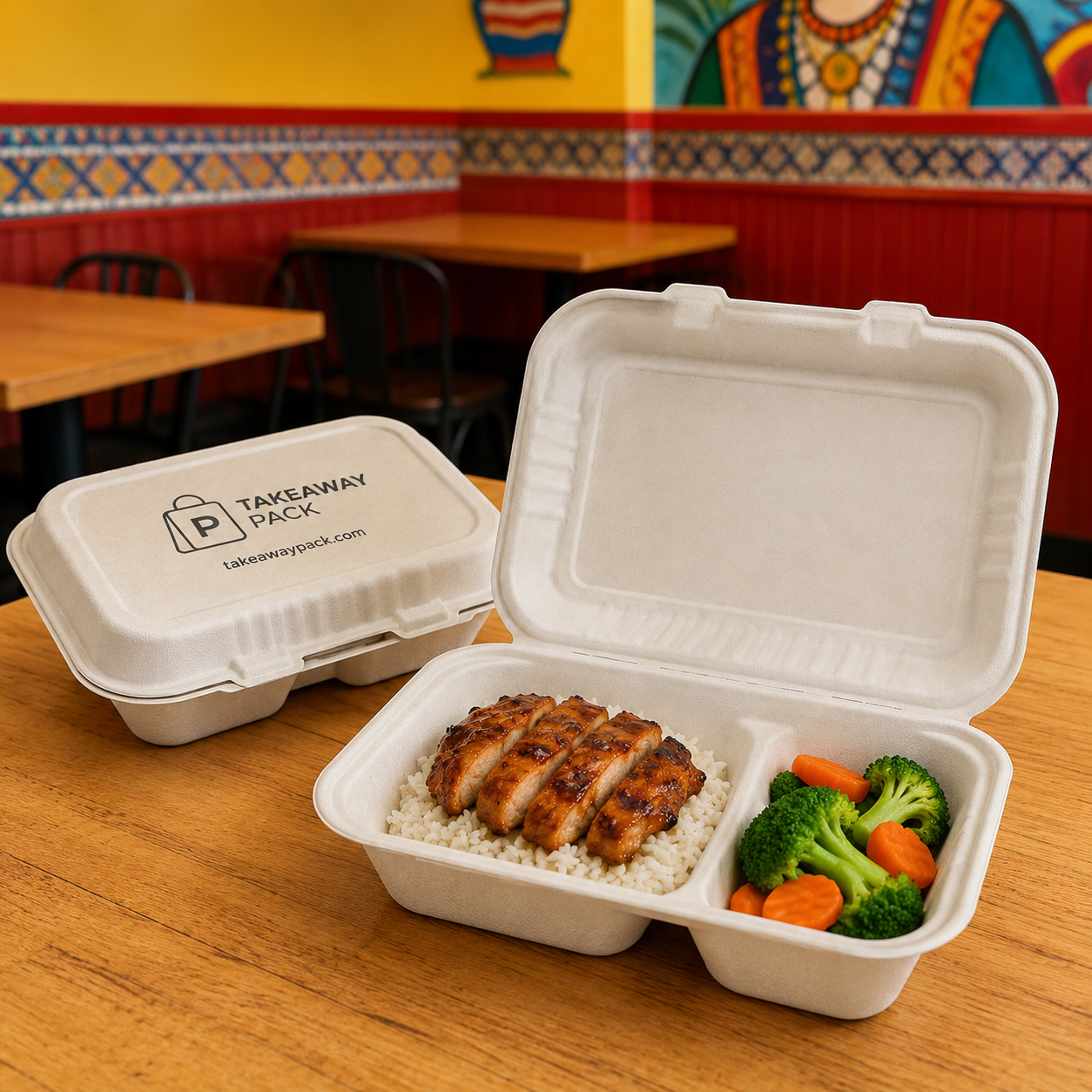
At Takeawaypack, an operator of its own printing facility working with a number of disposable foodservice packaging factories, RFQ handling is built around that level of specificity: product or category, material, size and capacity, quantity, printing and logo requirements, and destination port or country, with structure, coatings, capacity, lid matching, and carton packing discussed during quoting rather than after. The product catalogue spans cups, bowls, boxes, containers, trays, lids, bags, and cutlery, and the internal product records carry the material field explicitly per item — plant fibre pulp, sugarcane bagasse, kraft paper, PP, PS, OPS, PET, or aluminium foil — which is exactly the starting data you need when you are checking a format against what a local MRF or composter will take. Documentation scope for food contact, fibre sourcing, recycled content, origin, and compostability is confirmed against the specific SKU, quantity, and destination market rather than asserted as a blanket property, and custom-printed orders proceed from a digital proof that you approve in writing before production. Flexible small-batch runs make it feasible to trial one format in one location before you commit a network-wide target.
That is the behaviour to look for in any supplier, whoever you buy from: material stated per item, documentation scoped per SKU and per destination, and no environmental conclusion offered that your own local facilities cannot support.
If you are building a packaging standard this quarter and want to work through format-by-format options and the document scope for your destination markets, start the conversation at https://takeawaypack.com — bring your facility acceptance list, and the specification discussion gets much shorter.