Safest Material for Takeaway Food Containers: Choose by Use Conditions, Not Material Names
There is no universally safest material for takeaway food containers. A material name alone does not establish that a finished pack is appropriate for a particular meal. The practical decision is to match the complete container system—base, lid, coatings, inks, labels, and closure—to the food, fill temperature, contact time, handling route, destination market, and evidence available for that exact configuration.
2026-08-21 - 6 min read
Summary
There is no universally safest material for takeaway food containers. A material name alone does not establish that a finished pack is appropriate for a particular meal. The practical decision is to match the complete container system—base, lid, coatings, inks, labels, and closure—to the food, fill temperature, contact time, handling route, destination market, and evidence available for that exact configuration.
Why “paper,” “plastic,” or “fiber” is not a safety conclusion
Material labels are useful starting points, not final answers. They do not describe every layer, additive, coating, printed area, adhesive, or lid that forms the finished article.
They also do not describe how a pack will be used. A dry chilled salad, a hot broth, an acidic sauce, and an oily curry can impose very different conditions on the same-looking container.
A safer procurement decision therefore begins with a defined intended use, rather than a preferred material name.
Assess the complete takeaway-container system
A takeaway pack is a system, not just a bowl or box. Review the base and lid together, along with any coating, laminate, print, label, adhesive, seal, and closure feature used in the supplied configuration.
Define the food and contact conditions
Write a brief for each menu item or menu family. It should state whether the food is dry, aqueous, acidic, salty, oily, chilled, hot-filled, or reheated.
Also state the planned fill temperature, maximum contact duration, holding conditions, transport time, and whether the food may be stored, frozen, or reheated after handoff. Do not assume that an evaluation for one combination applies to another.
Include temperature, time, and fat content together
Temperature is only one variable. A short hot hold and a long delivery route are different use conditions. Fatty foods and sauces should be identified explicitly, rather than grouped under a generic “hot food” label.
The question for a supplier or technical reviewer is not “Is this material safe?” It is “Does the available evidence cover this complete configuration under these stated food, time, and temperature conditions?”
Treat the lid as part of the decision
A lid affects closure fit, headspace, steam handling, stacking, and the chance that food reaches a seam or rim during transit. The selected lid must be identified by part number or other unambiguous product identity.
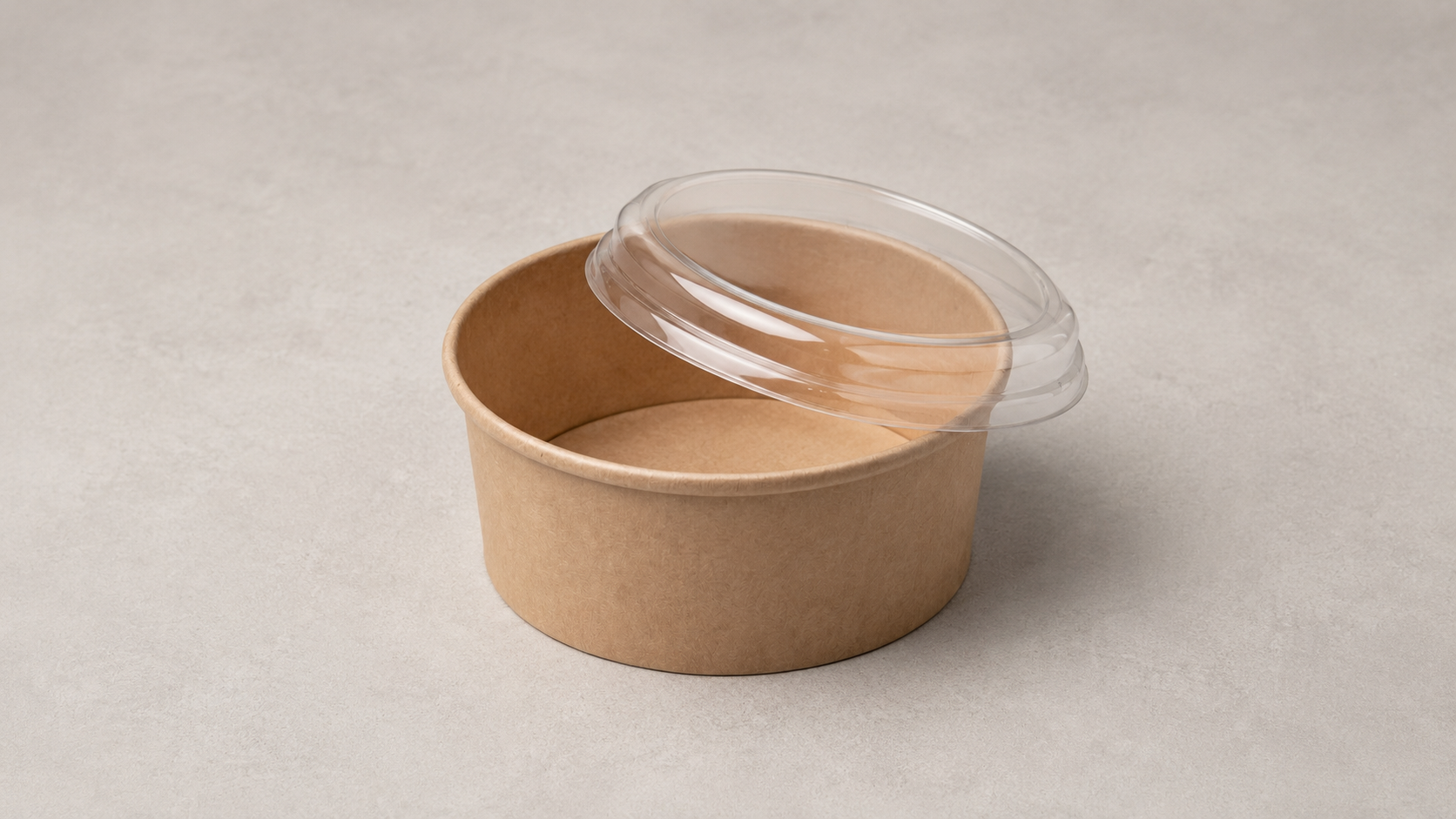
A photograph of a lidded form can help a team discuss shape and presentation. It cannot demonstrate suitability, leak resistance, heat tolerance, food-contact status, or any other performance characteristic.
Separate evidence questions from operational questions
Technical evidence and route performance answer different questions. Both matter, and neither should be inferred from a material label or a product image.
Evidence and test scope
Ask what the document or test actually covers: the finished article or only a component; the identified SKU or a broader family; the stated food categories; the contact time; and the temperature range or other conditions used.
Record the document type, issuer, issue date, version, product identity, material construction, and any limitations. If a coating, lid, print, adhesive, or supplier changes, check whether the prior evidence still applies before relying on it.
Avoid translating a narrow result into a broader marketing statement. Evidence that is limited to one item or one condition should remain limited in the procurement record.
Real-menu and route evaluation
Run a separate practical evaluation with the actual menu. Pack portions at the normal fill level, apply the normal closure, and use the intended hold, stack, bagging, and handoff process.
Include the route conditions that matter to the operation: delay before collection, vehicle movement, stacking, temperature loss, and customer opening. Inspect the pack at dispatch and arrival, and record observations such as closure engagement, visible deformation, sauce migration, condensation, presentation, and handling issues.
A single successful trial is an observation, not a blanket claim. Repeat or expand the evaluation when the menu, route, portion, packing method, or configuration changes.
A practical route for hot, oily, and saucy meals
For a hot, oily, or high-liquid menu, start by defining the meal rather than choosing a material category. Note broth or sauce volume, fat content, particulates, fill level, expected hold time, and whether the customer may reheat the food.
Then shortlist complete configurations that can be identified clearly. Request the relevant scope information for each candidate, and keep the candidate base and lid paired throughout evaluation.
Finally, run the real-menu route check. This sequence prevents a team from treating a broad material description as proof for a demanding use case.
Supplier document checklist for container procurement
For every candidate configuration, request and file a structured package of information:
- SKU, drawing, photo, or other product identity for the base and lid;
- material construction, including relevant layers and components;
- the stated intended food types, contact conditions, and limitations;
- declarations, test reports, or other supporting documents, with scope and version;
- document issuer, issue date, and traceable product reference;
- information needed for the destination market’s own review and labeling decisions; and
- change-control details for material, coating, print, adhesive, closure, or manufacturing changes.
This is a request list, not a statement that every supplier has every document or that any document proves all uses. Procurement should review what is actually supplied against the intended-use brief.
Make the purchasing decision traceable
A useful buying record links each decision to a menu and a configuration. It should show the menu conditions, selected base and lid, evidence reviewed, route-evaluation observations, remaining uncertainties, approver, and next review date.
Do not let price, appearance, or a broad sustainability label replace this record. Those factors may influence selection, but they do not answer the intended-use question.
A simple decision sequence
- Describe the food, time, temperature, and route.
- Identify the complete base-and-lid configuration.
- Request documents with a defined product and condition scope.
- Review scope and limitations against the intended use.
- Evaluate the actual menu on the actual route.
- Document the decision and recheck it when the configuration or use changes.
Next step for takeaway-container sourcing
Use an intended-use brief when opening a packaging conversation. It creates a clearer basis for comparing configurations without assuming performance from a material name or visual reference.
For a neutral starting point to browse packaging forms, visit TakeawayPack. Any product-specific technical, documentation, or use-condition question should be evaluated for the exact configuration and intended use before a purchasing or product claim is made.