Leak-Proof Takeaway Containers for Soup and Saucy Meals on Scooter Deliveries
For soup-heavy or sauce-heavy delivery meals, a “leak-proof” claim should be treated as a packaging-validation question, not a label to accept at face value. Cloud kitchens and virtual brands should match the container, lid, fill level, and carry orientation to the real scooter route, then confirm the choice with samples and a documented practical test before ordering at scale.
2026-08-11 - 5 min read
**Summary:** For soup-heavy or sauce-heavy delivery meals, a “leak-proof” claim should be treated as a packaging-validation question, not a label to accept at face value. Cloud kitchens and virtual brands should match the container, lid, fill level, and carry orientation to the real scooter route, then confirm the choice with samples and a documented practical test before ordering at scale.
Why scooter delivery exposes weak packaging choices
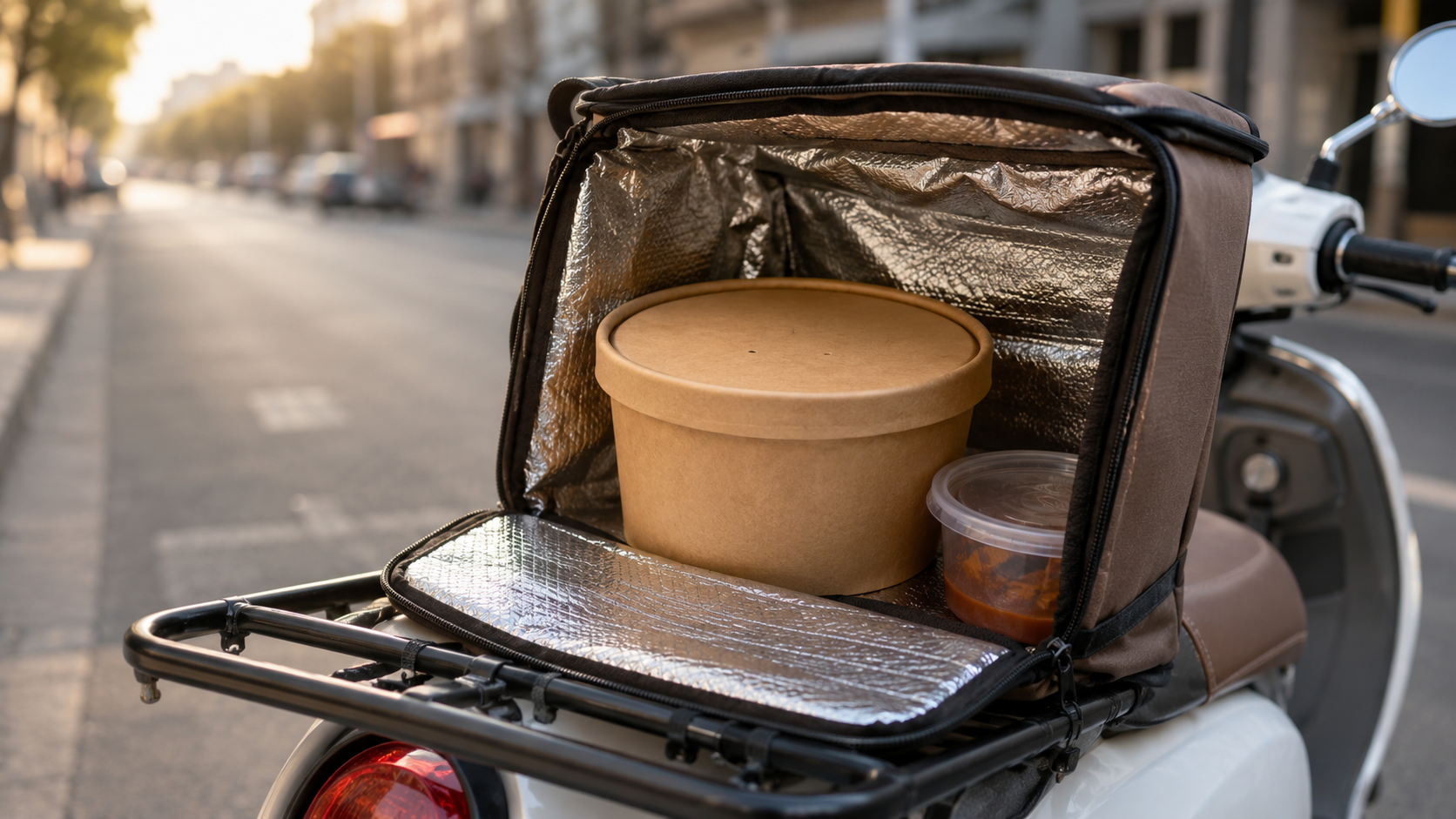
A delivery bag on a scooter is a demanding environment for a filled meal. Road vibration, turning, braking, tilting, stacked orders, and a warm meal that builds internal pressure can all challenge the closure. A container that appears secure on a level counter may still allow liquid or grease to escape when it is carried at an angle.
For a cloud kitchen, one failed pack can affect more than the food itself. A leak can soften outer packaging, contaminate other orders, obscure labels, and leave a customer with a poor first impression of a virtual brand. The right decision begins by defining the actual delivery condition rather than choosing a container by appearance alone.
Start with the meal, not the word “leak-proof”
Different dishes create different risks. Thin broths can find a small gap quickly. Oily sauces may travel along a rim or lid interface. Thick sauces may be less mobile but can still spread when a hot, overfilled container is tilted. Food particles on the sealing surface can also interfere with a clean closure.
Build the specification around the meal:
- **Food state:** hot, chilled, oily, acidic, brothy, or thick-sauced.
- **Fill level:** leave realistic headspace instead of testing an overfilled pack only when it is upright.
- **Portion and geometry:** select capacity and shape for the prepared portion, not just the menu description.
- **Lid fit:** confirm the intended lid matches the exact container format.
- **Route profile:** consider delivery time, rider transport, stacking, turns, and handoff.
The goal is not to promise that one container works for every dish. It is to identify a repeatable pack configuration for a specific menu item and delivery route.
What a practical leak-validation check should include
Buyers asking for test data or samples are asking the right question. If formal, SKU-specific performance data is needed, request the relevant documentation for the exact finished configuration and intended use. Do not treat a generic statement, a photo, or an unrelated report as proof for a different container-and-lid combination.
A practical in-house check can complement supplier documentation. Use representative prepared food or a safe liquid substitute at the intended fill level. Close the pack as staff would during a busy service, then observe it through the movements that matter: gentle tilting, carrying in the expected orientation, short simulated vibration, and stacking with the other components of the order. Record the container and lid, fill level, food condition, test steps, and result. This creates a useful approval reference for repeat orders and training.
Check not only for a visible spill. Inspect the rim, lid edge, exterior wall, base, and outer bag for weeping, grease transfer, deformation, or a closure that has shifted. A package can avoid a dramatic leak and still fail the customer experience.
Keep the closure clean and the headspace realistic
Operational details often decide whether an otherwise suitable package performs well. Train packers to wipe the rim when needed, seat the lid evenly, and use the approved fill level. If a dish is routinely filled to the edge, the packaging choice or portioning process may need to change.
For meals with a separate sauce, consider whether the sauce should travel in its own appropriately matched container instead of sharing the main entrée pack. For a liquid-heavy menu item, do not assume a lid used on another format will perform the same way. Exact container-and-lid matching matters.
Evaluate the complete delivery pack
The food container is only one part of the system. The outer bag, tray, carrier, dividers, tamper-evident approach, and order arrangement can either protect the closure or add pressure to it. Place the heaviest and most stable items where they will remain level. Avoid letting a tall pack lean against a hot or heavy item that can push the lid edge during transit.
Repeat the test with the whole order, not just a single container. This is especially important for virtual brands that run multiple menus from one kitchen: the packing standard should be clear enough that staff can apply it consistently at speed.
Ask suppliers questions that support a real approval decision
A focused RFQ reduces uncertainty. Give the supplier the menu use case, target capacity, material preference, expected quantity, delivery destination, and any printing or branding needs. For a soup or sauce application, include the intended food condition, the exact container and lid under consideration, expected fill level, and the type of evidence or sample review you need.
TakeawayPack’s public sourcing information supports RFQs that define product or category, material, size or capacity, estimated quantity, print or logo requirements, and destination. During an inquiry, buyers can discuss structure, coating, capacity, printing, lid matching, and carton packing. TakeawayPack also states that it can support samples, drawings or print-file alignment, plus packaging and export-handoff communication. These are useful inputs when a delivery pack must be validated before a larger commitment.
Move from a promising sample to a controlled packaging standard
Once a configuration passes your practical check, capture it as an approved pack standard: the exact container and lid, portion or fill guidance, closing steps, outer-pack arrangement, and the date and conditions of the check. Re-test when the menu, recipe, supplier, container format, lid, or route changes.
For TakeawayPack buyers, a clear inquiry is the best next step: share the dish, capacity, expected quantity, target market, and the scooter-delivery conditions you need to validate. Start with the product range and RFQ details at TakeawayPack to align samples, lid matching, and pack specifications before scale-up.