How to Standardize Corporate Catering Packaging for Daily Bulk Orders: Labels, Seals, and Boxes That Prevent Mix-Ups
Handling a daily corporate catering order of 150 meals with individual dietary restrictions, name labels, and multi-floor delivery requires a repeatable packaging system — not improvisation.
2026-09-07 - 12 min read
Summary: Handling a daily corporate catering order of 150 meals with individual dietary restrictions, name labels, and multi-floor delivery requires a repeatable packaging system — not improvisation. This guide covers the meal-by-meal labeling format, packing station workflow, transport box standardization, and packaging specifications that help restaurant operators, food trucks, and caterers deliver the right meal to the right person at the right floor without errors.
Why Corporate Catering Distribution Breaks Down (And Why Labels Alone Aren't Enough)
A daily 150-meal corporate order is a logistics problem as much as a cooking one. Even when the kitchen gets every dietary restriction right, the distribution stage introduces three failure points:
Identification. Names are misspelled, handwriting is illegible, and "I'll take anything" eaters grab meals meant for someone with a nut allergy. When 150 meals travel in unmarked transport boxes, a single misread label sends the wrong meal up the wrong elevator.
Handoff. A delivery driver or office coordinator has to match individuals to meals under time pressure, often in a busy lobby. If the meals aren't categorized and labeled in a way that lets someone make the right call in three seconds, errors multiply.
Replenishment and re-routing. When one category runs low, staff start "borrowing" from another category. Labels get separated from containers. The vegan meal ends up in the standard box, and the gluten-free meal goes to someone who ordered regular.
The solution is not better labels. It is a standardized packaging system — containers, seals, labels, and transport boxes — that forces every meal to stay in its correct category from your packing station to the employee's desk.
Start Here: The Corporate Catering Packaging Checklist
This checklist is operational. It is designed so you can brief a kitchen team, not just "hope it works."
1. Define your meal categories — and what does not become a category
For most corporate catering orders, keep the category set stable and small. A practical set:
- Standard
- Vegetarian
- Vegan
- Gluten-free
- Dairy-free
- Nut-free (or "nut-aware" depending on your policy)
What you want to avoid: creating a separate category for every combination ("vegan + gluten-free + soy-free") unless the order genuinely requires it. Combination diets are real, but your packing system collapses when categories explode. A practical compromise: keep the six main categories and create a small "special handling" list for true exceptions.
2. Build an intake form that separates preference from allergen
On your catering order form, separate these two questions:
- Diet preference: vegetarian, vegan, etc.
- Allergen concern: gluten, dairy, nuts, sesame, shellfish, etc.
Do not force the corporate client to guess what matters most. Let them choose one primary category, then add a note for special handling. This reduces the number of edge cases your kitchen has to handle.
3. Plan for late changes and day-of adjustments
Assume you will have:
- Employees who register late
- People who forget what they ordered
- Individuals who change their selection that morning
Your packaging system should absorb these changes without forcing a full re-sort. That is where pre-printed blank labels and a controlled exception process matter.
4. Confirm packaging format before the first order
For multi-diet corporate catering, individual packaging is the cleanest way to prevent mix-ups — especially for gluten-free, dairy-free, and nut-free categories. If you use platters for standard and vegetarian meals, keep every special-diet meal individually packaged and sealed so they cannot be "accidentally shared" during transport.
5. Lock in the label format before printing
Printed labels (or printed stickers) with a consistent layout are non-negotiable at 150 meals per day. Handwritten labels fail when the handwriting is inconsistent, the marker smears, or the label is too small to read in a dimly lit lobby. Specify the format with your packaging supplier up front.
The System: Standardized Packaging + Color-Coded Labels + Zone-Based Packing
The core idea: make the correct meal obvious at a glance, and route meals through the packing station without anyone having to "think" about which container goes where.
Color coding that works at a glance
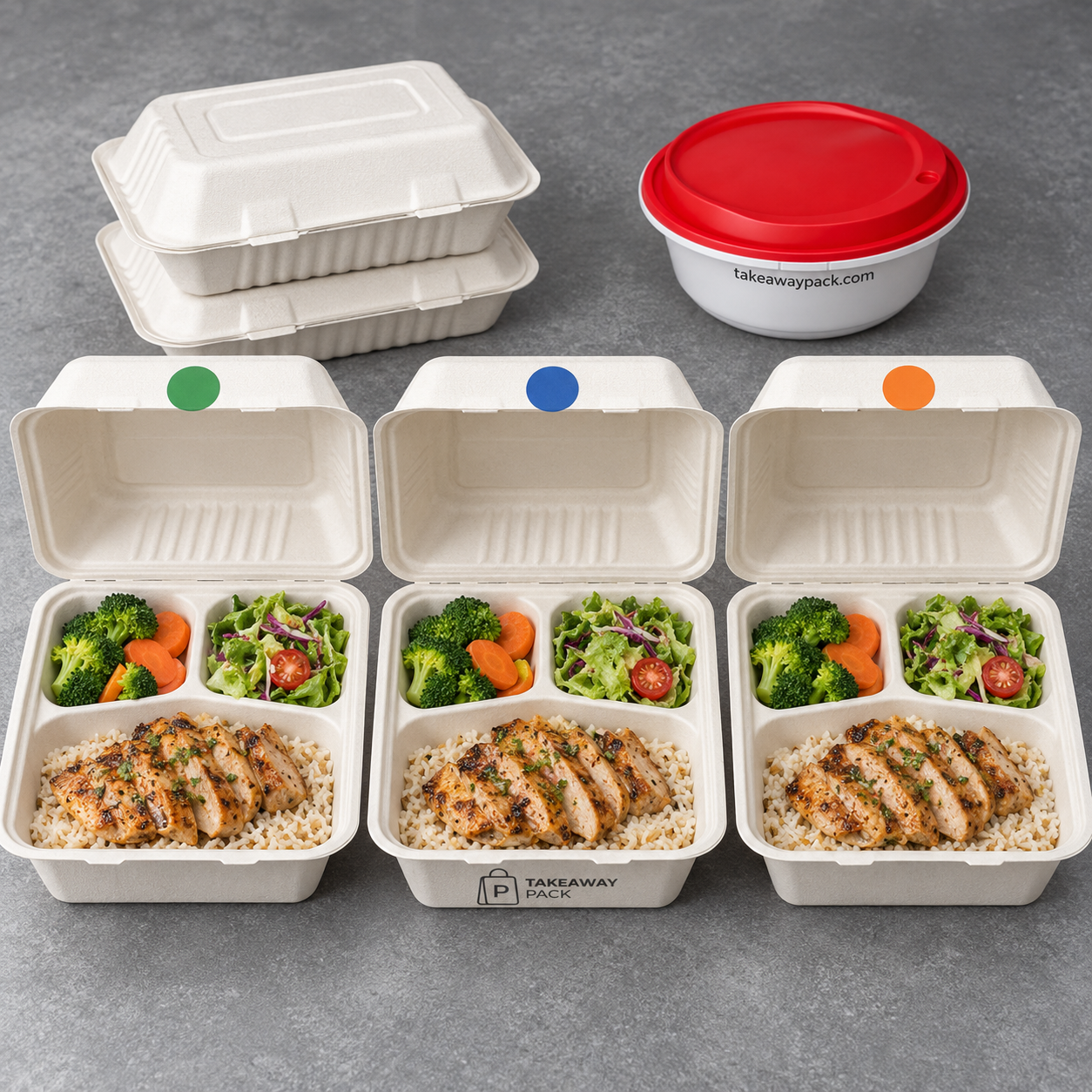
Color coding only works if it is consistent, large enough to see from across a packing table, and used everywhere — on labels, on transport boxes, and on the delivery manifest.
Pick six colors that are clearly different under fluorescent kitchen lighting and office lobby lighting. Avoid "two blues" or shades that look the same at a distance.
Where to use color:
- On the meal label: a large color stripe or icon
- On the transport box: a matching color sticker or tape on the side
- On the delivery manifest: a color legend that the office coordinator can reference
Zone-based packing for the packing station
If every meal goes through one packing station, one slow interaction becomes everyone's problem. Set up packing zones:
- Zone A: Standard meals (fastest, highest volume)
- Zone B: Vegetarian and Vegan (medium volume)
- Zone C: Allergen-managed meals — gluten-free, dairy-free, nut-free (slower, requires double-checking)
This prevents a single "is this gluten-free?" conversation from stalling your entire 150-meal pack-out.
Name-and-category matching
Two methods work at scale:
Method 1 — Alphabetized tray racks. Pre-sort labeled meals into open trays by last name initial. A single worker can scan the rack and pull meals for a specific floor in under a minute.
Method 2 — Floor-zone grouping. Label each meal with the delivery floor as a secondary marker. Pack meals for floor 3 into one transport box, floor 5 into another, and so on. The office coordinator receives pre-grouped boxes and distributes within each floor.
Labeling That Prevents Mix-Ups at Scale
Labels are not decoration. They are the last line of clarity between your packing station and the employee's lunch break.
What every meal label should include
Every individually packaged meal label should include:
- Employee name (large, readable font)
- Diet category (very large text — this is the primary cue)
- Key allergen note (short, standardized wording such as "Contains dairy" or "No nuts")
- Delivery floor (secondary, but essential for multi-floor orders)
- Visual cue (color stripe, icon, or both)
Example label layout:
TOP: "GLUTEN-FREE" (large, bold) MIDDLE: "Taylor R." BOTTOM: "Contains dairy" (small, only if verified) LEFT: Green stripeHow to label gluten-free without implying allergen-freeOne of the most common confusion points: people read "gluten-free" and assume it means "safe for everything." A safer approach is to label clearly:
- "GLUTEN-FREE (see allergen notes)"
- Or "GLUTEN-FREE — NOT allergen-free"
Only include allergen notes if they are backed by your kitchen's documented process. When in doubt, use cautious wording and direct the office coordinator to the exception contact.
Handling dietary overlaps without creating 12 categories
You will have overlap diets — vegetarian + gluten-free, vegan + nut-free. Two clean options:
Option 1 — Treat overlaps as "special handling." Keep the six main categories stable. Meals with overlapping restrictions go into a small special set that is handed out by the office coordinator, not the general box.
Option 2 — Two-part labels. Example: "VEGAN" as the primary category with "GLUTEN-FREE" as a secondary marker. This works only if your packers are trained and the system is consistent.
If you are running this system for the first time, start with Option 1. It is easier to control.
Where labels fail
Labels fail when they are:
- Inconsistent (different formats across different meal types)
- Too small to read from arm's length
- Placed on lids that get separated from containers during transport
- Only present on one side of the package
Test this: after packing, stack a few meals in a transport box, close the lid, then open it and see how many labels are still readable. If meals are stacked, labels need to be visible without moving containers around.
The Packing Station: How to Set Up a 150-Meal Assembly Line
Even a good label system can collapse if your packing station is disorganized.
Station layout
A linear layout works best for volume. From left to right:
- Container station: stacks of containers, lids, and seals for each category
- Label station: pre-printed labels sorted alphabetically or by floor
- Packing station: one person placing meals into containers
- Sealing station: one person applying lids and tamper-evident seals
- Transport box station: one person packing sealed meals into transport boxes by category and floor
Tamper-evident seals for corporate catering
Corporate clients expect sealed meals. A tamper-evident sticker or seal across the lid and container body serves two purposes: it prevents the meal from opening during transport, and it signals to the recipient that the meal has not been disturbed.
For allergen-managed meals, the seal does something more important. It is physical proof that nobody opened the container between your kitchen and the employee's desk — which is exactly the assurance a person with celiac disease or a nut allergy needs before eating a meal they did not watch being made.
Check with a packaging supplier like takeawaypack.com about tamper-evident seals and custom-printed stickers that can double as name labels. When you are producing 150 meals daily, combining the name label and the tamper-evident seal into one sticker saves a step — and one fewer step across 150 meals is real time back in your day. Custom printing is available at low minimum order quantities, so you do not need to commit to a year of stock to test a label format.
Assigning a packing runner
Designate one person as the packing runner. Their job is to:
- Monitor category counts and replenish containers at each station
- Handle exceptions (unlisted diets, last-minute changes)
- Verify that every transport box has the correct label
This protects your packers from making judgment calls they should not be making. It also gives you a single point of accountability: if a meal goes to the wrong floor, you know exactly which step in the process to review.
A quick end-of-pack audit
Before the boxes leave, run a 60-second audit. Count the meals in each allergen-managed category against the order sheet. Confirm every box has a floor label on two sides. Spot-check three labels at random for readability. This is the cheapest error prevention available to you, and it catches the kind of mistake that costs a recurring account.
Transport Box Standardization: Keeping Categories Separate in Transit
The meal is correctly packed and labeled. Then it goes into a transport box, rides in a delivery vehicle, and gets unloaded in a lobby. The transport box is where categories mix.
Box specifications
Standardize on a single transport box size that fits your meal containers without crushing them. For 150 meals, you will need approximately 5–8 transport boxes depending on container size. Each box should:
- Be rigid enough to stack without collapsing
- Have enough headroom so lids are not pressed against the box above
- Be labeled on the outside with the category and floor
Category separation within transport boxes
Two approaches:
Approach A — One category per box. When volume allows, dedicate one transport box per dietary category. The office coordinator opens one box and knows every meal inside is gluten-free. This is the safest option and the fastest to unpack, but it costs you box count — at 150 meals across six categories plus multiple floors, you may end up carrying half-empty boxes.
Approach B — Dividers within a single box. When you need to consolidate (e.g., only 10 nut-free meals), use cardboard dividers to separate categories within the same box. Clearly label the divider from above so the coordinator can see the separation without lifting meals. The risk here is that dividers shift in transit; tape them to the box floor or choose boxes with slotted divider channels.
A practical rule: use Approach A for the three allergen-managed categories, where a mix-up carries real risk, and Approach B for standard and vegetarian meals, where consolidation saves space without creating safety exposure.
The floor label
Every transport box needs a floor label printed in large type. This seems obvious, but it is the most common thing to skip when packing at speed. Prefix the floor number with the dietary category: "FLOOR 5 — GLUTEN-FREE" and "FLOOR 5 — STANDARD."
Put the floor label on two adjacent sides of the box. Boxes get stacked and rotated during loading, and a label on a single face disappears the moment the box is turned. If your client's building has a service elevator with a strict schedule, add the delivery window to the same label so the driver does not have to consult a separate sheet.
How to Vet Your Packaging Supply for Multi-Diet Reliability
You need a packaging supplier who can deliver printed labels, tamper-evident seals, and consistent containers at volume — not just someone who sells boxes.
Questions to ask a packaging supplier
- "Can you provide printed labels with category names and a color stripe?"
- "Can you supply tamper-evident seals that also serve as name labels?"
- "What is the MOQ for custom-printed containers and labels?"
- "Can you supply compartment trays that keep different food items separate within one meal?"
These questions separate suppliers who understand bulk corporate catering from those who only stock standard inventory.
Signs a supplier has done corporate catering volume before
Look for practical competence:
- They ask about your category counts early
- They talk about label formats and color coding without prompting
- They can handle "six meal categories per day, 150 meals" without sounding surprised
- They offer a range of container sizes that fit different meal types
If a supplier only talks about unit price and not the handoff logistics, you will be solving the packaging problem yourself.
Why container choice matters for corporate catering
The container itself affects how fast you can pack. Lock-lid PP bowls (750–2000ml) close quickly and stay sealed during transport. Compartment trays keep hot and cold items separate without extra wrapping. Kraft soup tubs with PP lids handle saucy dishes without leaking. Choose containers that seal cleanly and can be labeled easily — textured surfaces make labels hard to read.
For corporate catering, consider these container types:
- Lock-lid PP bowls: fast sealing, leak-resistant, stackable
- Compartment trays: keeps sides separate, ideal for boxed lunches
- Kraft soup tubs: good for soup-heavy menus, fit standard PP lids
- Clear PET containers: lets recipients see the meal without opening the seal
Make Corporate Catering a Repeatable Revenue Stream
A daily 150-meal corporate order is a high-value recurring revenue stream — but only if your packaging and labeling system makes it easy for the client to say yes again.
Standardize everything you can:
- Use the same container format every day so your packers build muscle memory
- Pre-print labels in batches once the weekly order is confirmed
- Keep a stock of blank labels for last-minute changes
- Deliver transport boxes that are pre-sorted by floor and category
When the office coordinator receives boxes that are clearly labeled, pre-sorted, and easy to unpack, they will trust you with the next order. And the one after that.
If you are setting up a corporate catering packaging workflow for the first time, start with the checklist above. Get the container, label, and transport box format right, then scale. For printed labels, tamper-evident seals, custom-printed containers, and compartment trays suited to daily bulk catering, check with a supplier like Takeawaypack to see what fits your volume and menu.
The goal is not fancy packaging. It is correct, calm, and repeatable — every single day.