
How to Stop Soup During Delivery: Matching Bowls, Lids, Seals, and Packing Methods
Soup, noodle soup, and stew delivery leaks are rarely caused by a single faulty container. The real problem is that the bowl, the lid, the sealing method, and the packing process are bought and treated as separate items — when they actually function as a single system.
2026-09-07 - 12 min read
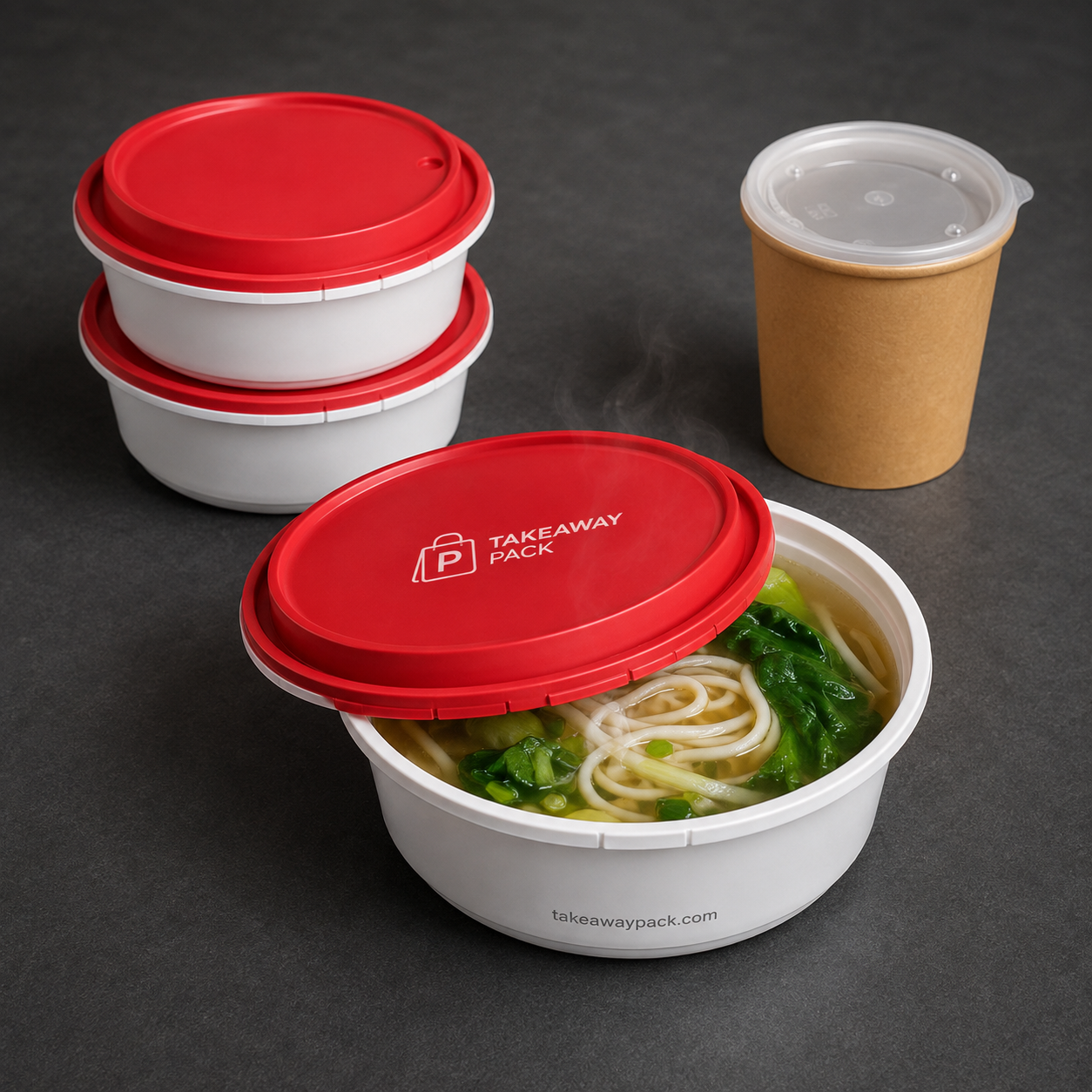
Soup, noodle soup, and stew delivery leaks are rarely caused by a single faulty container. The real problem is that the bowl, the lid, the sealing method, and the packing process are bought and treated as separate items — when they actually function as a single system. If one part of that system is mismatched, the liquid finds a way out. This article explains why delivery leaks happen and how to select and combine lidded soup bowls, seal films, leak-resistant bags, and compartment dividers so that each component reinforces the others instead of creating a weak point.
Why "Leak-Proof" Labels Don't Cover Delivery Conditions
Almost every disposable soup container sold today carries a leak-proof claim. Yet drivers still arrive with broth-soaked delivery bags, and reviews still mention greasy puddles at the bottom of the takeout bag. The label is not a lie — it is just tested under conditions that do not match real delivery.
A leak-proof claim is typically validated on a static container sitting upright on a lab bench. The container is filled, sealed, and observed. No tilting. No vibration. No temperature cycle. A 45-minute delivery run on a scooter or in a car trunk involves all of those things. The same container that passes a static test can fail before it reaches the customer.
The useful question is not "is this container leak-proof?" but "under what conditions does this container stay sealed?" Once you answer that, the right combination of components becomes clear.
Four Root Causes of Soup Container Leaks in Delivery
Before changing suppliers or adding packaging layers, identify which failure mode is actually happening in your kitchen:
- Gap between lid and rim. Small inconsistencies in the rim finish or lid geometry let liquid escape under pressure, even when the lid looks fully attached.
- Material softening from heat. Hot soup at 80–90°C (175–195°F) softens certain container materials, which deforms the rim and breaks the seal.
- Steam pressure buildup. Broth held above 80°C keeps generating vapor, and that vapor loads the lid from underneath. Seal it tight with no vent and the pressure simply transfers to the walls or the base.
- Transit impact. Every hard stop, pothole, or corner sends liquid slamming into the seal. Repeated impacts weaken the closure over the duration of a route.
Each root cause has a specific fix. The risk is that buyers treat "leak-proof" as a binary feature, rather than a set of engineering trade-offs that must be managed together.
The Lid Is the Most Common Failure Point — But Not the Only One
A lid resting on a rim is not a seal. Sealing happens through compression: the lid has to clamp a groove or gasket down onto the rim. Absent that mechanical bite, pressure inside the bowl will eventually push liquid past the joint.
| Lid Type | Seal Strength | Suitable for Hot Delivery | Notes |
|---|---|---|---|
| Snap-fit with groove | High | Yes | Most forgiving option under road vibration |
| Screw-on | Very high | Yes | Slower for customers to open |
| Heat-seal film | Medium | Conditional | Works in static shipping, less reliable with repeated movement |
| Flat snap-on (no groove) | Low | No | Degrades when the bag tilts |
After 30 minutes of road movement, a grooved snap-fit lid and a flat-edge lid perform differently. The grooved design maintains compression through vibration; the flat-edge lid relies on surface contact that breaks the moment the container tilts inside the delivery bag.
PP dome lids with a recessed sealing ring perform best for hot liquid delivery. They maintain compression across the temperature range and do not deform when the soup inside is still hot at packing time.
Material Choice: Why PP Outperforms Paper for Hot Soup
Paper containers look clean and photograph well on menus. But once hot soup sits in a paper bowl for 15–20 minutes, the walls begin to soften, the base may sag, and the lid seal geometry distorts. Fiber-based containers behave similarly above roughly 70°C (158°F).
Polypropylene (PP) holds its dimensional shape across a much wider temperature range — typically from -10°C to 110°C (14°F to 230°F). It does not warp during hot filling, and it does not soften during holding or reheating. That dimensional stability is what keeps the lid seal intact through an entire delivery route.
| Material | Hot Soup Performance | Seal Reliability in Transit |
|---|---|---|
| PP | Stays rigid up to 110°C | Consistent |
| Paper / paperboard | Softens above 70°C | Unreliable — rim deforms |
| PET | Rigid at ambient, poor heat tolerance | Not suitable for hot fills |
| Aluminum foil laminate | High heat tolerance | Good, but lid matching is critical |
If the container body warps, the lid seal breaks. Material choice is not a branding decision for hot liquid delivery — it is a structural one.
Delivery Conditions: The Difference Between Lab and Road
A bench leak test tells you very little about what happens inside a courier bag. A bowl standing upright on a counter behaves nothing like the same bowl wedged at an angle beneath three other orders for 45 minutes in July.
Testing protocols such as ISTA 3A (for parcel delivery system shipments) and ASTM D4169 (for shipping container performance) routinely simulate vibration, drop, and compression that real-world packages encounter. The same principles apply to food delivery packaging: the seal must survive repeated impact cycles, not just a single static hold.
The U.S. FDA Food Code (2022 edition) recommends that hot TCS (Time/Temperature Control for Safety) food be held at 57°C (135°F) or above. That means the packaging must maintain its seal integrity at holding temperatures, not just at room temperature.
Steam Pressure: The Hidden Failure Mode
A tight lid introduces a second problem. Hot soup gives off steam, and steam raises the internal pressure. The tighter the closure, the more that pressure accumulates. With no release path, it loads the lid edges, the base seam, and the sidewall joints.
That is why some containers hold at the lid line but leak from the base instead.
The engineering answer is a micro-vent built into the lid: a controlled release point that bleeds off pressure without weakening the primary seal. Skip the vent and you are stuck picking between a bowl that lets steam out through an uncontrolled gap and one that keeps building pressure until something gives. A properly sized vent removes that dilemma; leaving it out only relocates the failure to a spot you notice later.
Container Body Structure: The Factor Most Buyers Overlook
Everyone specifies the lid. Almost nobody checks the container body — yet that is where pressure-related failures often originate.
Three structural details that make a measurable difference in real delivery:
- A deep sealing groove on the rim. Keeps the lid edge engaged when the bag tilts or vibrates.
- A reinforced base. Stops the bottom from bulging under the weight of hot liquid.
- Straight or near-straight walls. Tapered walls look neat when stacked but push uneven pressure onto the rim seal. Straight walls distribute force evenly around the lid contact area.
A container that flexes under load eventually breaks its own seal. No lid, however well designed, can fix a weak base.
Leak Prevention Is a System, Not a Single Feature
There is no single container or lid that is simply "leak-proof." What you are actually buying is a combination of four variables that either work together or do not:
- Lid: grooved, compression-fit, and vented for pressure release
- Material: PP or another heat-stable resin — not paperboard, not thin PET
- Structure: a reinforced base, a real sealing groove, minimal wall taper
- Packing method: fill to 80% at most, snap the lid all the way round, keep the order upright
Get three out of four right and the system still fails. The liquid just escapes from a different spot.
Practical Combinations for Different Menu Items
Soup and noodle soup (30–60 min delivery routes). Use a snap-fit PP bowl with a grooved lid, sized to the portion — usually somewhere between 16 oz and 32 oz. Of the common setups, this one survives the widest span of delivery conditions. Add a seal film under the lid for extra protection on longer routes, but verify that the film does not interfere with the lid's snap engagement.
Malatang (spicy broth with solid ingredients). Because the solid ingredients take up volume and the broth is very hot, use a slightly oversized PP bowl (leave 20% headspace) with a vented dome lid. The solids prevent the lid from seating flush in some containers, so a dome lid with a sealing groove is more reliable than a flat lid.
Stews and braised dishes (thicker liquid, lower spill risk). A PP round container with a tamper-evident lid works well. The thicker consistency generates less splashing, but the lid must still hold compression. A compartmented container (e.g., a 2- or 3-compartment PP tray) can separate the stew from rice or vegetables, but check that the compartment walls are high enough to prevent liquid from spilling over into adjacent sections during tilting.
Using a leak-resistant bag as backup. A PE single-cup bag or double-cup bag (sized to match the bowl diameter) adds a second containment layer. This is not a substitute for a proper lid seal, but it catches the occasional drip before it reaches the delivery bag. The bag should be sized snugly around the bowl so the container does not slide around inside it.
Seal film (heat-seal or pressure-seal). Film seals work well for central kitchen operations where the containers are filled, sealed, and shipped in controlled batches. For restaurant delivery, the film adds tear resistance but makes the package harder for customers to open. If using film, pair it with a PP container that has a flat rim surface wide enough for the film to bond properly.
Controlling Packaging Cost Per Order While Fixing Leaks
Most operators worry that leak-proofing means paying more per order. In practice, the cost impact depends on which lever you pull, and the cheapest levers are usually the ones that cost nothing per unit.
Levers with no unit-cost increase:
- Correcting fill level from overfilled to 80%. This actually reduces product cost per order.
- Training staff on full lid engagement. Zero material cost.
- Fixing lid-to-bowl mismatches in your SKU list, so every bowl has the correct matching lid. This often eliminates a whole category of complaints without changing what you buy.
Levers with a small unit-cost increase:
- Switching from a flat lid to a grooved or vented lid on soup items only, rather than across the whole menu. Applying the upgrade selectively keeps the blended cost per order close to flat.
- Right-sizing bowl capacity. Moving a portion from an overfilled smaller bowl into a correctly sized larger one can cost slightly more per piece but removes the leak cause entirely.
Levers to use sparingly:
- Double-bagging every liquid order adds a bag cost to every ticket and increases pack time. It is useful as a stopgap, not as a standing policy.
- Adding seal film to all orders means buying film plus a sealing machine, and it slows the pack line. Film makes sense when you are sealing in batches, less so on a peak-hour restaurant line.
The practical approach is to spend on the seal system for the items that actually leak — soup, noodle soup, malatang — and leave the rest of the menu on standard packaging. Ask suppliers to quote lids and bowls separately, so you can upgrade one component without re-sourcing the whole range.
Test Before You Commit to a New Configuration
Supplier spec sheets are a starting point, not evidence. Three quick checks will tell you whether a combination actually works:
- Inversion check. Fill to 80% with warm water (around 60°C), close it with the lid you plan to buy, and stand it upside down on a white paper towel for a minute. Any damp patch means the closure is not good enough.
- Hot-fill check. Fill with liquid at 85°C (185°F), close it, and look at the lid five minutes later. A domed or flexing lid, or steam escaping at the rim, points to inadequate venting.
- Movement simulation. Place the sealed container in a delivery bag, shake it side to side for 2–3 minutes, then check for residue on the bag interior.
If the container fails the inversion test, the other two tests do not matter — the lid seal is the wrong starting point.
Most Leaks Originate in the Kitchen, Not at the Supplier
One reality that is often overlooked: a significant portion of soup leaks are not packaging defects. They are packing errors. The three most common:
- Overfilling. Once the liquid sits above the shoulder line, it touches the seal every time the bag tips. Cap fills at 80% of stated capacity.
- Incomplete lid engagement. A lid that looks closed from above may not be fully snapped around the entire rim. The sound of a full snap is different from a partial one.
- Mismatched components. A lid that fits the opening diameter but is geometrically incompatible with the sealing groove will never seal, no matter how hard it is pressed.
Five minutes of line training on fill marks and lid engagement usually eliminates more complaints than switching vendors. Audit the pack station before you audit the supplier.
When a Backup System Makes More Sense
Sometimes the container alone is not the right lever to pull:
- Double-bagging. Using a leak-resistant outer bag adds containment at the cost of material waste and handling time. Best used as a short-term fix while the primary container system is upgraded.
- Compartment dividers. For stews and braised dishes served with rice or noodles, a compartmented container (2-comp or 3-comp) keeps the liquid section separate from the dry section. This prevents the liquid from saturating the starch component during transit.
- Separate liquid cups. For very long routes, packing the broth in a separate sealed PP cup and letting the customer combine it at the table eliminates the leak risk entirely.
For most operators the practical default is still a well-specified PP bowl with a grooved snap-fit lid — not because it is flawless, but because nothing else lands acceptably on heat tolerance, seal behavior, reheatability and unit cost all at once.
Key Takeaways
Soup leaks trace back to one weak link among four: the lid seal, the material, the body structure, or how the order is packed. Identify which one is failing and the rest of the system holds. Guess wrong and you end up cycling through suppliers while the complaint rate stays flat.
A practical starting point: ask your packaging supplier to confirm the container material (PP preferred), the lid type (grooved snap-fit with venting), and the recommended fill level, then test the combination with your actual menu items before placing a bulk order.
For kitchens that need to source matching bowls, lids, and compartment containers for hot liquid delivery, TakeawayPack offers a range of PP soup cups, lock-lid bowls, and compartment containers designed for foodservice packaging procurement. Their RFQ process covers product specification, material, size, quantity, printing, and destination — so you can confirm the exact configuration before committing to a volume order. Contact the TakeawayPack team at takeawaypack.com to request samples or discuss your specific packaging requirements.