Sustainable Food Packaging Design: Why Appearance, Information, and Practicality Must Work Together
Sustainable food-packaging design works best when appearance, practical use, customer information, and product-specific evidence align. An unfamiliar or unsuitable pack cannot be repaired by broad environmental messaging.
2026-08-13 - 6 min read
Summary
Sustainable packaging is not chosen by material alone. Research on a new biodegradable food-packaging material found that unfamiliar appearance could lower willingness to pay even when detailed environmental information was supplied. The order of exposure mattered: first impressions remained influential, while perceived naturalness and practicality were associated with higher valuations.
For food-service packaging teams, the implication is straightforward. Build a lower-impact packaging choice around the real customer experience: a clear visual cue, a practical food-service format, precise information, and a claim that is supported for the exact SKU and destination. Do not assume that a sustainability statement can overcome a pack that looks unfamiliar or feels unsuitable in use.
Why appearance belongs in sustainable packaging selection
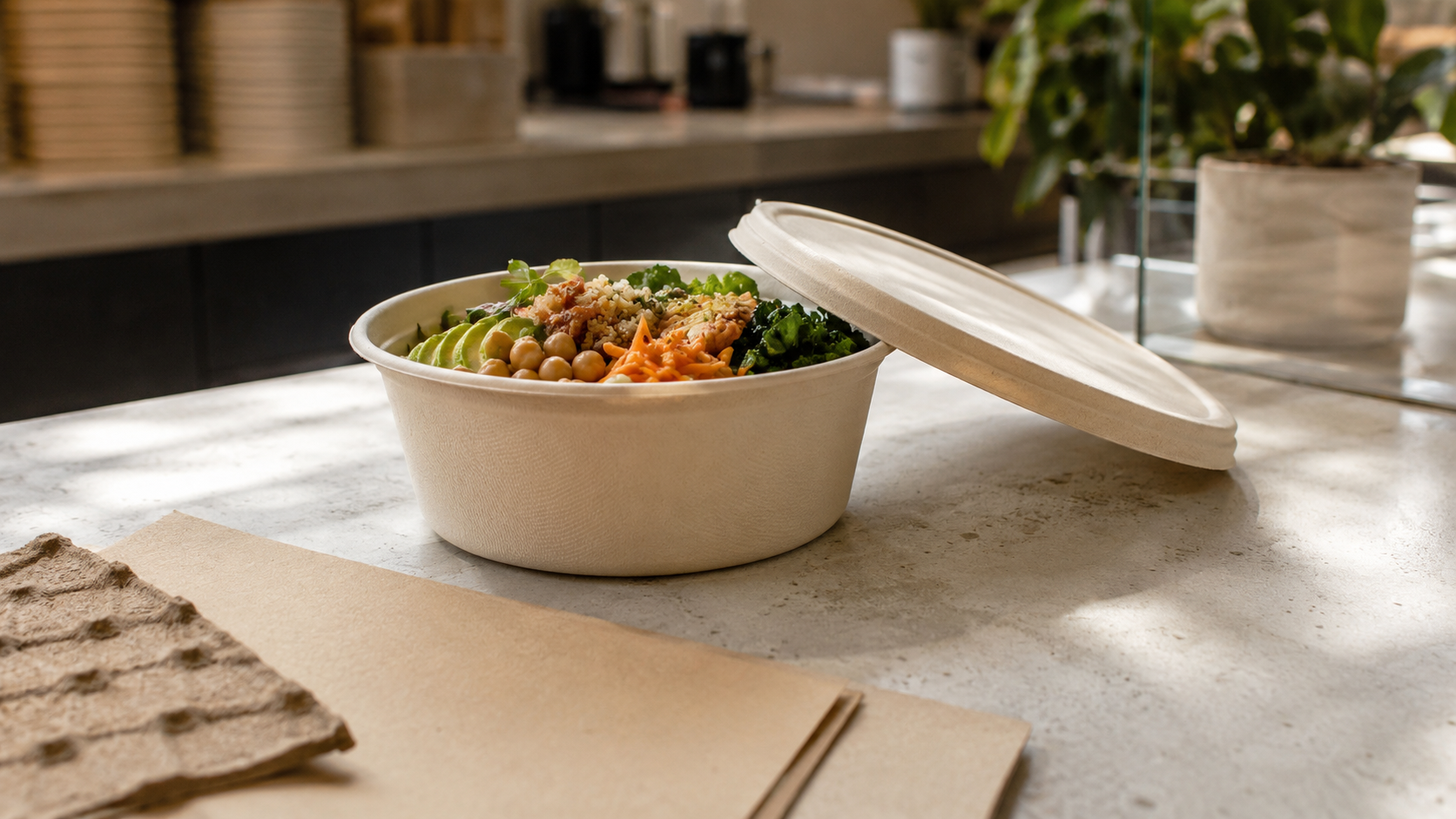
Customers make rapid judgments from what they see and touch. A material may have a credible environmental rationale while still presenting an unfamiliar colour, texture, translucency, surface feel, or visual finish. If that first encounter makes the item look less practical or less appropriate for food, a detailed explanation may arrive too late to change the initial judgment.
That does not mean sustainability messaging is unhelpful. It means the message should be developed with the product experience rather than added after the packaging choice is complete.
When reviewing a candidate design, ask:
- Does the pack look appropriate for the menu and service setting?
- Does its form make the intended use obvious?
- Does the closure, opening, stacking, and carry experience appear practical?
- Does the customer-facing information explain the relevant attribute without overstating it?
- Are the visual and verbal cues consistent with the actual product specification?
Start with a tested use case, not a broad environmental label
Before selecting a packaging architecture, define the job it needs to do. A hot, oily delivered meal, a chilled salad, a bakery item, and a dry snack can create different requirements for the container, lid, barrier, handling, and presentation.
Evaluate the full system:
- 1. Food and service conditions: temperature, moisture, grease, fill level, holding period, transport, and stacking.
- 2. Pack configuration: the main pack, closure, label, insert, bag, and any other customer-facing component.
- 3. Customer interaction: opening, carrying, eating, resealing where relevant, and separating components.
- 4. End-of-life communication: what can be stated and what instruction is appropriate in the destination market.
A material name or a green colour does not prove that the complete pack meets the use case or has a particular end-of-life outcome. Confirm documentation and requirements for the specific SKU, configuration, order, and destination.
Make the first impression practical and honest
The findings point to the importance of practical, natural-looking cues. In packaging development, this is an opportunity to make the product easier to understand—not to create a greener-looking impression than the evidence permits.
Use form and information together
Choose a structure and presentation that help customers recognize the item’s purpose. Pair any claim with a clear, readable explanation of the component covered and the action the customer should take, subject to local guidance.
A useful internal copy structure is:
- What is covered: name the pack or component.
- What is supported: state the limited, documented attribute.
- What conditions apply: include any necessary separation or disposal limitation.
- What to do: use a location-appropriate disposal instruction.
Avoid unsupported shortcuts such as “eco-friendly,” “zero impact,” “better for the planet,” or “compostable everywhere.” They can create an impression that exceeds the evidence and do not tell the customer what to do.
Do not rely on information alone to repair a poor experience
A long sustainability narrative cannot substitute for an appropriate container, a fitting lid, or simple handling. If a candidate pack creates uncertainty in real food-service use, change the design or specification before increasing the message volume.
A small, clear instruction placed where the customer can see it is often more useful than a large, vague environmental badge.
Use a staged design-and-choice workflow
A controlled workflow helps teams distinguish a promising concept from a market-ready packaging decision.
1. Define the specification
Record the product category, intended food, material, dimensions or capacity, lid or closure, print requirements, expected quantity, and destination. Keep the component list with the artwork version.
2. Screen visual and tactile concepts
Compare candidate packs in the context in which customers will encounter them. Look for clarity of use and whether the appearance signals naturalness and practicality without making claims that have not been verified.
3. Test actual use
Test the precise configuration with representative food, service conditions, and delivery handling. Record what works and what requires a different component, structure, or instruction.
4. Build the evidence file before public wording
Tie each claim to the exact component and documentation. Review the scope, limitations, and destination relevance. A document associated with one material, production entity, or order should not be extended to every product.
5. Pilot, then assess your own outcomes
If the pack is ready for an operational pilot, track the measures relevant to your business—such as packaging cost per order and customer-service themes. Do not promise ratings, repeat purchase, or customer preference outcomes in advance. Those outcomes vary by market, menu, price, operations, and communication.
Give sourcing teams the inputs needed for a practical design decision
TakeawayPack’s online catalog covers food-service packaging categories including cups, bowls, boxes, containers, trays, lids, bags, and cutlery. Its request process can capture the product category, material, size or capacity, estimated quantity, printing or logo requirements, and destination.
For a project-specific conversation, use those inputs to discuss structure, coating, capacity, printing, matched lids, and carton packing where confirmed for the order. Ask for any material, certification, food-contact, end-of-life, MOQ, availability, pricing, or delivery information to be evaluated for the exact SKU, order, and destination. That keeps a visual design decision connected to documented facts instead of a general sustainability promise.
Bottom line: A sustainable food-packaging choice is more credible when its appearance, practicality, information, and substantiation tell the same story. Use the material choice as the start of design work, not the end of it.
Disclaimer: This article provides general design and sourcing guidance, not legal, environmental, waste-management, certification, food-contact, or regulatory advice. Verify current requirements and supporting documentation for the specific product, order, and destination before making a public claim.
For a fact-bounded packaging request, visit takeawaypack.com.