How to Switch to Request-Only Cutlery Without Hurting Your Delivery Ratings
Restaurants across the US are cutting single-use plastic cutlery to save money and reduce waste, but many worry that removing default utensils will frustrate customers and trigger negative reviews.
2026-09-07 - 11 min read
Summary: Restaurants across the US are cutting single-use plastic cutlery to save money and reduce waste, but many worry that removing default utensils will frustrate customers and trigger negative reviews. This article explains how to transition to a request-only cutlery model — using order-page prompts, tamper-evident seals, and in-package messaging — so diners get what they need without the waste they don't. Drawing on the same approach behind the #CutOutCutlery movement, you'll learn practical steps to protect your ratings while trimming your supply costs.
Plastic forks, knives, spoons, and napkins have been a staple of takeout and delivery for decades. They're cheap, convenient, and disposable. They're also everywhere. A single order often lands at a customer's door with three sets of cutlery for one person — most of which goes straight into the trash.
The problem has reached a scale that's hard to ignore. According to waste-reduction advocates, roughly 40 billion pieces of plastic cutlery enter the waste stream every year in the United States alone. For restaurants, the cost is not just environmental. Every unnecessary fork or napkin pad adds up on the supply ledger. During the COVID-19 pandemic, restaurants that shifted to a request-only model saved an estimated $3.2 million collectively on disposable plasticware.
The growing push to #CutOutCutlery — a campaign that has won commitments from major delivery platforms like Grubhub, DoorDash, and Uber Eats — has made it easier for restaurants to stop sending cutlery by default. These platforms now default to zero utensils and napkins with every order. Diners who want them simply opt in during checkout.
For small-to-medium restaurant owners, food truck operators, and cafe managers, this creates a natural opportunity. But it also raises a real concern: if a customer expects a fork and doesn't get one, will they take it out on your rating?
The answer is yes — if you don't prepare them. The good news is that you can set up the right prompts, packaging, and backup systems so that customers feel informed, not shortchanged.
Why the Default-Cutlery Model Hurts Both Your Wallet and the Planet
The habit of tossing a handful of plastic forks into every bag was never based on customer demand. It was born from speed and convenience on the restaurant side. Throw in utensils, seal the bag, move to the next order. No thought required.
But that convenience comes at a hidden cost. Disposable cutlery and napkins are a small per-order line item, but the annual total is real: at a few cents of unused plasticware per order, a shop doing 150 delivery orders a day is throwing away hundreds to a few thousand dollars a year. For a multi-location operation or a ghost kitchen running heavier volume, that number climbs much higher.
Much of that plasticware is never used. Anyone who orders delivery regularly has a kitchen drawer full of unopened fork-and-napkin packets to prove it. From the restaurant's perspective, you're paying to stock, store, and throw away a product your customers didn't ask for.
The platforms have already moved. Grubhub launched its opt-in default in early 2022 as part of the #CutOutCutlery campaign. DoorDash followed. Uber Eats had already implemented a similar feature years earlier. The industry standard is shifting from "cutlery included by default" to "cutlery available on request."
The question is no longer whether to make the switch. It's how to make the switch without losing customer trust.
Setting Up the Right Opt-In Prompts at the Point of Order
The most important moment to communicate your cutlery policy is during checkout. If a customer discovers they have no fork only after the bag is opened, you've already disappointed them. If they are asked during ordering and given a clear choice, they feel in control.
Start by updating your online ordering system. Most third-party delivery platforms already have an opt-in mechanism built in. But if you run your own ordering website or use a direct ordering platform, you need to add a cutlery selection step. This can be as simple as a required checkbox or a dropdown menu item before the order is submitted.
The language matters. Avoid phrasing that sounds like a restriction. Instead of "No cutlery included," try "Help us reduce waste — add cutlery only if you need it." Frame it as a positive choice rather than a denial.
Some operators worry that asking about cutlery adds friction to the checkout flow. In practice, a single well-placed toggle has negligible impact on conversion rates. Customers who want utensils will check the box. Customers who don't will skip it. The key is making the option obvious without being intrusive.
If you use a full-service online ordering platform, check your settings. Many platforms now offer a "default no cutlery" toggle in the restaurant dashboard. Enable it, and then customize the prompt text if the platform allows it.
Using Tamper-Evident Seals to Reinforce Your Message
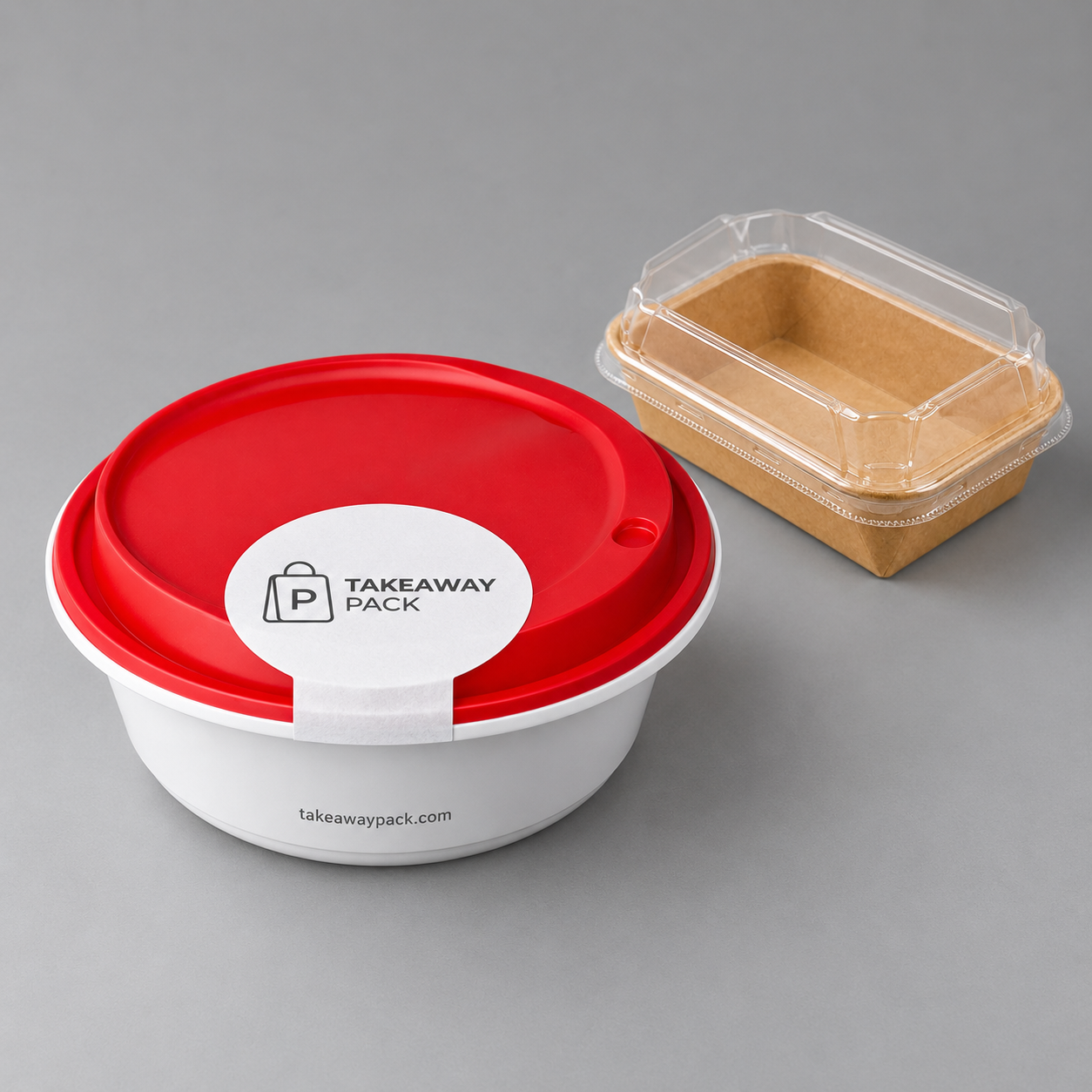
Once the order is packed and sealed, the customer's first interaction is with the packaging itself. A tamper-evident seal or sticker on the bag lid is a natural place to communicate your cutlery policy — and it doubles as a security measure.
Printed seals are inexpensive and highly visible. A simple sticker that reads "Cutlery included only if requested" or "Want utensils? Check your order confirmation" catches the customer's eye before they open the bag. This is especially useful for orders placed through third-party platforms where the checkout prompt may not be visible to the restaurant.
Suppliers like takeawaypack.com offer custom-printed tamper-evident stickers and seals that can be branded with your restaurant's logo and tailored messaging. The MOQ for custom stickers is typically low enough — 500 to 1,000 units — that even a small cafe can order a batch that lasts months.
Place the sticker across the bag flap or the lid seam so it must be torn to open the package. This ensures the customer sees the message. Use a concise, friendly tone. Avoid legal-sounding language. "Fork? Spoon? Just ask. We're happy to include them." This keeps the tone warm while reinforcing the policy.
For operators who want to go further, consider printing the same message directly on the bag or box. Kraft paper bags and custom-printed paper bags from takeawaypack.com can carry your cutlery message alongside your branding, creating a consistent look from checkout to unboxing.
In-Package Messaging: The Last Line of Communication
Even with the best checkout prompts and seals, some customers will miss the message. The in-package experience is your final opportunity to manage expectations.
Include a small insert card or a printed note on the inside of the lid. This is the place where a customer who expected cutlery will look. Print a friendly reminder: "We're skipping single-use plastics to keep our planet clean. If you need utensils, napkins, or sauce, just let us know on your next order."
This serves two purposes. First, it educates the customer about why cutlery wasn't included, turning a potential complaint into a point of alignment. Second, it creates a feedback loop for future orders. The customer who reads the note understands that next time they can simply request utensils at checkout.
Keep the insert small — business-card size or smaller — so it doesn't add to your packaging costs. A simple double-sided card with your logo on one side and the cutlery note on the other is sufficient. For high-volume operations, a printed note on the inside lid of your container is even more efficient.
Clear PET containers, lock-lid PP bowls, and molded pulp clamshell boxes from takeawaypack.com can all accommodate a small printed label or sticker on the lid interior. This approach is especially effective for compartment trays and bento-style boxes where multiple items are packed together and the customer might reasonably expect a fork.
What to Do When a Customer Complains
No matter how well you communicate, some customers will be unhappy. The goal is to minimize those cases and respond gracefully when they happen.
First, make it easy for customers to request cutlery post-order. If you use a direct ordering system, include a note in the order confirmation email that says "Need utensils? Reply to this email or call us." For third-party orders, the delivery platform's support system can handle utensil requests, but you can also include your phone number on the seal or insert.
Second, keep a small supply of emergency cutlery kits at your pickup counter or with your delivery drivers. If a customer calls and says they didn't get utensils, have a solution ready within minutes. This is not about admitting fault — it's about keeping the customer satisfied.
Third, track the complaint rate. If you see a spike in utensil-related complaints after switching to request-only, your messaging may need adjustment. Tweak the checkout prompt wording, move the sticker to a more visible location, or add the insert card. The data will tell you what's working.
Operators who make the switch with clear messaging in place generally report that utensil complaints stay rare and that the savings outweigh the occasional negative note. The key is having a system in place before you flip the switch, not after.
Choosing the Right Packaging Partners
The transition to request-only cutlery works best when your packaging itself supports the message. Customers who see thoughtful, branded packaging are more likely to believe that your cutlery policy is intentional and environmentally responsible rather than cheap or neglectful.
Consider upgrading to packaging that looks and feels premium. Compartment trays with snug lids, kraft soup tubs with clear PP covers, and molded pulp clamshells signal quality even before the customer opens the box. When the packaging looks curated, the absence of a plastic fork reads as a deliberate choice rather than an oversight.
For restaurants that serve a high volume of delivery orders, custom-printed paper bags offer a branding opportunity at the moment of handoff. A bag that says "Sustainably Packed" or "Utensils Available On Request" reinforces the message before the customer even reaches the seal.
Takeawaypack.com supplies a full range of custom disposable food packaging — from lock-lid PP bowls and tamper-evident containers to paper bags, sauce cups, and custom-printed stickers. Certain kraft and molded-pulp product lines are available with compostable or recyclable certification; ask them for the certificate on the specific SKU you are quoting. Products can be customized with your restaurant's logo and messaging, with minimum order quantities as low as 500 units. This makes it feasible for small and mid-sized operations to present a consistent, branded experience across every touchpoint.
Measuring the Impact on Your Bottom Line
The financial case for switching to request-only cutlery is straightforward. Track your current cutlery usage and cost per order for one month, then make the switch and compare the next month.
Do the math on your own numbers rather than an industry average: multiply the per-order cost of the cutlery pack you currently include by the share of orders where nobody actually needed it. For most quick-service operations that lands somewhere between a few hundred and a few thousand dollars a year — and it scales directly with volume, so ghost kitchens and catering operations see the largest gains.
Beyond direct savings, there are indirect benefits. Less cutlery means less storage space, fewer supply orders, and less time spent packing. The cumulative effect on operational efficiency is measurable.
And there is a reputational benefit. Gen Z and millennial diners are more sustainability-conscious than earlier generations and pay closer attention to how the businesses they buy from behave. When you communicate your cutlery policy clearly, you signal that your business is part of the solution, not the problem.
A Simple Three-Step Plan to Start Tomorrow
If you're ready to make the switch but don't know where to start, here is a plan that can be implemented in a week.
Step 1: Audit your current cutlery usage. Count how many forks, spoons, knives, and napkins go out per order. Multiply by your average daily order volume. Calculate the monthly cost. This is your baseline.
Step 2: Enable the opt-in setting on your delivery platforms. Log into your Grubhub for Restaurants dashboard, DoorDash Merchant Portal, and any other platform you use. Find the cutlery preference setting and switch it to "request only" or "opt-in." Test the customer experience by placing a test order.
Step 3: Order your messaging assets. Order custom-printed tamper-evident seals or stickers and small insert cards. A supplier like takeawaypack.com can handle both with a single order. If you already use branded bags or boxes, add the cutlery message to your next print run.
With these three steps, your switch to request-only cutlery is complete. The messaging is in place at the checkout, on the seal, and inside the package. Your customers are informed, your operational costs drop, and your environmental footprint shrinks.
Making the switch to request-only cutlery is one of the simplest changes a restaurant can make that benefits both the planet and the bottom line. The infrastructure is already in place — your delivery platforms support it, your customers are open to it, and your packaging can carry the message. The only thing standing between you and thousands of dollars in annual savings is a few days of setup.
Ready to make the switch? Visit takeawaypack.com to explore custom-printed packaging, stickers, and seals that help you communicate your cutlery policy clearly. Or reach out to takeawaypack.com/contact to speak with a packaging specialist who can help you choose the right solutions for your restaurant's volume and budget.