Switching from Sleeved Hot Cups to Double-Wall Paper Cups: How to Test Hand Feel, Insulation, Printing, and Supply Continuity
Removing the cup sleeve looks like a simple way to cut one packing step per hot drink. In practice it moves the insulation job from a separate part you can swap at will into the cup wall itself, which means the cup, the lid, the print, and the supplier all have to be re-qualified together.
2026-09-03 - 11 min read
Summary: Removing the cup sleeve looks like a simple way to cut one packing step per hot drink. In practice it moves the insulation job from a separate part you can swap at will into the cup wall itself, which means the cup, the lid, the print, and the supplier all have to be re-qualified together. Dunkin's U.S. move from foam to double-wall paper is a useful reference point because it was phased in as supplier manufacturing capacity ramped up rather than switched on in one day. This article sets out a four-part validation program — hand feel, insulation, printing, and supply continuity — with the tests, the acceptance thresholds worth writing down before you start, and the pilot sequence that keeps a failed batch from becoming a chain-wide problem. It closes with the specifications and documents to pin down in the RFQ so the cup you approve is the cup you receive.
Why Removing the Sleeve Is a Cup Redesign, Not a SKU Deletion
A sleeved single-wall cup splits two jobs between two parts. The cup holds the liquid; the sleeve handles heat and grip. If the sleeve underperforms, you change sleeves and keep the cup.
A double-wall cup merges both jobs into one part. The outer jacket wrapped around the inner vessel creates an air gap that slows heat transfer, and it is also the printed surface customers see. So a single change now affects thermal comfort, grip, rigidity, brand appearance, storage volume, lid fit, and supplier dependency at the same time.
That is why the labour saving — one fewer part to fetch and slide on per drink — should be treated as the reward for passing validation, not the reason to skip it. If the cup flexes under a normal grip, or the print seam shows a white sliver, you have traded a few seconds per drink for a visible quality problem at the counter.
What the Dunkin' Reference Actually Tells a Smaller Buyer
Dunkin' announced in February 2018 that it would remove polystyrene foam cups from its global supply chain, replacing U.S. foam cups with double-walled paper cups that, according to the company, do not need a cardboard sleeve to keep hands cool. The U.S. transition began in spring 2018 in California and New York City stores, and the company stated the double-wall cups would "be phased in across the U.S. as supplier manufacturing capabilities ramp up" (Waste Dive, February 2018).
The New England rollout followed later: the company said all Dunkin' restaurants in New England would be fully transitioned to the double-walled paper cup as of December 1, 2019, roughly a year after the cups were introduced in New York and California. The paper cups carry a polyethylene coating, and a company spokesperson noted the cups may not be recyclable everywhere, while the new lids can be recycled where No. 5 plastics are accepted (WBUR, November 2019).
Three lessons transfer directly to a chain of any size:
- The timeline was driven by supply capability, not by the design date. Capacity to produce your cup, at your print, at your volume, is a separate question from whether a sample cup performs well.
- The rollout was staged by region. Early markets absorbed the operational surprises before the rest of the network converted.
- The lid was part of the announcement. Cup and lid were communicated as a pair, because a rim change or a lid change alters leak behaviour and disposal messaging.
Part 1: Test Hand Feel Against Your Current Sleeved Cup, Not Against a Spec Sheet
Hand feel is the criterion most often skipped because it feels subjective. It is testable if you fix the conditions and compare against a control.
Set up three arms: your current sleeved cup (control), the candidate double-wall cup, and — if you have one — a second double-wall candidate from another source. Fill to normal service volume with your actual hot beverage at normal serving temperature, lid on.
What to score, at intervals rather than once:
- Continuous hold comfort at roughly 1, 5, 10, and 15 minutes after pour, scored 1–5 by staff and customers holding the cup one-handed.
- Grip security and side-wall deflection. Squeeze a full, lidded cup with normal holding pressure. Does the wall flex enough to unseat the lid or push liquid through the sip hole? A single-wall cup borrows rigidity from its sleeve; the double-wall cup has to supply its own.
- Outer diameter fit. A double-wall cup is wider than the same volume in single wall. Check car cup holders, cup carriers, and cup bags before you commit — a cup that no longer drops into your carrier creates a new problem while solving an old one.
- Surface behaviour under humidity. After a long hold, does the outer wall feel soft, tacky, or slippery?
- Base stability. Tip test on a counter and in a delivery bag; check heat at the bottom seam where the two walls typically merge.
Write the acceptance rule before testing. A workable one: the majority of testers rate the double-wall cup equal to or better than the sleeved control on comfort, nobody needs a napkin or a second hand to manage the cup, and no lid dislodges during the squeeze test. Ambiguous results should send you back to the supplier for a different board weight or wall structure, not into a purchase order.
Part 2: Validate Insulation Under Service Conditions, Not Lab Conditions
The claim being tested is narrow and specific: the exterior stays comfortable to hold without a sleeve, while the drink stays hot at least as long as it does today.
Instrumented protocol. Using an infrared or contact thermometer, pour at your normal serving temperature into matched volumes of the control and the candidate, lids on, and record at fixed intervals — for example 30 seconds, 5, 15, and 30 minutes:
- Exterior wall temperature at the mid-body and near the vertical seam.
- Interior liquid temperature over the same intervals.
- Ambient temperature, so results from different days remain comparable.
Run the stress cases that actually happen in your stores:
- Maximum fill volume and extra-hot drinks.
- Cups filled and left waiting during a rush before pickup.
- Delivery and commute simulation: cup carried, cup in a vehicle holder, cup sitting on a counter.
- Each size in the range, since wall height and diameter change the thermal behaviour.
Repeat each condition several times per size rather than relying on one cup. Log board weight, wall structure, and coating for every candidate so a later batch can be compared to the approved reference.
The decision rule that matters: approve only if the cup performs inside your own customer tolerance band — the range your current sleeved setup already delivers — not merely inside the supplier's published specification. Supplier specs describe a product; your tolerance band describes your customers.
Part 3: Print on the Real Cup, Because the Outer Wall Is Now the Brand Surface
Once the sleeve disappears, the cup carries the brand alone. Double-wall construction introduces print issues that a flat proof will not reveal.
Approve a physical cup, not a flat artwork PDF alone. The outer jacket is wrapped, so artwork behaves differently from the same file printed flat. Ask for printed samples or a short pilot run in your real colours and check:
- Overlap seam alignment. Inspect the back seam where the outer wall wraps. Look for misregistered artwork, visual distortion, or an unprinted white sliver along the overlap.
- Colour consistency between batches. Compare proofs under your actual store lighting, not office lighting. Board colour matters: kraft mutes bright colours, coated white board widens the achievable range.
- Rim clearance. Confirm the unprinted band near the lip meets the requirement for your destination market, since customers drink directly from that edge.
- Durability. Rub and abrasion after filling, condensation exposure, and stacking or shipping simulation. Check for scuffing, fading, and ink transfer to hands.
- Behaviour when hot. Fill, cap, and leave for several minutes; check whether any odour from ink or varnish interferes with beverage aroma.
- Documentation. Confirm the food-contact status of inks and coatings for your SKU and destination, rather than assuming a general claim covers your order.
Lock in a golden sample. Have both marketing and operations approve one physical cup that becomes the manufacturing reference. Every later batch is judged against that cup. Without it, "the colour looks different" becomes an argument instead of a decision.
Part 4: Treat Supply Continuity as the Real Risk
This is where a cup change most often fails, and it is the part the Dunkin' timeline highlights most clearly: the phase-in tracked supplier capacity.
Before signing, confirm with the supplier:
- Number of production sites and backup production capability for your SKU.
- Paperboard and coating sources, and whether a substitution would change performance or print behaviour.
- Capacity allocation during peak season, and how the range of sizes is scheduled.
- Historical on-time delivery and defect rates, and the defect categories tracked.
- The qualification path for a secondary source, before you need it.
Rim standardisation is your cheapest insurance. If every size in your double-wall range shares one rim diameter, one lid family covers the whole range and a switch between sources does not orphan your lid inventory. If primary and backup suppliers use different rim rolls, your lids become a single point of failure. Confirm rim dimensions in writing, and test lid fit on cups from every source and every size.
Plan the physical consequences. Double-wall cups are bulkier than single-wall cups, so compare cube volume per thousand cups against your current cups plus sleeves. Back-of-house storage, delivery frequency, and in-store dispensers all move with that number. Also test de-nesting: double-wall cups nest tightly, and if staff have to fight a stack to separate one cup, the labour you saved by dropping the sleeve is spent again at the dispenser.
Run dual inventory during the changeover. Keep enough of the current sleeved cups and sleeves to cover the transition window, convert one region or store cluster first, and only then extend.
A Pilot Sequence That Contains Failure
Document everything — temperatures, scores, photographs, defect logs — so acceptance thresholds are numbers you can hold a supplier to rather than impressions you have to argue about.
| Phase | Scope | Objective | Pass condition |
|---|---|---|---|
| 1. Bench | A small sample set per size | Thermal and structural behaviour | Exterior temperature inside your comfort band; no lid dislodgement in the squeeze test |
| 2. Print approval | Printed samples or a short run | Brand fidelity on the real cup | Golden sample signed by marketing and operations; no seam or registration defects |
| 3. Store pilot | One or two high-volume stores, several weeks | Speed of service and staff feedback | Measurable reduction in hot-drink assembly time; no rise in heat or leak complaints |
| 4. Staged rollout | Regional cluster, then network | Supply continuity and batch consistency | Consistent colour between runs; de-nesting and defect rates within your agreed limits |
What to Pin Down in the RFQ
By the time you talk to a supplier, the validation plan above tells you exactly what to ask for. A useful RFQ for a sleeve-to-double-wall switch covers the product category and material, dimensions and capacity per size, estimated quantity, printing, colour and logo requirements, and destination port or country — plus rim diameter, matching lid options, and carton packing, because those decide whether your lids, carriers, and storage plan survive the change.
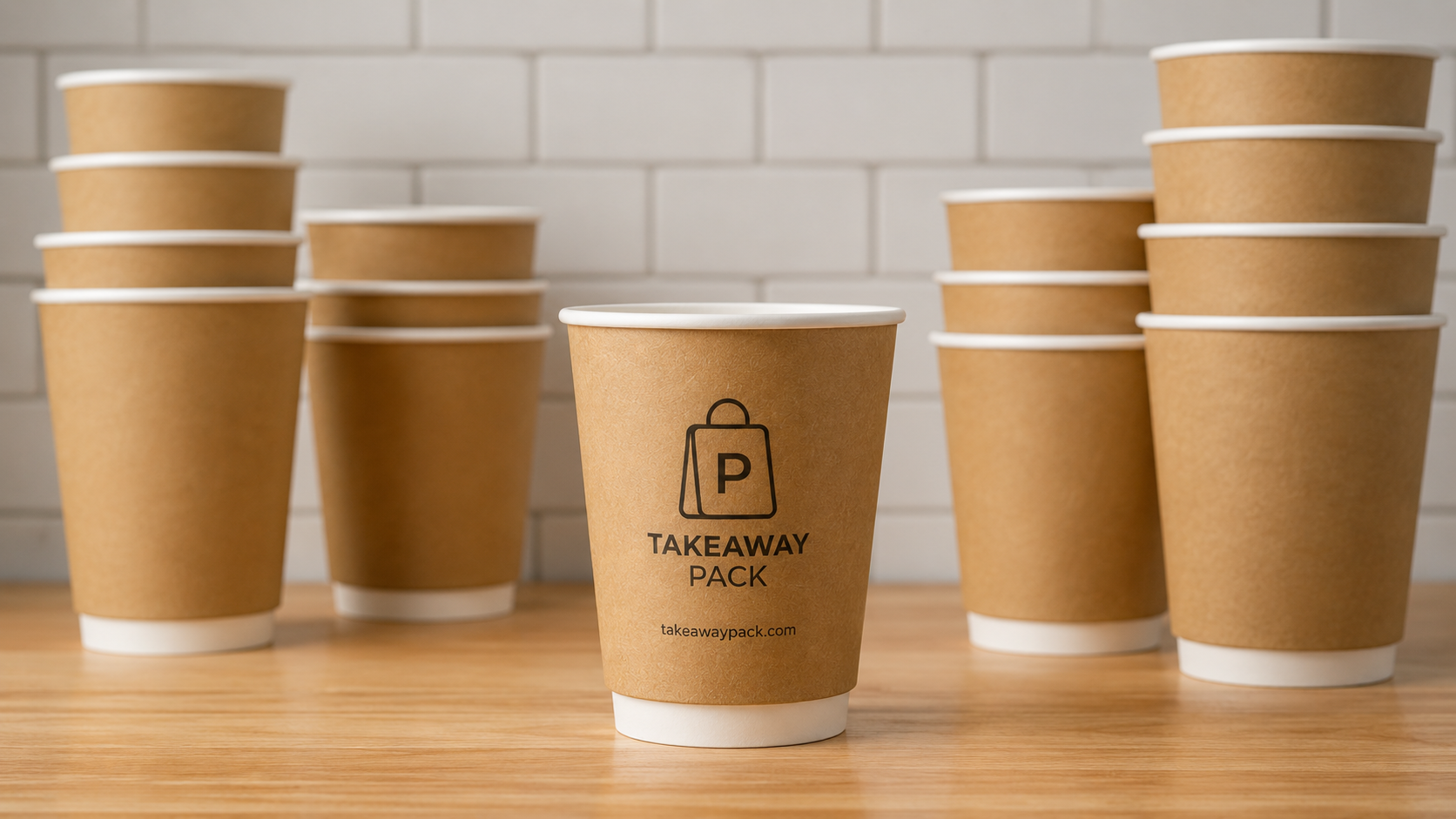
Takeawaypack, a foodservice packaging supply partner serving international buyers in North America, Europe, Australia, and the Middle East, works with this kind of specification set directly. Its catalogue includes a double-wall paper cup range in 8 oz / 280 ml, 10 oz / 330 ml, 12 oz / 400 ml, 16 oz / 500 ml, and 22 oz / 700 ml, produced in food-grade wood-pulp paper with double-wall construction, printed by four-colour gang-run printing, and packed 500 pieces per carton. Kraft and white are catalogued across all five sizes, with black listed for 8 oz through 16 oz. All sizes in the range share a 90 mm top diameter, so one lid family covers the whole hot-cup line — a practical answer to the lid-inventory risk described above. The 90 mm lid options include single-hole and double-hole flat lids, multipurpose injection-moulded lids, U-shaped lids, foldable lids that need no assembly, and paper-plastic dual-use rotating lids. A 90 mm cup sleeve (food-grade PP) and bagasse four-cup carriers are also catalogued, which is useful if you want to run a sleeved control and a sleeveless candidate side by side on the same rim.
Two process details are worth knowing before you plan your timeline. Custom-printed orders are produced from a digital proof — a PDF die-line mockup built from your artwork — and production starts only after you confirm that proof in writing, which is the natural checkpoint for the golden-sample decision in Part 3. And samples, drawings, or print files can be aligned with your requirements before mass production, with the scope of documentation — food-contact, FSC, GRS, origin, or compostability statements — confirmed for your specific SKU, quantity, and destination market rather than assumed from a general claim. Flexible MOQs are available; regular products generally start from 1,000 units, with the final MOQ depending on the specific product and production method as confirmed in the order quotation.
The Short Version
Do not buy a double-wall cup because it removes a step. Buy it because it passed your hand-feel panel against your current sleeved cup, held its exterior temperature inside your comfort band under real service conditions, printed cleanly across the wrap seam on a physical cup you signed off, and came from a supply arrangement where rim dimensions, backup capacity, and documentation scope were all agreed in writing.
Get those four answers first, and the packing step you save stays saved.
If you are scoping a sleeve-to-double-wall switch and want to line up sizes, rim diameter, lid matching, printing, and per-SKU documentation before you commit to a run, start the specification conversation at takeawaypack.com.