Best Takeout Containers for Halal and Middle Eastern Food: Rice, Grilled Meats, Sauces
For a halal or Middle Eastern combo meal, the practical “single-container” solution is usually a main-meal base that keeps rice and grilled meat organized—not a promise that every item, especially thin or oil-heavy sauces, belongs inside the same compartmented box.
2026-09-09 - 6 min read
Summary
For a halal or Middle Eastern combo meal, the practical “single-container” solution is usually a main-meal base that keeps rice and grilled meat organized—not a promise that every item, especially thin or oil-heavy sauces, belongs inside the same compartmented box. Start with the actual portion, free liquid, packing temperature, delivery route, and how the order will be stacked. A two-compartment format can be a useful candidate for rice plus protein; sauces should normally be evaluated as separate, lidded components; and any final choice should be tested with the restaurant’s own menu before bulk ordering.
Estimated reading time: 6 minutes
Can one container handle a halal Middle Eastern combo meal?
Yes—if “one container” means the main meal rather than every component in the order. A typical combo may combine rice, kebab or other grilled meat, hummus, salad, bread, and one or more sauces. Those foods do not have the same packaging job. Rice needs a usable footprint and enough headspace. Grilled meat can release juices and oil. Salad can be affected by heat and condensation. Toum, tahini, hot sauce, and other dressings can move into a lid channel or across a divider if they are packed loose.
The most reliable way to simplify packing is to define the meal architecture first:
- Main meal: rice and protein, in either a single large compartment or a divided base.
- Cold or moisture-sensitive items: salad and fresh garnish, evaluated separately from hot food when their quality could be affected.
- Sauces and dips: separate, portion-sized cups with lids that are specified for those cups.
- Bread or pita: packed where it will not contact free sauce or wet salad.
This is still a coherent meal system. It avoids forcing every component into one base merely to reduce the visible number of packages.
The word halal here identifies the food-service and menu context. It does not mean that a container is halal-certified, nor does it establish a food-contact, compliance, temperature, leak, or environmental claim for any packaging item. Those questions need product-specific documentation for the exact item and destination market.
Are compartment containers deep enough for rice, meat, and sauce?
A compartmented format is a candidate, not an automatic answer. “Deep enough” cannot be established from a category name, a product photo, or a generic material description. The decision depends on the restaurant’s normal portion, the rice mound, meat cut, sauce load, headspace below the lid, and what happens when the packed order is tilted or stacked.
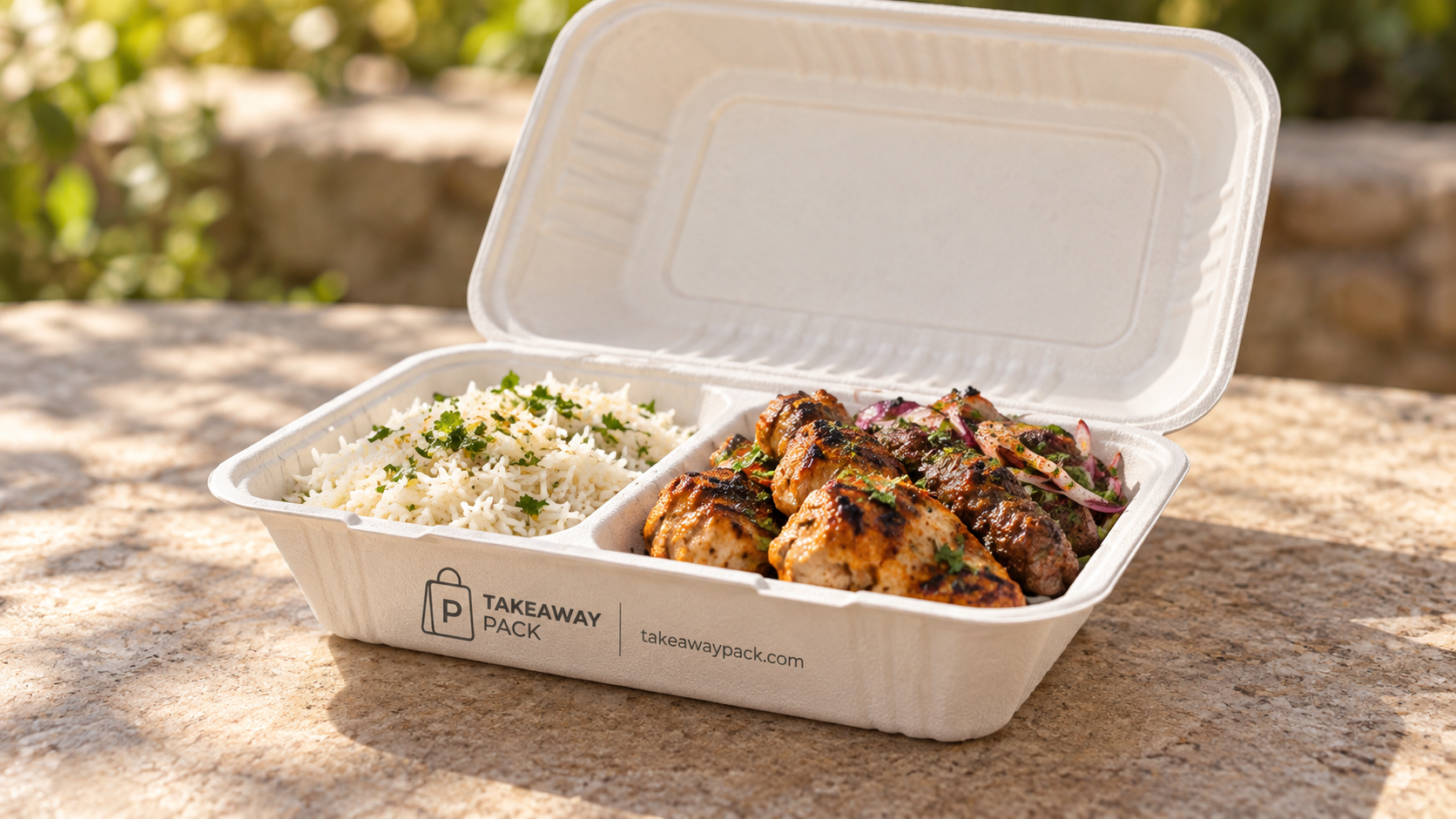
Takeawaypack’s ERP lists a double-compartment lock box (product code TP-ZJJJ-0008) with the product specification recorded as 250*165 and the material category recorded as Sugarcane Bagasse. Its description identifies a 9×6 Double-Compartment Lunch Box for rice, noodles, main dishes with side portions, bento meals, canteen service, and takeaway meals. It is a logical item to request as a sample for a rice-and-protein layout. The available record does not state usable capacity, compartment depth, lid compatibility, or menu-specific delivery performance. Those details should be confirmed rather than assumed.
The same ERP also lists single-compartment bagasse lock-box candidates: an 8-inch format (TP-ZJJJ-0003) and a 9-inch format (TP-ZJJJ-0005). A single compartment may work when rice and grilled meat can share the main base and the kitchen controls sauce separately. It is less useful when the operator needs a divider to keep a wet side away from rice or salad.
Before approving either format, pack a representative order at normal fill level. Check whether food reaches the closure area, whether rice contacts the lid, whether the divider still works after movement, and whether a sauce cup can remain upright in the bag. If the test exposes crowding or liquid migration, change the format rather than treating the container as a fixed menu constraint.
A practical packing format for rice, grilled meats, and sauces
For many rice-and-grill meals, start with one of these two routes.
Route 1: Two compartments for rice and protein
Use the larger section for rice and the other section for kebab, shawarma-style grilled meat, or a cooked side. This route can make packing repeatable when the menu has a stable two-part layout.
Do not assume the divider creates a liquid barrier. Examine the actual divider height, lid fit, fill line, and expected carry orientation. If the protein is brushed with sauce or releases substantial juices, keep sauce volume low in the main base or move it to a separate cup.
Route 2: One main compartment plus separate sauce cups
Use a single-compartment main box for rice and grilled meat, then add matched sauce cups for hummus, tahini, garlic sauce, hot sauce, or other wet additions. This can give the kitchen more freedom to portion the main meal while keeping liquid away from the rice and closure.
The container-and-lid pairing matters as much as the base. A cup lid should be intended for that cup; a meal lid should be intended for that exact base. Leave headspace rather than filling food or sauce into the rim area. Keep cups upright and away from direct compression inside the bag.
Match the closure approach to the food, not the label
A menu can contain two opposing packaging needs. A crisp item may need a way to manage retained moisture, while a sauce-heavy item needs containment. One closure approach should not be copied across both jobs without a menu test.
For a Middle Eastern combo, ask these operational questions before selecting a format:
- Which components contain free liquid, oil, or loose sauce?
- Which foods should stay physically separate to protect texture or presentation?
- What is the normal portion and fill level for each compartment?
- How long can an order wait before collection, and how is it usually carried?
- What items may be placed on top of the meal in a delivery bag?
- Which exact base, lid, and sauce-cup combinations are proposed?
These questions replace broad labels such as “leak-proof,” “heat-resistant,” or “food-grade” with a specification the restaurant can actually review. A general claim for a material or another SKU is not proof for the meal package being considered.
Run a meal-specific test before placing a bulk order
Test a complete packed order rather than an empty container. Use the same rice portion, grilled meat, sauces, fill temperature, staff workflow, bag, and stacking arrangement used in service. Include the expected hold time and a representative delivery route or controlled movement test.
Record the exact container and lid identifiers, fill level, carry orientation, any weight above the meal, lid engagement, visible spills, condensation, sauce-cup position, and presentation on arrival. Run more than one trial. The aim is not to promise that a format will never fail; it is to make a buying decision from the conditions the restaurant actually faces.
Build a concise RFQ for the right candidate
A useful RFQ describes the meal before asking for a material. Include:
- menu components and normal portion sizes;
- target format: single compartment, two compartments, or a meal base plus sauce cups;
- approximate base dimensions or target usable capacity;
- packing temperature, expected hold time, and delivery handling;
- required matching lids and separate sauce-cup options;
- destination market and the product-specific documents the buyer needs to review; and
- expected quantity, artwork needs, and delivery destination.
Ask the supplier to identify the exact SKU and compatible closure offered. Confirm capacity, dimensions, construction, documentation, commercial terms, availability, minimum order quantity, and production timing for that specific order; do not copy those details from a different product or project.
The bottom line
For halal and Middle Eastern takeout, a divided main-meal base can simplify a rice-and-grilled-meat combo, but it should not be expected to contain every sauce or protect every texture by itself. Treat sauces as their own lidded components, verify the exact base-and-lid pairing, and test the entire order under realistic handling.
Visit Takeawaypack.com with the menu layout, portions, destination, and packing conditions. Ask for a shortlist of exact product-and-lid combinations, then approve only the options supported by product-specific information and the restaurant’s own delivery trial.