Tamper-Evident Food Delivery Bags: A Practical Selection and Workflow Guide
Choose tamper-evident delivery bags by matching product type, closure, food, container load, order volume, packing workflow, and handoff conditions. Pilot the complete bag-and-closure system before scaling.
2026-08-13 - 7 min read
Summary
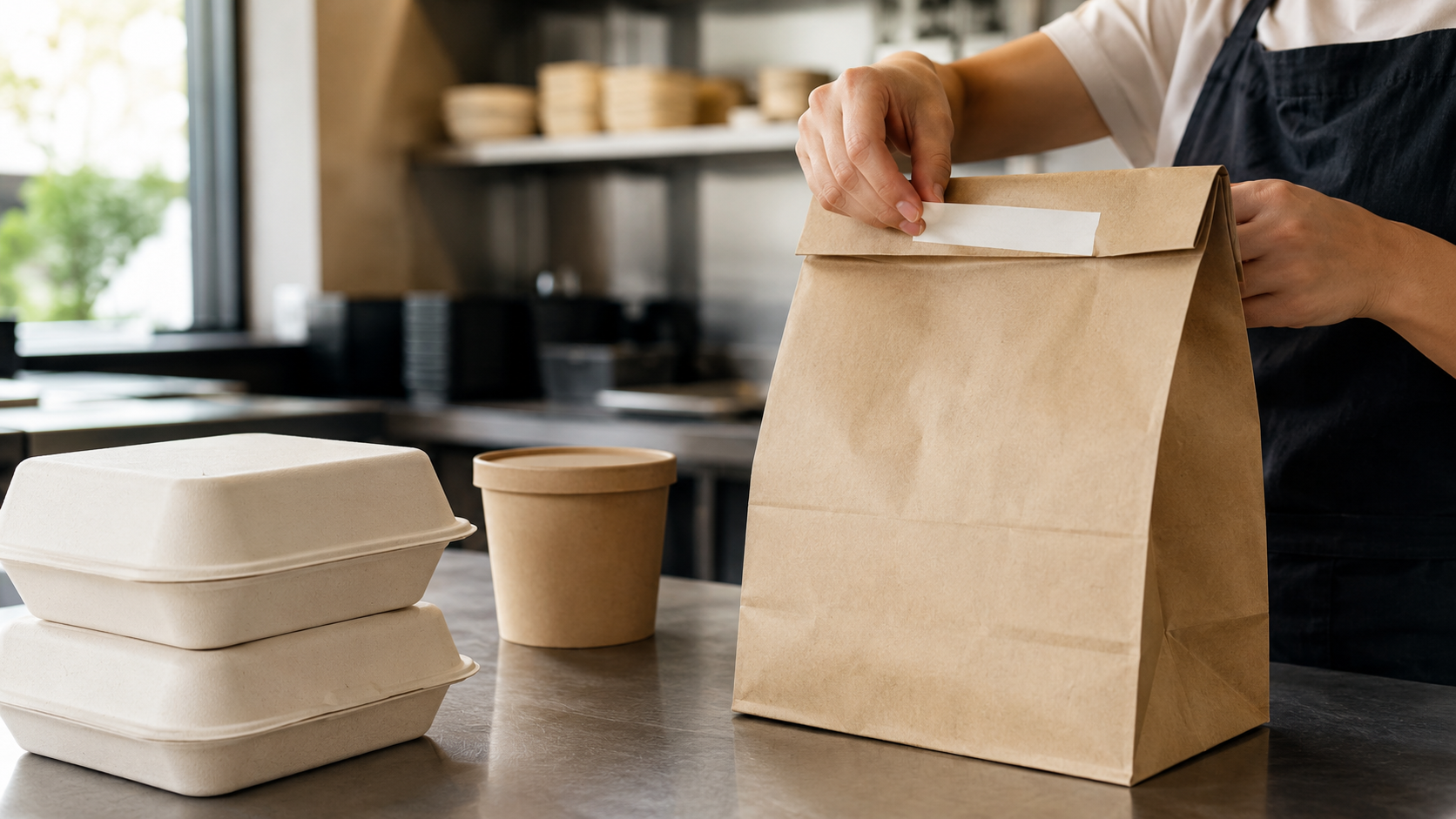
Tamper-evident food delivery bags are used to make an opened or disturbed closure visible during delivery. These bags can be compared by product type, closure type, application, end user, and distribution channel. For a restaurant, takeaway operation, or catering team, the useful first decision is not a market forecast: it is whether the chosen bag and closure fit the food, the volume, the packing workflow, and the local requirements that actually apply.
Common closure categories include adhesive, zipper, and heat seals, while product categories include single-use, reusable, thermal, paper, and plastic bags. Those categories describe options, not a universal instruction. A buyer should validate the exact product and process before making safety, compliance, sustainability, or tamper-evidence claims.
What a Tamper-Evident Bag Is Intended to Do
A tamper-evident bag is intended to show visible evidence if its closure has been opened or disturbed. It is not the same as a guarantee that food has never been accessed, contaminated, or damaged.
In a delivery workflow, the bag is one part of a larger system: the inner container needs to fit the food; the order needs to be identified correctly; the closure needs to be applied consistently; and the handoff needs to be organized. The bag cannot compensate for a leaking container, a missing item, unsuitable holding conditions, or an unclear pickup process.
Start With the Delivery Use Case
Map the order before choosing a bag. Consider:
- the food temperature, moisture, oil content, and portion size;
- the number and shape of containers in a typical order;
- whether drinks need to travel separately;
- expected delivery time and handling points;
- the volume of orders per shift;
- storage space and packing time; and
- the local disposal route and any verified requirements.
This assessment helps distinguish an occasional low-volume takeaway order from a high-volume delivery line or a multi-meal catering dispatch. A selection that suits one workflow may be impractical for another.
Choose a Product Type That Fits Operations
Common product categories include single-use, reusable, thermal, paper, plastic, and other bags. Each raises a different operational question.
Single-use bags
Single-use bags can simplify a one-way delivery workflow because they do not require collection, cleaning, or redistribution. Before choosing one, check the bag’s dimensions, load suitability, closure behavior, and verified disposal information for the destination.
Reusable bags
Reusable bags require a documented process for collection, cleaning or sanitization where appropriate, inspection, storage, and redistribution. A reusable format should not be selected solely for a broad sustainability message; the actual return and care process must work in the operation.
Thermal bags
Thermal bags are relevant where temperature retention is a key delivery concern. Confirm the product’s actual performance and use instructions for the exact configuration. Do not infer an insulation level, food-contact suitability, or delivery duration from the category name alone.
Paper and plastic bags
Paper and plastic are material categories, not performance conclusions. A buyer should verify the exact bag’s construction, intended use, closure compatibility, and any material or disposal claim with supplier documentation.
Compare Closure Types Before You Commit
Common closure types include adhesive seals, zipper seals, heat seals, and other systems. The right choice depends on the packing line and the intended customer experience.
Adhesive seals
An adhesive closure can be practical for a manual packing process. The team should define where it is applied, how the closure is checked, and what staff should do when a seal does not adhere as intended. The visual result should be clear enough for the restaurant’s own handoff process.
Zipper seals
A zipper can support repeated opening and closing in some bag designs. If the workflow also needs visible evidence of opening, evaluate the complete closure system rather than assuming that a zipper itself provides that outcome.
Heat seals
Heat sealing can require equipment, settings, training, and quality checks. It may suit operations that can control those variables, but its suitability must be assessed for the bag material and the actual packing line. A heat seal should not be described as irreversible or compliant without evidence for the specific system.
Build a Repeatable Packing Workflow
A useful workflow turns a packaging choice into a consistent routine:
- 1. Check the inner containers. Confirm lids are properly fitted and food is packed for the journey.
- 2. Organize the order. Keep meal components, sides, condiments, and drinks in their intended arrangement.
- 3. Identify the order. Apply the information staff and customers need to distinguish it.
- 4. Place the order in the bag. Avoid forcing containers into a bag that is too small or poorly shaped for the load.
- 5. Apply the chosen closure. Follow the defined method and inspect the result before handoff.
- 6. Stage for pickup. Use a clear pickup area and keep the order under appropriate holding conditions.
- 7. Record exceptions. Note seal failures, bag damage, incorrect orders, and customer feedback so the team can improve the process.
Train staff on the routine and use the same definitions for common failure types. That makes it easier to tell whether an issue relates to the container, bag, closure, assembly, holding, or delivery handoff.
Choose by Application and End User
Applications include online food delivery, takeaway restaurants, catering services, and other uses. End users include restaurants, food-delivery services, catering companies, and other operations.
For online delivery, focus on order identification, carrying convenience, and a closure process that staff can repeat during busy periods. For takeaway, the customer’s carry and opening experience may deserve more attention. For catering, test the bag against the larger load, longer holding time, and order complexity involved.
These are operational selection questions, not proof that a particular platform requires a particular bag. Do not claim that DoorDash, Uber Eats, or any other platform mandates a packaging format unless the current requirement is verified for the relevant merchant terms and market.
Evaluate a Pilot Before Scaling
Run a limited pilot with a defined order type and a small shortlist of bag-and-closure configurations. Keep other variables as stable as practical and record:
- packing time per order;
- closure failures or rework;
- bag damage, leakage, or carrying complaints;
- order-accuracy issues;
- food-condition feedback at arrival;
- customer comments about opening or package condition;
- unit and accessory costs; and
- storage and replenishment needs.
Review the results with the people who pack and hand off orders. A pilot can reveal whether the process is genuinely workable without turning a market category into an unsupported performance promise.
Keep Market Figures and Compliance Claims in Scope
Market forecasts and segment estimates are not independent proof of a future outcome or a reason to treat a specific bag as suitable for every market.
General discussion of regulations and platforms should not be converted into a blanket legal or platform claim. Requirements can differ by jurisdiction, product, merchant relationship, and date. Confirm the current authoritative rule before marketing a bag as mandatory, certified, compliant, or accepted by a platform.
The Practical Answer
Choose a delivery bag by matching the food, containers, order volume, closure process, and real handoff conditions. Make the closure step visible and repeatable, test it in normal service, and document what the team learns. Then verify any product, safety, environmental, platform, or destination-specific claim against the exact product and authoritative documentation.
Legal Disclaimer
This article provides general operational information, not legal, regulatory, food-safety, food-contact, certification, sustainability, or packaging-performance advice. Verify requirements and product suitability for the exact bag, closure, order, use conditions, platform arrangement, and destination market.
For a sourcing discussion, TakeawayPack’s online catalog includes foodservice packaging categories such as cups, bowls, boxes, containers, trays, lids, bags, and cutlery. Its RFQ process can be used to discuss the product category, material, dimensions or capacity, expected quantity, printing or logo requirements, and destination. takeawaypack.com