Tamper-Evident Packaging Choices for Delivery Orders
For delivery orders, tamper-evident packaging should provide a visible indication that a defined access point has been opened or disturbed. It should not be described as tamper-proof, and no single seal is automatically the best choice for rider vibration, customer opening, hygiene review, or a delivery-platform requirement.
2026-08-16 - 10 min read
Summary
For delivery orders, tamper-evident packaging should provide a visible indication that a defined access point has been opened or disturbed. It should not be described as tamper-proof, and no single seal is automatically the best choice for rider vibration, customer opening, hygiene review, or a delivery-platform requirement.
A useful selection process compares five practical options—adhesive seals, sealed outer bags, integrated tamper-evident containers or lids, heat-applied foil seals, and tape-based bag closures—against the actual SKU, menu item, pack-out sequence, and delivery route. Test the complete order, document the outcome, and confirm any product-specific performance, food-contact, hygiene, regulatory, or platform requirement separately for the selected configuration and destination.
What Tamper-Evident Packaging Does—and Does Not Do
Tamper-evident packaging is designed to leave a visible change when a package is opened through its intended access path. A broken label, separated tear strip, lifted seal, or opened one-time tab can give the restaurant and customer something to inspect at handoff.
That is different from saying a package is impossible to open. Every delivery configuration has variables: the food’s moisture and fill level, lid geometry, bag load, packing consistency, transport movement, and the way the customer opens the order. The goal is a clear, repeatable handoff condition—not an absolute prevention claim.
Before choosing a method, identify every meaningful access point in the order:
- the main food container and its lid;
- sauces, soups, drinks, or other separately packed components;
- the outer bag opening and handles; and
- the customer’s intended first opening action.
A bag seal may make the whole order easier to inspect, but it does not replace a correctly closed container. Likewise, a container feature does not solve poor stacking or an overloaded carry bag.
The Five Delivery Tamper-Evident Options
1. Adhesive Tamper-Evident Labels or Seals
An adhesive label can bridge a box flap, container lid edge, cup access point, or folded bag opening. It is often a simple option to sample because it can be applied at the packing line without changing the container itself.
The key question is not whether a label looks secure on a flat sample. Review whether it adheres to the actual substrate and placement used in service. Grease, moisture, steam, creases, textured surfaces, and a crowded bag top can all affect the result.
For each candidate label, define:
- the exact SKU or bag/container surface;
- the seal position and number of seals required;
- the application action, including any pressure or dwell time in the work instruction;
- the visible condition expected before opening; and
- what the customer is meant to pull, tear, or lift.
Keep the seal away from a necessary opening grip, order information, or a lid area where it could interfere with normal closure. A branded label can also be considered as part of a custom brief, but artwork, placement, substrate, and production feasibility must be confirmed for the proposed configuration.
2. Sealed Outer Delivery Bags
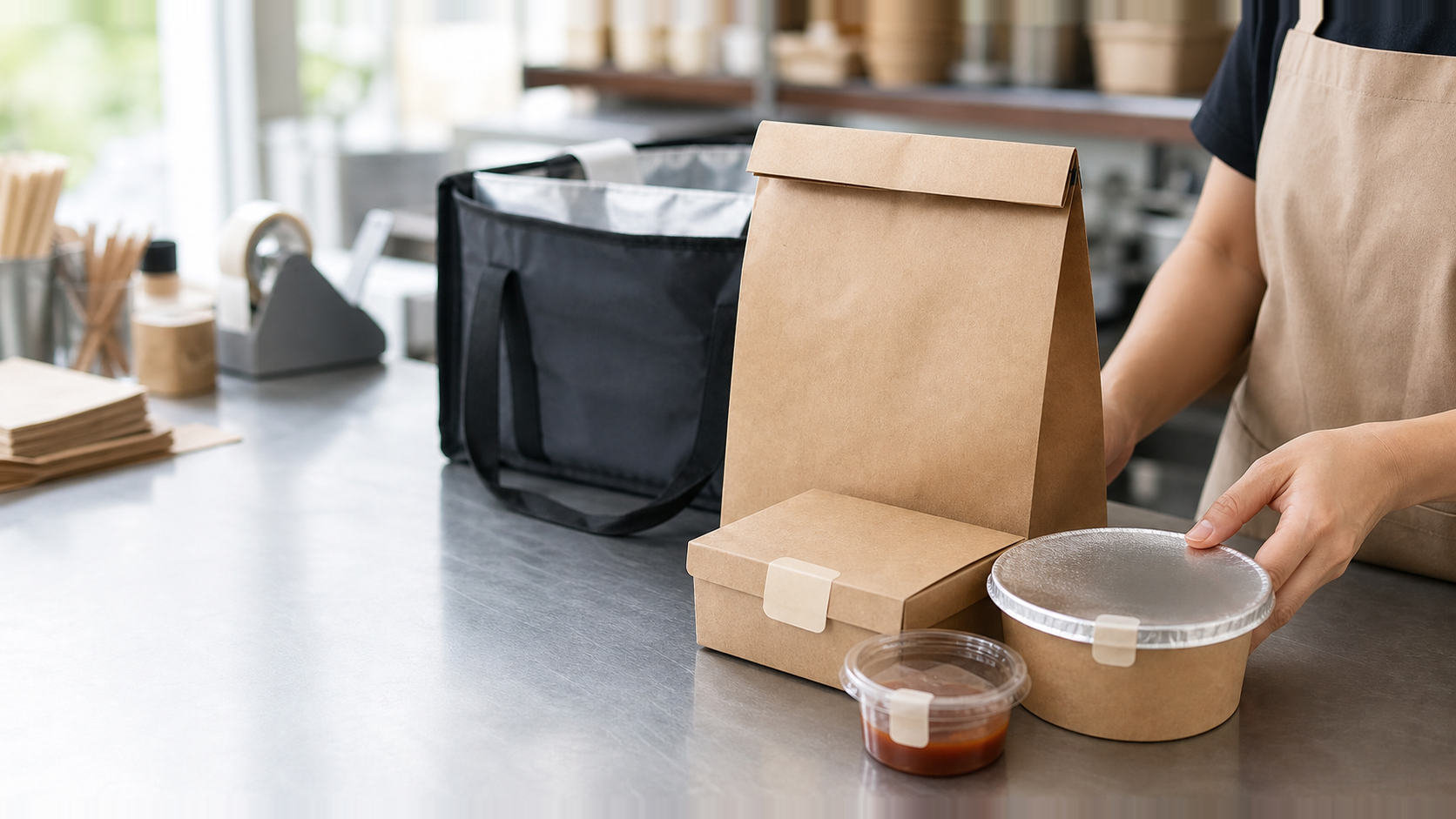
Sealing the carry bag creates one final handoff unit after the individual containers have been checked and packed. Depending on the bag design, this may involve a built-in adhesive strip, a folded-top seal label, or a handle-area closure.
This approach can be useful to evaluate for multi-item orders because it groups food containers, sauces, cutlery, and receipts into one visible package. It is not a substitute for closing each container, especially where drinks or liquid-heavy items have their own access points.
A bag-closure trial should include the real bag size, handle style, normal and high order loads, and the menu combinations that challenge the top area. Check whether the handles align naturally, whether the closure is applied after all items are inside, and whether the bag can be carried without the contents pressing into the sealing zone.
3. Containers or Lids With Integrated Opening Evidence
Some container systems use a one-time locking tab, tear strip, breakable bridge, or another integrated opening feature. Because the feature is built into the package, the packing team may have fewer separate components to handle.
Evaluate the selected container and matching lid as a system. Confirm how the feature engages after the actual food is filled, whether the intended opening evidence is visible after transport, and whether the customer can open the pack without disturbing the rest of the order.
For soup, sauce-heavy meals, or other liquid-containing dishes, also inspect the complete closure area after packing and after the route test. An integrated feature should not be treated as a blanket statement about leakage control, suitability, or delivery performance; those findings belong to the exact container, lid, fill condition, and route that were tested.
4. Heat-Applied Foil Seals
A heat-applied foil seal is a process choice as much as a packaging choice. It typically requires compatible packaging components, equipment, a documented application method, and a customer-opening plan.
Consider this route only when the operation can evaluate the full production workflow. The review should include the container geometry, the proposed seal material, packing-line space, equipment use, cycle time, handling controls, and the condition of the sealed package after a representative journey.
The team should also test how the customer removes the seal and where the customer places the opened component. A strong-looking seal alone does not establish suitability for the food, use conditions, or any external requirement. Those questions require configuration-specific confirmation.
5. Tape-Based Bag Closures
Tape can be a straightforward outer-bag closure to evaluate when a restaurant wants a simple, visible final step. Its effectiveness in a particular delivery setup depends on the paper or film surface, fold geometry, tape width, application consistency, and the bag’s loaded condition.
A tape trial should inspect more than whether the bag stays folded. It should ask whether the tape visibly changes when opened, whether it leaves an ambiguous re-close path, whether it pulls fibers from the bag during normal handling, and whether the opening action is clear to the customer.
Avoid treating a low component cost as a complete purchasing decision. Include labor, packing-line interruptions, seal placement errors, retests, customer-opening feedback, and any damaged-order handling in the comparison.
Use a SKU-to-Menu Map Before Comparing Options
A practical framework starts with a one-line record for each menu item or family of similar items. This prevents a result from a dry snack box from being applied automatically to a soup, drink, or multi-item meal.
For every trial line, record:
| Record item | Why it matters |
|---|---|
| Menu item and portion | Defines the actual packed load. |
| Food condition | Identifies hot, cold, crisp, wet, oily, saucy, or liquid-heavy conditions to include in the trial. |
| Container and lid SKU | Keeps the result tied to the exact primary package. |
| Bag and closure SKU | Identifies the outer handoff configuration. |
| Fill level and headspace | Shows whether food or containers can press into the closure area. |
| Separate drinks, sauces, and sides | Identifies additional access points and movement risks. |
| Pack-out sequence | Makes the application method repeatable across staff and locations. |
| Route scenario | Links the result to the handling conditions actually reviewed. |
If any of these inputs changes, decide whether the existing result still applies. A different lid, new bag size, changed portion, revised menu mix, or longer delivery territory can be enough reason to retest.
Build the Packaging Process Around the Menu
The closure method should fit the packing process rather than ask staff to improvise at the end of every order. Create a simple station standard that identifies what is checked, what is sealed, and in which order.
Start with the primary package
First, pack the intended food in the selected container and matching lid. Check the rim, seating area, tabs, threads, or other closure points according to the specific configuration. Confirm that the fill level leaves the planned headspace and that sauces or toppings are not pushed into the closure area.
Then stabilize the order
Place heavier or more stable items in positions that match the operation’s delivery-bag setup. Keep drinks, sauces, and fragile items in the arrangement used for the test. Use separate bags or dividers only where the operation has decided they are part of the configuration being evaluated.
Apply the visible-evidence feature last
The final seal should be applied after the item count and order identification are checked. This helps avoid reopening and resealing a completed order without a defined exception process. The final visual inspection should confirm that the closure is present, aligned, readable where applicable, and not already damaged.
Run a Route Test Instead of Relying on a Countertop Sample
A closure that looks consistent on an empty package may behave differently when it is exposed to food weight, steam, sauce, stacking, courier-bag placement, lifting, turns, vibration, and handoff. A route test evaluates the complete delivery system under recorded conditions.
Use the same test plan for every candidate
To compare options fairly, apply the same representative order and handling sequence to each one. The plan may include normal packing, lifting, placing the order inside the courier bag, controlled tilting, stop-and-go movement, unloading, and a customer-style opening check.
At the end of the test, inspect and document:
- lid engagement, container position, and any shifted components;
- leaks, drips, condensation, or moisture near the closure area;
- the bag’s handles, folds, and overall load shape;
- lifted edges, tears, split labels, or broken opening features;
- whether visible disturbance is distinguishable from ordinary wear;
- legibility of the order label and clarity of the intended opening point; and
- the customer’s ability to open the order without creating avoidable tipping or confusion.
Photograph the completed order before movement, after the route, and after opening. Tie each photo and observation to the full configuration, not only to a general closure category.
Include more than one route condition when needed
If deliveries vary by vehicle, distance, order size, or terrain, create representative scenarios instead of assuming one route tells the full story. Compare only observations made under the stated conditions. Do not extend a test result into a universal claim for every rider, market, menu, or delivery platform.
Make the Customer Opening Experience a Selection Criterion
A seal should give the customer a clear, understandable opening path. During a trial, ask participants to open a normally packed order with minimal instruction. Observe where they start, whether they use the intended feature, whether food containers move as the bag opens, and whether they can recognize the seal’s pre-opening condition.
If a customer cannot distinguish a designed opening change from normal handling marks, the configuration may need a different placement, a clearer opening cue, a different bag load, or another candidate method. The goal is to reduce ambiguity, not to make an unsupported claim that the order is invulnerable.
Use a Decision Record for Procurement and Rollout
A short decision record makes a packaging trial reusable without turning it into a broad promise. For each candidate, retain:
- the container, lid, bag, and closure identifiers;
- the menu item, portion, fill level, and component mix;
- the packing and sealing work instruction used;
- route-test conditions and handling sequence;
- before-and-after photographs;
- observations about movement, moisture, closure condition, and opening evidence;
- customer-opening feedback; and
- the trigger for retesting, such as a SKU, menu, route, or process change.
This record supports a more controlled choice between adhesive seals, sealed bags, integrated features, heat-applied seals, and tape closures. It does not itself establish food-contact status, sanitary performance, legal compliance, or acceptance by an inspection authority or delivery platform. Those matters should be reviewed separately for the chosen SKU, intended food and use conditions, destination, and current applicable requirements.
Takeaway
The right tamper-evident delivery option is the one that produces a clear visible signal and a workable customer opening experience in the exact order system being used. Start with a SKU-to-menu map, apply each candidate through the normal packing sequence, and compare it on the actual route before standardizing it.
For an RFQ or a custom packaging conversation, contact TakeawayPack with the food type, container and bag format, expected quantity, customization needs, destination, and the route conditions you want to test. The discussion can be scoped to the proposed project; product-specific performance, documentation, and suitability should be confirmed for the selected configuration.