UK Plastic Packaging Tax 2026: What Takeaway Suppliers Need to Know
For packaging components produced in or imported into the UK on or after 1 April 2026, the statutory Plastic Packaging Tax rate is £228.82 per metric tonne of chargeable components.[1] A finished plastic packaging component is chargeable when the proportion of recycled plastic in it, measured by wei
2026-09-09 - 4 min read
Summary
For packaging components produced in or imported into the UK on or after 1 April 2026, the statutory Plastic Packaging Tax rate is £228.82 per metric tonne of chargeable components.[1] A finished plastic packaging component is chargeable when the proportion of recycled plastic in it, measured by weight, is below 30% of the total plastic in that component.[2] For a supplier, the usable response is a component-specific record: evidence for recycled plastic, a written calculation or obtained calculation, and a review path when the inputs no longer remain accurate.[3]
This article is estimated to take 3 minutes to read.
Start with the component, not the commercial pack name
The legal unit is a packaging component, rather than a catalogue label or a meal set.[4] The 2021 Regulations treat a qualifying single-use product as a packaging component when it is designed for containment, protection, handling, delivery or presentation of goods, whether it is designed to work alone or in combination with other products.[4]
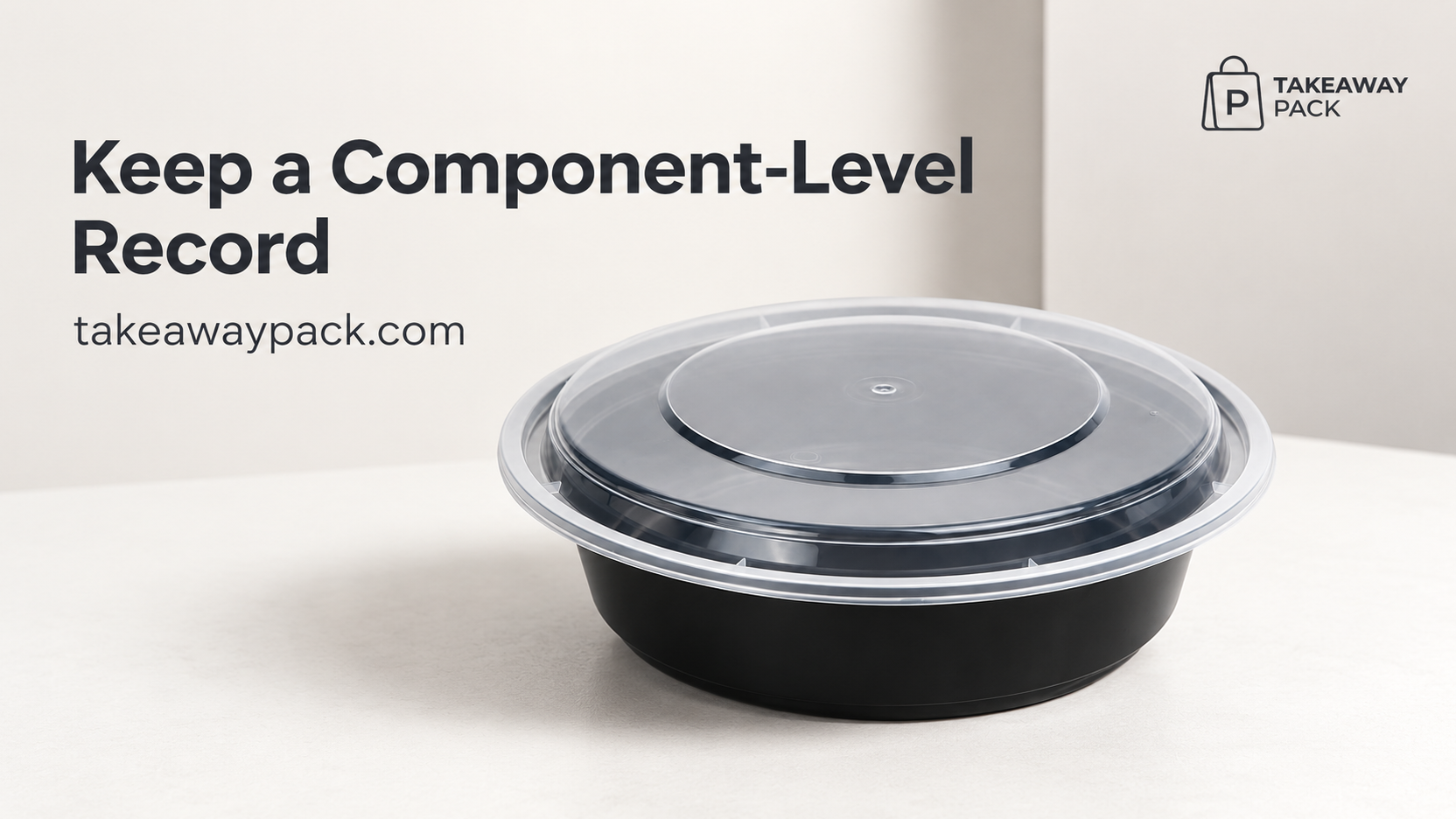
For an internal review, make a list of every item that may be a separate finished component.[3] In a takeaway format, that can mean reviewing a bowl and a lid as separate records when they are separate components, rather than attaching one recycled-content statement to the whole set.[3] The tax charge arises when a chargeable component is produced in the UK or imported into the UK on behalf of a business; the Act places payment liability on the producer in the first case and on the person on whose behalf it is imported in the second.[2]
A practical component register can record the component identifier, product-line or production-run reference, material breakdown, component weight, plastic weight, recycled-plastic weight, and the date or period to which the record applies.[3] Those fields mirror the distinctions used in the Regulations for product lines, production runs, design specifications and indicative components.[3]
Apply the 30% test to plastic weight in that component
The chargeability test is about the proportion of recycled plastic by weight within the individual plastic packaging component.[2] It is not a percentage of the meal, the order value, or the non-plastic material in a multi-material item.[2]
For a registered or registerable person seeking to show that a component does not fall below the threshold, the Regulations require a component calculation to be undertaken or obtained and retained in writing.[3] They identify the inputs as the weight of recycled plastic used to produce the component and the weight of plastic used to produce it.[3]
Keep the inputs next to the result.[3] A specification-based calculation is permitted for a product line only when the specification includes the component, plastic and recycled-plastic weights, and an indicative component has been weighed and matches the specification.[3]
Build evidence that can be traced and rechecked
The Regulations require sufficient evidence that plastic is recycled plastic and a written record of that evidence. They also require a written record of the calculation used to show that a component does not fall below the chargeability test.[3]
For a supplier handover, organise the file around the component rather than a general company statement.[3]
- Component identity: SKU or drawing reference, product line or production run, and the relevant material and weight fields.[3]
- Recycled-plastic evidence: documents that support the recycled-plastic input used for that component or run.[3]
- Calculation record: the input weights, calculation, applicable specification, indicative-component check where used, and the responsible internal reviewer.[3]
- Change record: the point at which a changed material, weight, production run or specification requires the calculation to be checked again.[3]
This structure keeps evidence and calculations ordered by component.[3] If an indicative component is no longer representative, or the calculation is inaccurate or no longer correct, the Regulations require a further calculation or obtained calculation and a written record.[3]
Imported packaging needs the same component discipline.[3] Where imported packaging contains other relevant packaging components, the importer must undertake or obtain, and retain, a determination for those other components.[3]
Confirm the liable party and registration position early
The statute distinguishes between UK production and importation on behalf of a person.[2] Before a shipment is priced or dispatched, make sure the commercial documents identify the party on whose behalf any finished component is imported, and keep that responsibility separate from the supplier's technical evidence pack.[2]
Registration becomes relevant at a 10-metric-tonne threshold: it applies where the expected 30-day amount, or the amount over the preceding 12 months, is at least that threshold.[2] This article cannot determine whether a particular party, route or shipment meets that test.
Keep food-contact documentation as a separate file
Maintain the PPT evidence file separately from food-contact documentation. If the component will contact food, request and assess food-contact documentation for the exact material, production conditions and destination market as a separate product-control exercise.
Use the RFQ to prevent rework
At the RFQ stage, ask for the component identity, intended UK destination, production-run or product-line reference, plastic and recycled-plastic weights, supporting evidence, and the party on whose behalf the component will be imported.[2][3] Recheck the calculation when the specification or representative component changes, rather than carrying a prior percentage forward without review.[3]
For a foodservice-packaging enquiry with TakeawayPack, start with the exact component and destination at takeawaypack.com, then agree the documentation required for that shipment.
This article is practical procurement information, not tax or legal advice. The UK business responsible for a return should confirm scope, liability, exemptions and filing treatment with a qualified UK tax adviser before filing.
Sources
[1] https://www.legislation.gov.uk/ukpga/2026/11/section/104 — Finance Act 2026 — section 104
[2] https://www.legislation.gov.uk/ukpga/2021/26/part/2 — Finance Act 2021 — Part 2
[3] https://www.legislation.gov.uk/uksi/2022/117 — The Plastic Packaging Tax (General) Regulations 2022
[4] https://www.legislation.gov.uk/uksi/2021/1417/made — The Plastic Packaging Tax (Descriptions of Products) Regulations 2021