How to Verify Leak-Proof Soup Container Claims Before Ordering in Bulk
A "leak-proof" label on a soup container is validated under static, controlled conditions — not under the vibration, tilting, stacking, and steam pressure of a real delivery ride. For cloud kitchens and virtual brands serving soup, curry, broth, and sauce-heavy dishes, reliable packaging depends on four variables working together: the lid seal, the material, the body structure, and how the pack is filled and carried. Buyers who want test data or samples should ask for SKU-specific evidence and then run a simple practical check before committing to a large order.
2026-08-11 - 7 min read
**Summary:** A "leak-proof" label on a soup container is validated under static, controlled conditions — not under the vibration, tilting, stacking, and steam pressure of a real delivery ride. For cloud kitchens and virtual brands serving soup, curry, broth, and sauce-heavy dishes, reliable packaging depends on four variables working together: the lid seal, the material, the body structure, and how the pack is filled and carried. Buyers who want test data or samples should ask for SKU-specific evidence and then run a simple practical check before committing to a large order.
Why soup containers fail on real delivery routes
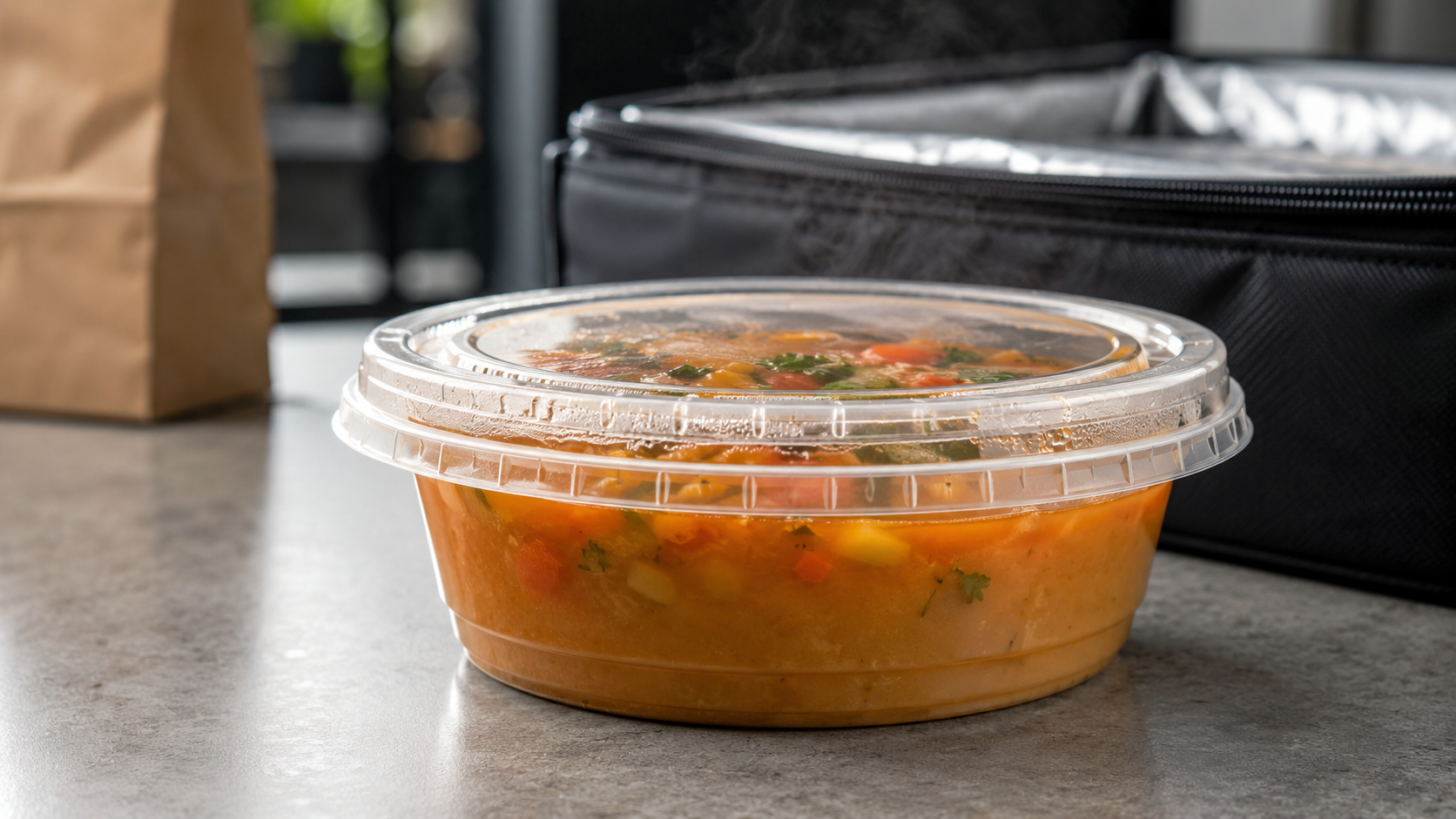
A container that holds perfectly on a level counter can fail before it reaches the customer. A filled soup pack on a scooter or car seat experiences repeated vibration, hard stops, turning, and tilting. At the same time, hot liquid builds internal pressure. Together these forces push against the weakest point of the package.
The label almost never lies on purpose — it is simply narrow. "Leak-proof" usually means the container passed a controlled lab test while sitting still. A 45-minute delivery is not a controlled test. Operators who understand this treat packaging as an engineering decision rather than a marketing claim.
Treat leak-proof performance as a system, not a single feature
There is no one container that is simply "leak-proof." What a buyer is actually selecting is a set of variables that must work together:
- **The lid seal** — how the lid compresses a groove or gasket against the rim.
- **The material** — whether the container keeps its shape at hot-fill temperatures.
- **The body structure** — whether the base and walls resist pressure without flexing.
- **The usage method** — how full the pack is, how the lid is seated, and how it is carried.
If three of the four are right and one is weak, the leak simply moves to a different location. The practical goal is a repeatable pack configuration for a specific menu item and delivery route.
The lid seal is where most failures start
A lid sitting on a rim is not sealing anything. What actually holds is compression — the lid pressing a groove or gasket tight against the container rim. Without that mechanical contact, internal pressure finds a path out.
After forty minutes of movement, a flat-edge lid and a lid with a sealing groove are not the same product. Snap-fit designs with a sealing rim maintain compression through vibration, while flat-edge lids rely on surface contact that degrades the moment the bag tilts.
Choose a material that holds its shape when hot
Material choice is a structural decision, not a branding one. If the container warps, the seal fails.
Polypropylene (PP) holds its shape across a temperature range down to roughly -10°C and up to about 110°C. It does not soften during hot filling or microwave reheating, and that dimensional stability is what keeps the seal intact through a delivery route. Paper and fiber containers can soften above roughly 70°C, which distorts the walls, base, and lid seal. PET is rigid but less heat-tolerant for hot liquid.
Check the body structure, not just the lid
Everyone specifies the lid; almost nobody specifies the container body. Yet pressure failures often originate in the body. Three structural details make a measurable difference in real delivery:
- A deep sealing groove on the rim that holds the lid edge under lateral pressure.
- A reinforced base that prevents the bottom from bowing outward when filled with liquid.
- Straight walls instead of sharply tapered ones, which create uneven pressure against the lid.
A container body that flexes under load will break its own seal. No lid design compensates for a structurally weak base.
Understand the steam-pressure tradeoff
The better the lid seal, the more pressure can build inside. Steam from hot soup has nowhere to go, so it pushes against lid edges, base seams, and sidewall joints. This is why some containers do not leak at the top — they leak at the bottom instead.
A micro-vent built into the lid can release pressure without compromising the main seal. Without one, an operator is choosing between a container that breathes and one that eventually gives way under pressure.
What to ask for when you request test data or samples
Buyers who ask whether leak-proof performance can be verified are asking the right question. Sensible next steps:
- Request documentation for the exact finished container-and-lid configuration you intend to use, not a generic statement or an unrelated report.
- Ask which conditions the test covered — temperature, fill level, orientation, and duration.
- Request physical samples so you can run your own check with your actual menu item.
Before you order at scale, a short in-house test can complement supplier documentation.
Run three simple tests before you buy in bulk
Do not rely on supplier specifications alone. Three practical tests tell you what you need to know:
- **Inversion test** — fill the pack to about 80%, seal it, turn it upside down over white paper for 60 seconds. Any residue means the configuration fails.
- **Hot-liquid test** — fill with hot liquid (around 85°C), then check for steam leakage and lid flex after about five minutes.
- **Transit simulation** — put the sealed container in a bag and simulate 15 minutes of movement, then check for residue.
If the pack fails the inversion test, the other two do not matter. Record the container and lid, fill level, food condition, test steps, and result so the check can be repeated for training and repeat orders.
Fix the operational causes of leaks first
A significant share of soup leaks are not manufacturing defects — they are kitchen failures. The most common operator errors are:
- Overfilling, so liquid above the shoulder line contacts the seal on every tilt.
- Half-snapped lids that look closed from above but are not engaged.
- Lid-base mismatch, where a lid physically fits the opening but is geometrically incompatible with the sealing groove.
A few minutes of staff training on fill level and lid engagement often fixes more leaks than changing suppliers. Check the kitchen before blaming the packaging.
Match the container to your delivery setup
One configuration does not fit every operation. For standard food delivery routes of 30–60 minutes, a snap-fit PP container with a grooved, vented lid is the configuration that holds through the full range of delivery conditions. For a central kitchen or meal-prep line with more controlled transit, a film-sealed option can work. For dine-in plus takeout, choose PP bowls that are microwave-safe and still seal through a short delivery run.
Build a repeatable packing standard once a configuration passes
Once a container-and-lid combination passes your practical check, capture it as an approved pack standard: the exact container and lid, portion and fill guidance, closing steps, outer-pack arrangement, and the date and conditions of the check. Re-test when the menu, recipe, supplier, container format, lid, or route changes.
For TakeawayPack buyers, the sourcing process supports exactly this kind of validation. TakeawayPack's public inquiry information covers product or category, material, size or capacity, estimated quantity, print and logo requirements, and destination. During an inquiry, buyers can discuss structure, coating, capacity, printing, lid matching, and carton packing. TakeawayPack also states it can support samples, drawings or print-file alignment, and packaging and export-handoff communication — useful inputs before a soup- or sauce-heavy delivery pack moves to volume.
To validate a leak-proof soup container against your menu and delivery route, start with the product range and RFQ details at TakeawayPack to align samples, lid matching, and pack specifications before you scale up.