What Molded Fiber (Bagasse) Containers Are Good For — and What They're Not
Molded fiber can be worth evaluating when a restaurant wants a non-foam format for prepared food, but the material name does not establish microwave use, heat tolerance, oil resistance, liquid containment, or an environmental claim. Make the decision from the finished container, its closure, the men
2026-09-09 - 6 min read
Summary
Molded fiber can be worth evaluating when a restaurant wants a non-foam format for prepared food, but the material name does not establish microwave use, heat tolerance, oil resistance, liquid containment, or an environmental claim. Make the decision from the finished container, its closure, the menu, and documented conditions—not from a broad supplier “yes.”
This article is estimated to take 4 minutes to read.
Start with the failure you need to prevent
A switch from foam to bagasse is not one decision. It is a set of decisions about the food, the delivery journey, the closure, and what customers may do after the order arrives. A container that looks stable during packing can soften in a delivery bag, wick oil at a corner, or become unsuitable once a lid or lining is added.
The practical question is not “Is bagasse good?” It is “Is this complete package suitable for this menu and this use?”
Choose a container format around the way your food fails in transit or during reheating.
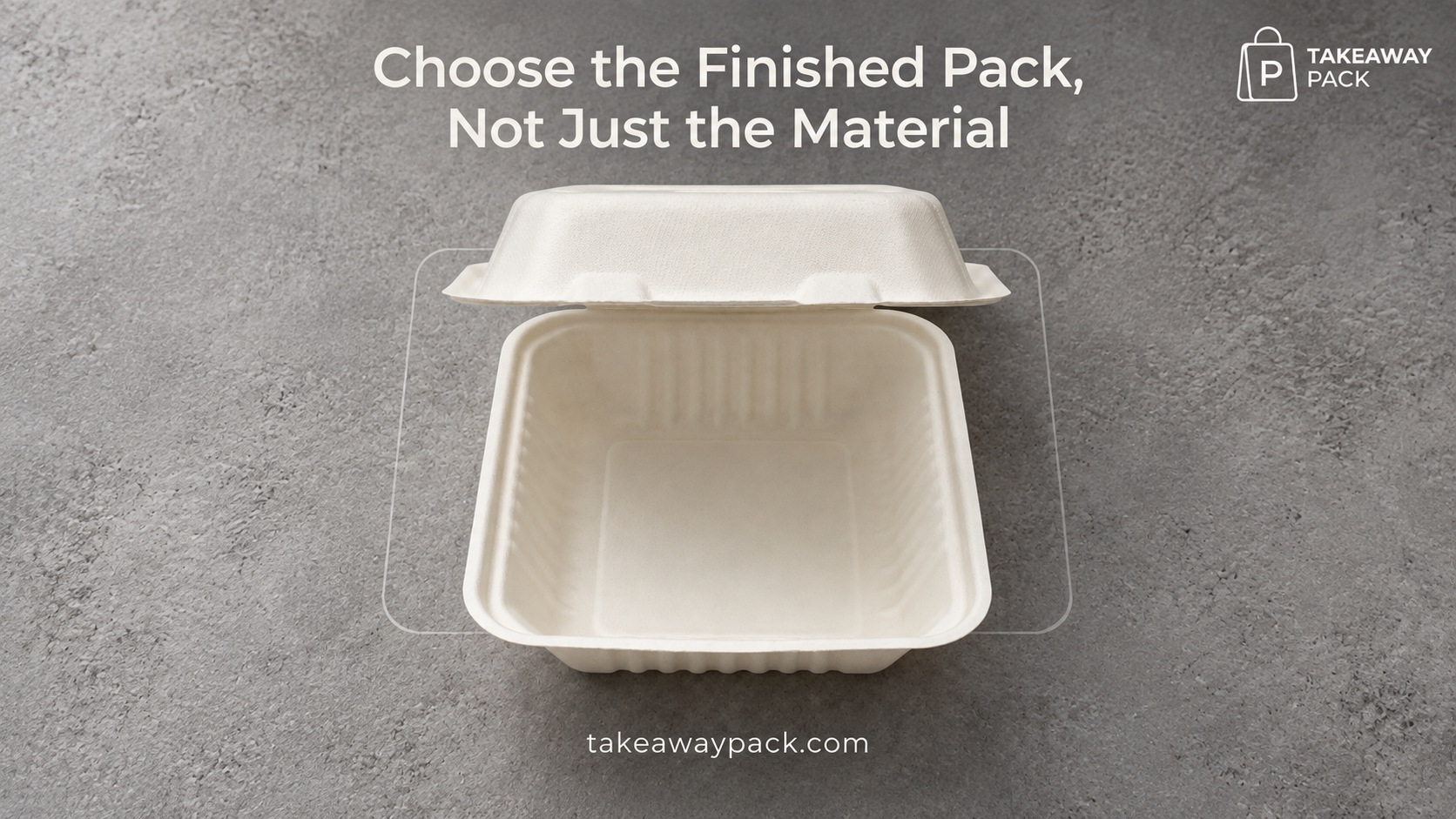
A molded-fiber clamshell can be a reasonable format to trial for meals that are mostly solid and have limited free liquid. Rice dishes, sandwiches, fried items, and portioned entrées are examples of menus where shape, closure, and grease staining should be tested before approval.
A saucy meal raises different questions. The package needs enough depth, a stable rim, a closure that stays engaged, and a realistic hold-time test. The fact that a container survives hot filling does not show that it will survive a stacked delivery order.
For broth, thin soup, or a loose curry, begin with a purpose-built liquid container and its intended lid rather than assuming a hinged box is the right format. A lid that appears to fit is not necessarily a compatible liquid seal. Treat the container and lid as one system.
This menu-first approach prevents a common mistake: asking one general-purpose container to perform as a plate, a delivery vessel, a soup tub, and a microwave dish at once.
Separate the four heat questions
“Heat resistant” combines several different uses that should be specified separately:
- Hot filling: Can staff pack the food at its normal serving temperature without the package losing shape?
- Delivery holding: What happens after the longest normal delay, stacking, movement, and trapped steam?
- Microwave reheating: Is the exact finished package approved for a stated power level, time, fill, and lid condition?
- Dry heat: Is it intended for a warming cabinet or conventional oven? Do not infer this from a microwave statement.
There is no responsible universal temperature number for molded fiber. A number only becomes useful when it names the SKU, the food or test medium, exposure time, fill level, and acceptance result. Hot water, hot oil, microwave energy, and dry oven heat stress a package differently. A short test in one condition cannot approve the other three.
Write each requirement into the buying brief. If customers will reheat food, that requirement deserves its own evidence and its own customer instruction.
Ask for a microwave instruction, not a yes/no answer
A supplier’s “microwave safe” statement is incomplete unless it describes the whole item under real conditions. Before staff or customers are told to reheat in the package, ask for written confirmation covering:
- the exact container SKU and its matching lid or film;
- microwave power and maximum heating time;
- the type and quantity of food used in the test;
- whether the container was filled, covered, vented, or used without a lid;
- what counts as failure, including distortion, scorching, odor, leakage, loss of rim strength, and lid-fit failure; and
- any restrictions for repeated heating, frozen food, dry food, or high-fat food.
The base may be molded fiber while the lid, coating, printing, adhesive, or liner has a different use condition. Do not assume that an approved base makes every version of the package approved. If the lid lacks a microwave instruction, remove it rather than guessing; if a closure needs venting, follow the documented instruction.
A customer-facing rule can stay simple: reheat only packaging marked for microwave use, use the written conditions, and stop if the container changes shape or shows signs of damage. A takeout container is not automatically oven cookware.
Oil, sauce, and soup need their own trial
Molded fiber is not automatically a barrier to oil or liquid. The result can change with pulp density, forming, seams, geometry, surface treatment, fill level, temperature, and the closure. “Grease resistant” or “leak proof” should therefore be a documented claim for the finished package, not a conclusion from the word bagasse.
Test oily food at the actual service window. Check the outside corners and underside for darkening, oil breakthrough, softening, loss of stiffness, and closure movement. A visible stain may be acceptable for one menu; a greasy delivery bag is not.
Test liquid food in the way it travels. Fill the package normally, hold it for the longest expected delivery period, place it in the courier orientation, stack it as orders are stacked, and inspect the container-and-lid pair. A counter-top water test does not reproduce a moving, hot delivery order.
If a package fails, record where: hinge, rim, corner, base, lid, or wall. That turns a vague “it leaked” complaint into a usable next sample request.
Keep performance and environmental claims separate
A container can be made from molded fiber and still require separate evidence for food-contact suitability, PFAS status, compostability, recyclability, certification, or a particular market. Do not use one document, logo, or statement about another product family as a shortcut for all of those claims.
For a U.S. food-contact claim supported by an effective Food Contact Substance Notification, verify that the substance and manufacturer/supplier in the document actually match what is being supplied. FDA states that an effective notification applies only to the food-contact substance at issue and the manufacturer or supplier listed in that notification.[1]
That is a documentation-matching principle, not legal advice. Ask for the document that matches the final item, order, market, and claim you intend to make. If it does not match, treat the claim as unconfirmed.
Run a trial that produces a purchasing decision
Before changing a menu or placing a production order, conduct a small recorded trial using multiple samples from the same proposed SKU.
- Pack food at the normal fill level and temperature.
- Hold orders for the longest realistic delivery period.
- Put them through the normal bagging, stacking, and transport pattern.
- Inspect shape, rim strength, closure, leakage, oil marks, and customer-facing appearance.
- Reheat only where written SKU-level instructions allow it, using the stated time and power.
- Record the food, fill, temperature, elapsed time, container code, lid, and result.
Repeat the trial if the mold, thickness, coating, lid, supplier, or production run changes. The purpose is not to prove a material category; it is to approve the package that will actually reach customers.
Turn the result into a clear RFQ
A useful RFQ starts with the menu problem: dry versus saucy versus liquid food, normal serving temperature, expected delivery duration, fill weight, stacking, reheating need, and destination market. Add the desired product category, material, size or capacity, quantity, printing requirements, and matching-lid requirement.
TakeawayPack can organize that RFQ information, including category, material, size or capacity, quantity, printing or customization, lid matching, and destination. Its product records include a sugarcane-bagasse single-compartment format, but that record is not a microwave, leak-proof, food-contact, PFAS, compostability, certification, availability, price, MOQ, or lead-time promise. Request the exact SKU documents and samples for the claims that matter to your menu.
The useful bottom line
Molded fiber is good for a controlled package decision, not a blanket performance claim. It may be a practical candidate for the right prepared-food application, provided the final container and closure pass a menu-specific trial and the supplier can document the use conditions you need.
Start the specification conversation at takeawaypack.com, then approve the finished package—not the material name.
Sources
[1] https://www.fda.gov/food/inventory-effective-food-contact-substance-fcs-notifications/about-fcs-review-program — FDA: About the FCS Review Program