Window Paper Boxes, Clear PET Containers, or Solid Paper Boxes? Packaging Choices for Product Photography
For a bakery or healthy-food shop that sells through photo-led marketplaces, the package has to do more than carry the food. It has to make the product legible in a thumbnail, protect it through handling, and fit the food-contact conditions of the finished item. Window paper boxes work well when a curated glimpse supports the sale. Fully clear PET containers work well when layers, colour, portion, or decoration need to remain visible. Solid paper boxes work well when structure, stacking, print area, or a more protected presentation matters most. The practical choice starts with the product, then checks moisture, temperature, transport, and the full food-contact package system.
2026-09-01 - 9 min read
Summary
For a bakery or healthy-food shop that sells through photo-led marketplaces, the package has to do more than carry the food. It has to make the product legible in a thumbnail, protect it through handling, and fit the food-contact conditions of the finished item. Window paper boxes work well when a curated glimpse supports the sale. Fully clear PET containers work well when layers, colour, portion, or decoration need to remain visible. Solid paper boxes work well when structure, stacking, print area, or a more protected presentation matters most. The practical choice starts with the product, then checks moisture, temperature, transport, and the full food-contact package system.
Start with the product’s “proof of freshness”
Online shoppers cannot smell a croissant or press a cookie before ordering. They make a quick judgement from colour, finish, toppings, layers, and apparent portion size. Packaging can either reveal that proof or make the listing photography carry the whole burden.
Ask one question first: **what detail makes this product worth choosing?** A glossy fruit tart, decorated cookie, layered parfait, and gift assortment benefit from being seen. A hot sandwich, rustic bread, or delivery bundle may benefit more from airflow, protection, and a controlled unboxing moment.
The answer should guide the package format—not the other way around.
When window paper boxes are the right fit
A window paper box gives customers a focused view while retaining the warm, printable presence of paperboard. It is a strong option for pastries, cookies, brownies, muffins, small tarts, gift sets, and other items whose top surface or arrangement helps sell the product.
The window acts like a frame. It can show frosting, golden layers, colourful inclusions, or a neatly arranged assortment without exposing every side of the item. That balance is useful when the product should look handmade or premium, while the box still needs room for a label, brand artwork, or product information.
For photo listings, photograph the closed box and the opened presentation. The closed image shows what the customer receives; the opened image makes texture, scale, and arrangement clear. Keep the window clean, avoid reflections, and use lighting that does not turn the film grey or overly glossy.
There is a structural trade-off. A cut-out window removes some paperboard from the panel, and a thin folding carton is not a substitute for transport protection. Delicate cupcakes, iced donuts, high toppings, or loosely packed cookies need an insert, divider, tray, or other means of keeping them off the window and away from the sidewalls.
Window packaging also needs a moisture and grease check. The paperboard, window film, adhesive, coating, ink placement, and the intended food conditions all matter. A window box that looks excellent for dry cookies may not be the right direct-contact format for a warm, oily, or highly moist item without a suitable barrier or liner.
When fully clear PET containers make more sense
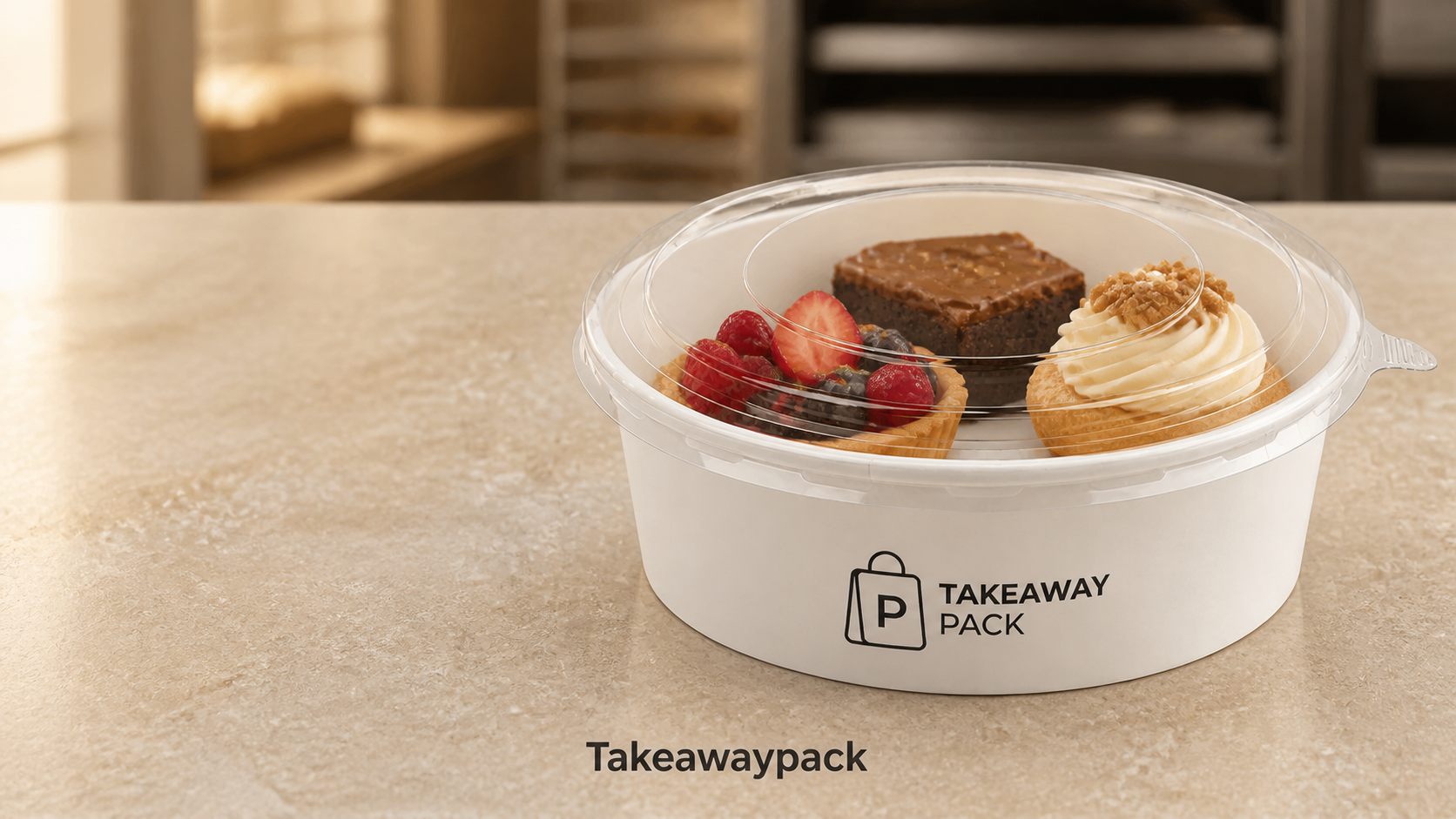
Fully clear PET containers are useful when visibility itself is the selling tool. They are especially suited to chilled desserts, cake slices, fruit-forward items, parfaits, granola, energy bites, cookies, nuts, snack mixes, and products with layers or decoration that shoppers want to inspect before purchase.
Clear walls make quantity and presentation easier to judge. For a marketplace image, that can reduce uncertainty: customers can see the topping level, ingredient mix, or shape rather than infer it from an opaque box. A rigid, well-fitting container can also protect an item from incidental contact better than a light paper carton in many handling situations.
Use the actual product in the product photograph. A clear empty container communicates very little. Fill it to the normal sale level, use the intended closure, and show a close-up that makes the lid, seal area, and portion size understandable. If the product is sold cold, photograph it cold enough to look authentic—but control condensation so the image does not suggest poor handling.
Clear plastic is not automatically the best answer for every fresh item. Steam and condensation can cloud the view. Crisp baked goods may lose their desired texture if the package traps moisture. Scratches can become visible during handling, and a clear container exposes every shift in the presentation. The package should be tested with the real product and the actual delivery path, not only judged on a studio table.
Temperature matters too. Do not treat a generic clear container as a hot-fill or oven-to-go solution. Confirm the material and use conditions with the supplier before putting warm or hot food into it. When a product needs higher-heat performance, venting, or a different barrier, specify that requirement rather than relying on appearance alone.
When a solid paper box is the better packaging choice
A standard paper box is often the most practical choice for bread, sandwiches with an appropriate liner, large bakery orders, delivery bundles, subscription packs, and products that need more stacking support or a larger print area. It is also useful when the product is better introduced through a hero photograph than through a window.
An opaque box can make the brand feel intentional. It gives room for a clear product name, flavour, handling guidance, nutrition or menu information where relevant, and visual identity. It also shields the contents from light and hides minor presentation changes that would be highly visible through clear plastic.
For online selling, the trade-off is simple: if customers cannot see the food through the pack, your photography needs to do more work. Show the product unpacked, show the filled box in a second image, and use one scale cue such as a serving, a hand, or a clearly described quantity. Do not depend on a beautiful exterior box to explain an unclear product.
For heavier or delivery-led orders, evaluate board grade, folds, corners, closures, and the outer shipping arrangement together. A well-designed display box may still need a separate outer carton or cushioning layer. Separating display packaging from shipping protection often creates a better customer experience than forcing one package to do both jobs.
A quick product-to-package guide
**Choose a window paper box when:** the visual appeal is concentrated on the top or front of dry-to-moderately moist bakery items; a paper-led look matters; and the product can be held securely with an insert or divider.
**Choose a fully clear PET container when:** the item’s layers, decoration, colour, portion, or texture are core buying cues; the product benefits from broad visibility; and the specified container suits the food’s temperature and moisture conditions.
**Choose a solid paper box when:** the order needs stronger stacking logic, a protected reveal, large print space, or an outer presentation for a product that has already been clearly photographed.
For a mixed menu, using all three formats can be more coherent than choosing one universal box. For example, a bakery may reserve window boxes for giftable pastries, clear containers for chilled or highly visual items, and solid boxes for bread, bundles, or delivery orders. The customer sees a consistent decision: each package has a job.
Balance visibility with crush resistance
A package that wins the photograph but loses the delivery is not a successful package. Build the selection around the most fragile part of the product: a tall frosting peak, a brittle cookie edge, a layered dessert, or a lid that can pop open.
Use internal retention before adding excessive outer material. Inserts, cavities, trays, dividers, cake boards, and correctly sized bases can stop an item from sliding or touching the lid. Then assess the outer package for stacking and handling. A display package can sit inside a protective shipping carton when the route is demanding.
Run a realistic test before scaling: fill the package as sold, close it normally, place it in the usual delivery setup, and check it after simulated stacking, vibration, turns, and temperature exposure. Record what happens to the product, not only to the box. A carton can look intact while frosting, garnish, or a crisp crust has already failed.
Treat food-contact suitability as a system
“Food-safe box” is too vague for procurement. Food-contact suitability depends on the particular food, the intended temperature, contact time, moisture and fat level, and every relevant component of the final package. That can include paperboard, PET, window film, coatings, liners, adhesives, inks, and closures.
Write the requirement in product terms. State whether the item is dry, fatty, acidic, chilled, warm, or hot; whether the package contacts food directly; whether it must resist grease or condensation; whether it needs venting; and how long the food will remain packed. Then ask for documentation appropriate to the SKU, market, and intended use.
This approach avoids two common mistakes: choosing paperboard that stains or softens with the product, and choosing a clear container that fogs, distorts, or is unsuitable for the actual temperature. It also keeps visual goals from turning into unsupported compliance claims.
Build a packaging brief before asking for a quote
A useful packaging brief includes the product dimensions and weight, desired visible area, product temperature at packing, moisture and grease behaviour, closure type, internal retention needs, stacking exposure, route length, outer shipping requirement, print needs, and destination market. Add photographs of the finished product in its normal sellable state.
That brief makes it easier to compare a window box, a clear container, and a solid box on the same criteria. It also gives photographers a repeatable product setup: the real pack, the real fill level, and the details buyers should expect to see.
For foodservice packaging projects, explore the product categories and start an enquiry at Takeawaypack. A clear brief can help focus the discussion on structure, material, size, printing, lid matching, coatings, carton packing, and the documentation needed for the specific order.