
How to Prevent Soggy Delivery Food: 7 Packaging Decisions for Entrées, Sides, and Sauces
Protect delivery texture by packaging each entrée, side, and sauce for its own moisture behavior, then validating the complete order under real route conditions.
2026-08-07 - 7 min read
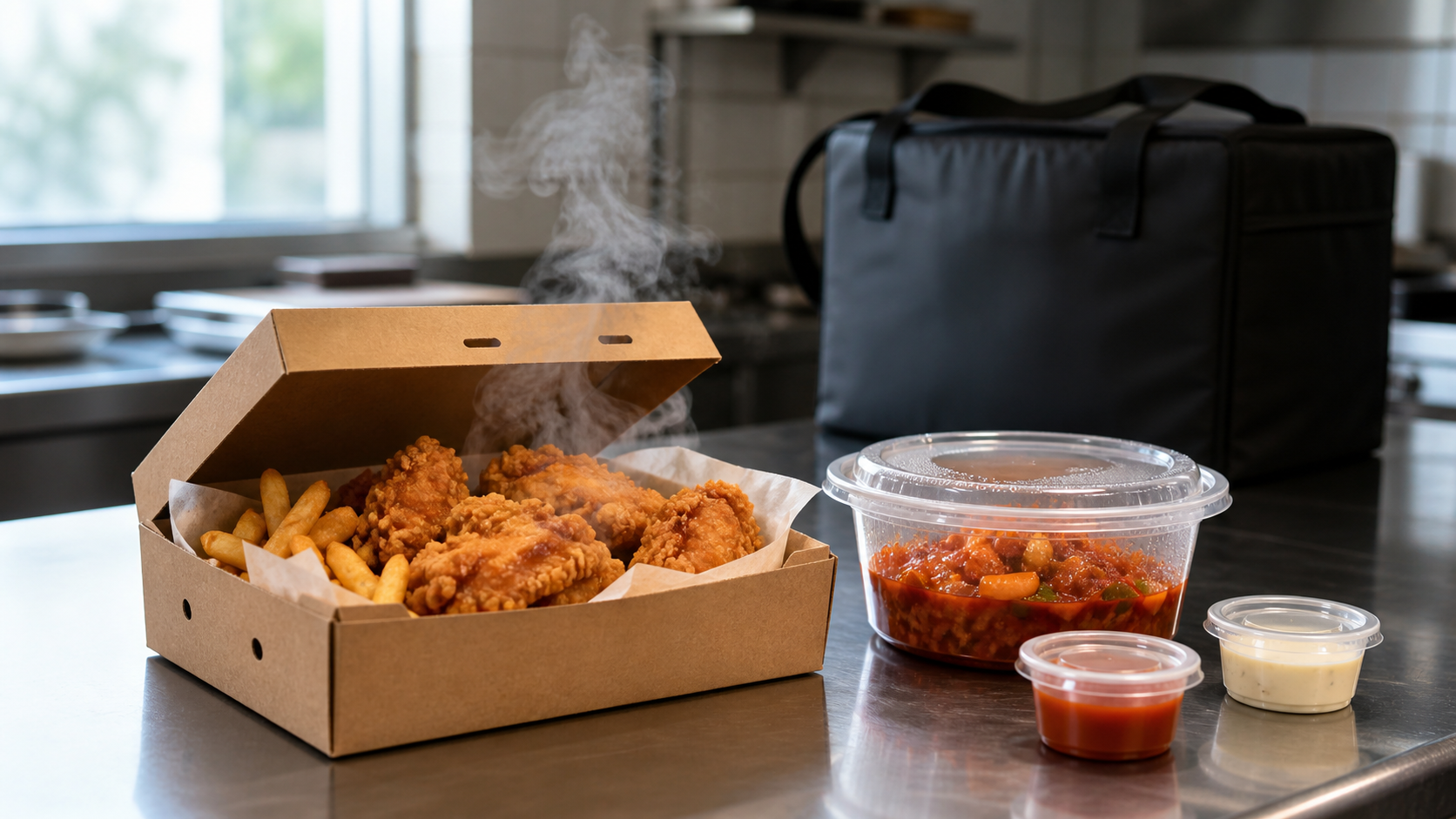
Why good food becomes soggy in delivery
A meal can leave the kitchen at its best and still disappoint at the door. Crisp coatings soften, rice clumps, lids collect water, and a loose sauce cup can affect every component in the bag. For multi-location restaurant chains, the same failure can be repeated across many stores when the menu and packing routine are standardized.
The cause is usually not one material or one lid. It is the interaction of hot food, released moisture, headspace, closure design, travel time, and the way wet and dry components share space. A more reliable approach is to package each part of a meal for its own behavior, then test the complete order under real delivery conditions.
Freshly cooked food continues to release heat and vapor after packing. In a fully closed container, that vapor can cool on the lid and return to the food as condensation. Fried or breaded items are especially vulnerable because a small amount of surface moisture can change their texture quickly.
Moisture and odors can also move between components. Sauces, vegetables, curries, rice, and hot proteins behave differently, and a closure that contains a liquid component may retain too much steam around fries. Packaging should follow the food and delivery route, not simply the order size.
1. Use controlled ventilation where vapor release matters
For hot, crisp foods, consider a container-and-lid combination designed to let excess vapor escape in a controlled way. The goal is not to leave food exposed; it is to reduce the condensation that develops when steam remains trapped.
Confirm the result with the actual food, fill level, and expected delivery time because the appropriate amount of ventilation varies by dish. The related steam–seal tradeoff guide explains why steam release and liquid containment should be tested as separate paths.
2. Select a container according to the food’s behavior
Start by grouping items by what they need during transit. A fried entrée, a moist rice side, a chilled salad, and a curry do not have the same moisture or movement profile.
Ask whether each item needs vapor release, containment, insulation, separation, or a combination. This creates a clearer specification than choosing a single generic takeaway box.
3. Keep wet and dry elements apart
When a meal includes a crisp item and a wet accompaniment, separate them whenever the menu allows. Separate containers are often the clearest option.
Compartments may also help, but a divider alone should not be assumed to stop vapor, sauces, or odors under movement. Evaluate the compartment depth, divider shape, lid fit, and the way the meal is carried.
4. Treat the lid as part of the packaging system
Specify the base and lid as a pair. A lid affects whether steam is retained, whether liquid reaches the rim, how the container stacks, and whether the closure remains seated during transport.
For crisp food, a lid that manages internal vapor may be useful. For a liquid or oily item, the priority may instead be an even, secure fit. Use the exact base-and-lid pairing intended for service rather than treating lids as interchangeable.
5. Leave practical headspace instead of overfilling
Overfilling can push food or sauce into the closure area and reduce the air space in which heat and vapor can move. It can also make a container more likely to open or leak when stacked.
Define a workable fill level for every menu item, including sauce cups, and train packers to use it consistently.
6. Use compartments strategically for combination meals
A compartmented format can be useful when components need to travel together, but the layout should reflect the food. Keep high-moisture or saucy components away from crisp elements where possible.
Position cups upright and do not rely on a neighboring compartment to contain a loose lid. Before wider adoption, test the fully packed meal through the intended bagging, stacking, and rider-handling sequence.
7. Confirm the material and use conditions for the exact product
Materials respond differently to heat, moisture, and food-contact conditions. Instead of making a broad assumption from a material name, request the applicable specifications, drawings, samples, and documentation for the exact container-and-lid construction under consideration.
This is particularly important for hot, oily, acidic, refrigerated, or reheating use cases. Product suitability should be confirmed for the actual menu and operating conditions.
Build a repeatable packing practice across locations
Packaging selection works best alongside a repeatable packing routine. Pack close to dispatch where feasible so hot food spends less time releasing steam inside a closed container. Put sauces and dressings in dedicated cups with their specified lids, allow appropriate headspace, and keep them upright in the bag. Do not place heavy items where they can compress a cup or dislodge a lid.
For a chain, the practical question is whether every store can execute the method during busy periods. Document the matched pair for every component: entrée base plus lid, side container plus lid, and sauce cup plus lid. Include portion size, typical fill temperature, fill level, packing orientation, and any separation rule so procurement, operations, and store teams work from the same standard.
A dish-by-dish starting guide
Use this matrix to define directions for a shortlist, then test each configuration with the real menu. It is a planning guide, not a substitute for product-specific validation: results can change with the recipe, portion, hold time, store routine, delivery bag, or route.
| Meal component | Main delivery risk | Packaging direction to evaluate | Lid approach to evaluate |
|---|---|---|---|
| Fried or breaded entrée | Steam softens the coating | A rigid format with room for the portion and managed vapor release | Controlled-vent design where validated for the dish |
| Curry, gravy, or saucy protein | Spills, rim contamination, and moisture migration | A container sized for the portion with practical headspace | Securely matched closure verified with the actual fill |
| Rice, noodles, or moist sides | Condensation and texture changes | A dedicated container rather than shared space with crisp food | Select according to moisture behavior and trial results |
| Fries, chips, or dry sides | Exposure to nearby steam and sauces | Separate from wet components whenever practical | Controlled ventilation where the full-meal test supports it |
| Cold side or salad | Temperature and moisture transfer from hot food | Keep physically separate from hot components | A matched lid suited to the cold item and route |
| Sauce, dip, or dressing | Tipping and leakage | A dedicated cup sized to the portion | A lid specified for that cup; keep upright and out of compression |
Validate the complete order before a network rollout
Do not test an empty container in isolation. Pack the actual entrée, sides, and sauces at normal fill temperatures and portions. Run the order through the expected hold period, bag setup, stacking pattern, and delivery movement. Review lid engagement, visible leakage, condensation, texture, odor transfer, cup orientation, packing time, and the receiving experience.
For a multi-store pilot, use a representative mix of store types, ordering channels, and peak periods. Record the exact package pairs and the conditions of every result. If the trial shows slow packing, leaks, breakage, or repeat complaints, correct the configuration before expansion. The delivery-leak checklist provides a concise companion for checking the full order journey.
Build a testable packaging shortlist
TakeawayPack is a foodservice-packaging brand and sourcing coordinator that works with multiple packaging manufacturers. Its online categories include cups, bowls, boxes, containers, trays, lids, bags, and cutlery. For a restaurant chain comparing options, an RFQ can identify the product category, material, size or capacity, expected quantity, printing or logo requirements, and destination country or port.
Project discussions can cover structure, coating, capacity, printing, lid matching, and carton packing, while samples, drawings or print-file alignment, packaging, and export handoff communication can be coordinated where applicable. Some stock items may support trial orders; custom minimum order quantities depend on the product and production method.
Share an order-specific packaging brief with the menu, portion sizes, delivery conditions, and test criteria so a proposed shortlist can be reviewed against the chain’s own product documentation and delivery trials.